Archer Stance Shoulder Pull
The archer stance shoulder pull is an exercise that primarily focuses on pulling the elbows and shoulders backward using the latissimus dorsi and shoulder muscles. The middle trapezius and rhomboids assist in pulling the shoulders backward. The four smaller muscles in the shoulders, the rotator cuff, stabilize the shoulder. Depending on the execution, lower-positioned muscles may also actively assist or merely have a stabilizing function, such as the erector spinae, glutes, and hamstrings.
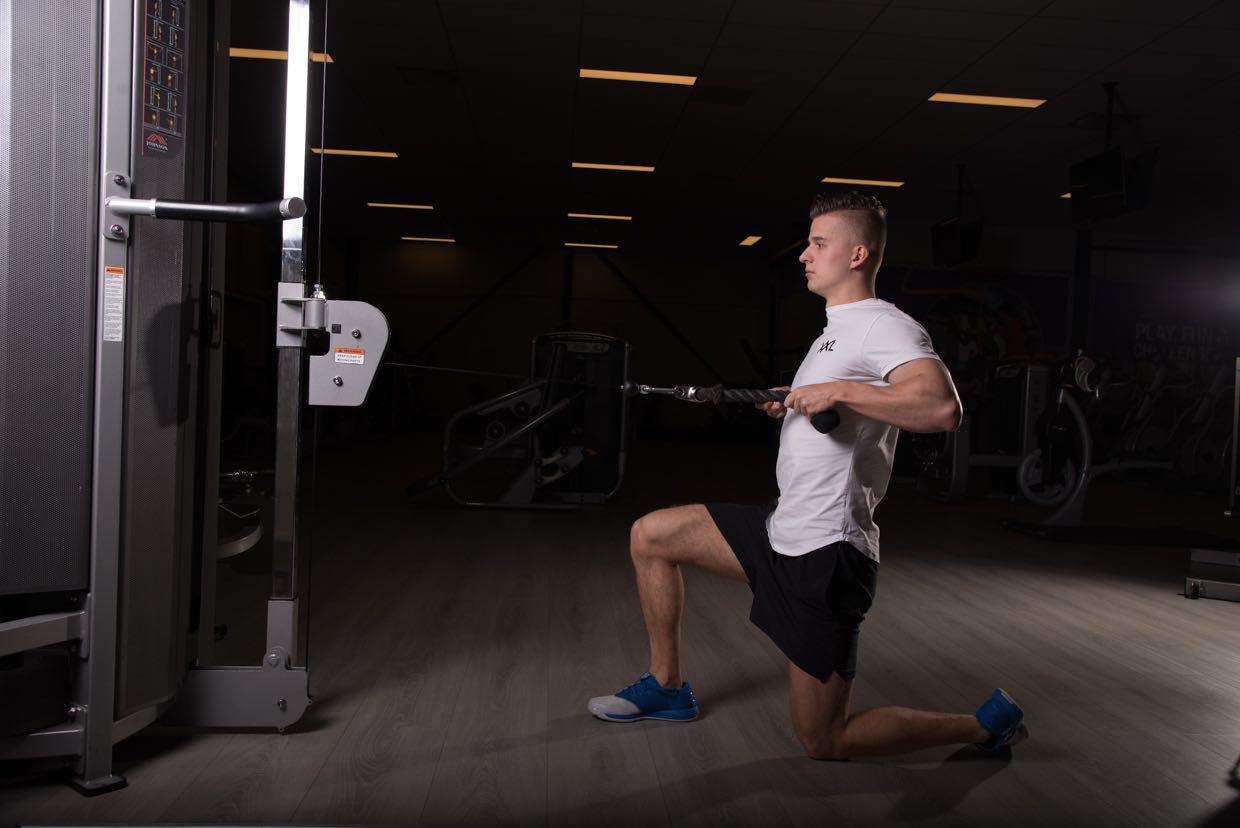
Archer stance shoulder pull execution
-
1
Choose the appropriate weight on the cable machine and make sure the pin is secured. Attach the double rope to it.
-
2
Set the cable machine to a height that is approximately chest height when kneeling on one knee.
-
3
Grip the rope with both hands and kneel on one knee in front of the cable machine. Place your foot and knee far enough apart (hip- to shoulder-width) for sufficient balance. Make sure you are far enough from the cable machine to maintain tension with your arms extended.
-
4
Begin the exercise by bringing your hands to slightly in front of or beside your chest. Keep your forearms horizontal. Keep your elbows at chest height throughout the movement. This means they should be held slightly away from the body, but not raised all the way up.
-
5
Control the return of your hands to the starting position by extending your arms.
Archer Stance shoulder pull
Main muscles:
- Latissimus dorsi
- Deltoids (especially the rear deltoids)
- Trapezius (especially the middle trapezius)
- Rhomboids
- Rotator cuff (supraspinatus, subscapularis, teres major, teres minor)
- Biceps brachii, brachialis, and brachioradialis (elbow flexion)
Archer stance shoulder pull technique
This execution of the exercise primarily targets the latissimus dorsi and rear deltoids. Raising the elbows higher, as in 'face pulls', places even more emphasis on the rear deltoids and less on the back.
As with seated rows, the upper body can be fixed or move along with the exercise. When the upper body moves forward and backward during the exercise, the erector spinae and lower-body muscles that align the upper body with the legs do more work, as during a back extension, hip thrust, or deadlift. These muscles include the glutes and hamstrings. To isolate the latissimus dorsi and rear deltoids as much as possible, keep your upper body still and move only from the arms.
Alternatives
- Seated row
- Dumbbell row
- Barbell bent-over row
- T-bar row
Run your fitness business with more structure
- Planning, member management and coaching in one platform
- Built for coaches, studios and gyms
- Fewer separate tools, more overview