Unilateral Dumbbell Incline Bench Press
The bench press is one of the most popular exercises in strength training. It is a compound exercise that engages several large muscle groups. The chest muscles and the front of the shoulder muscles are engaged to pull the upper arm forward and inward. The triceps are engaged to extend the arms. Muscles in the shoulders, back, and lower back help stabilize your body.
The bench press can be performed in different ways to emphasize the various muscles involved. For example, the bench can be positioned flat or inclined. In an incline position, with the head higher than the feet, it is called incline, while decline refers to a position in which the head is oriented toward the legs. This incline variation places more emphasis on the upper fibers of the chest muscles.
The bench press generally refers to the classic variation with a barbell. In this variation, the resistance is provided by dumbbells. Unilateral means that the exercise is performed alternately by the arms.
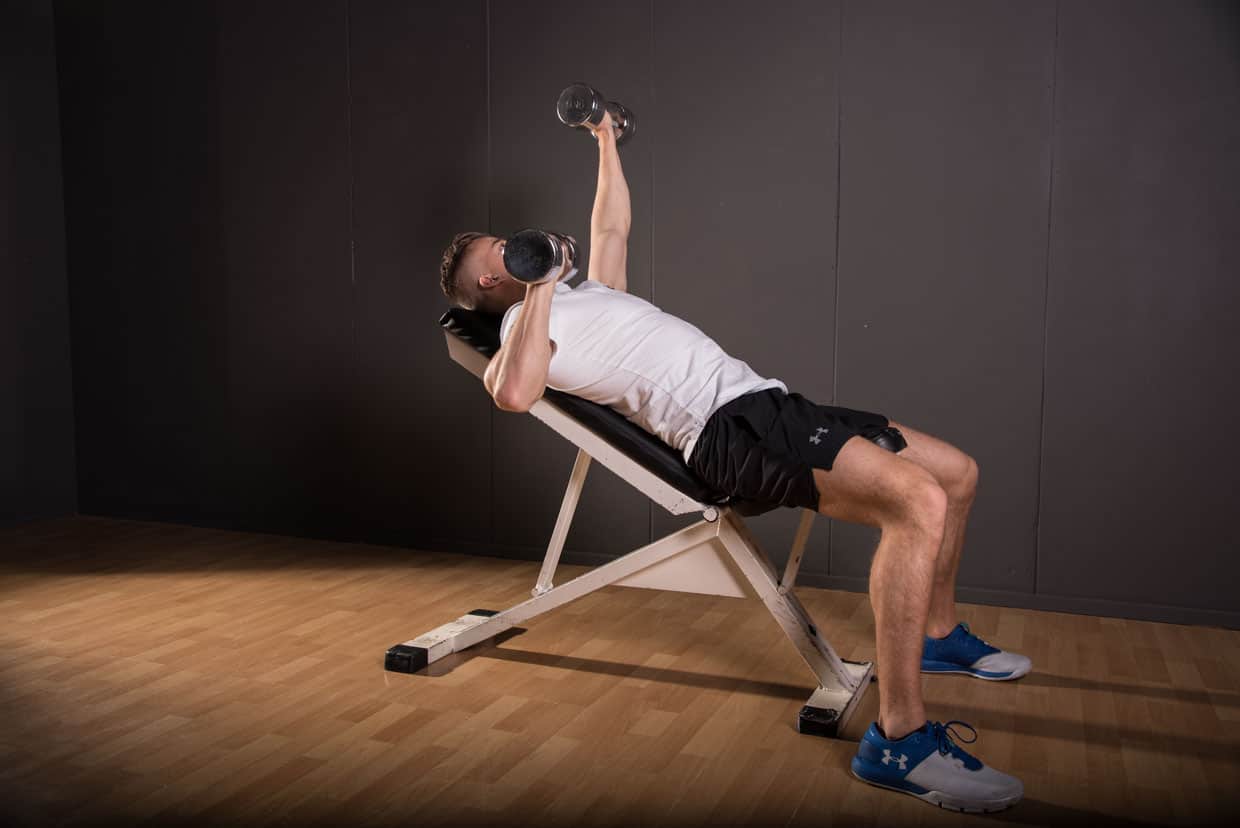
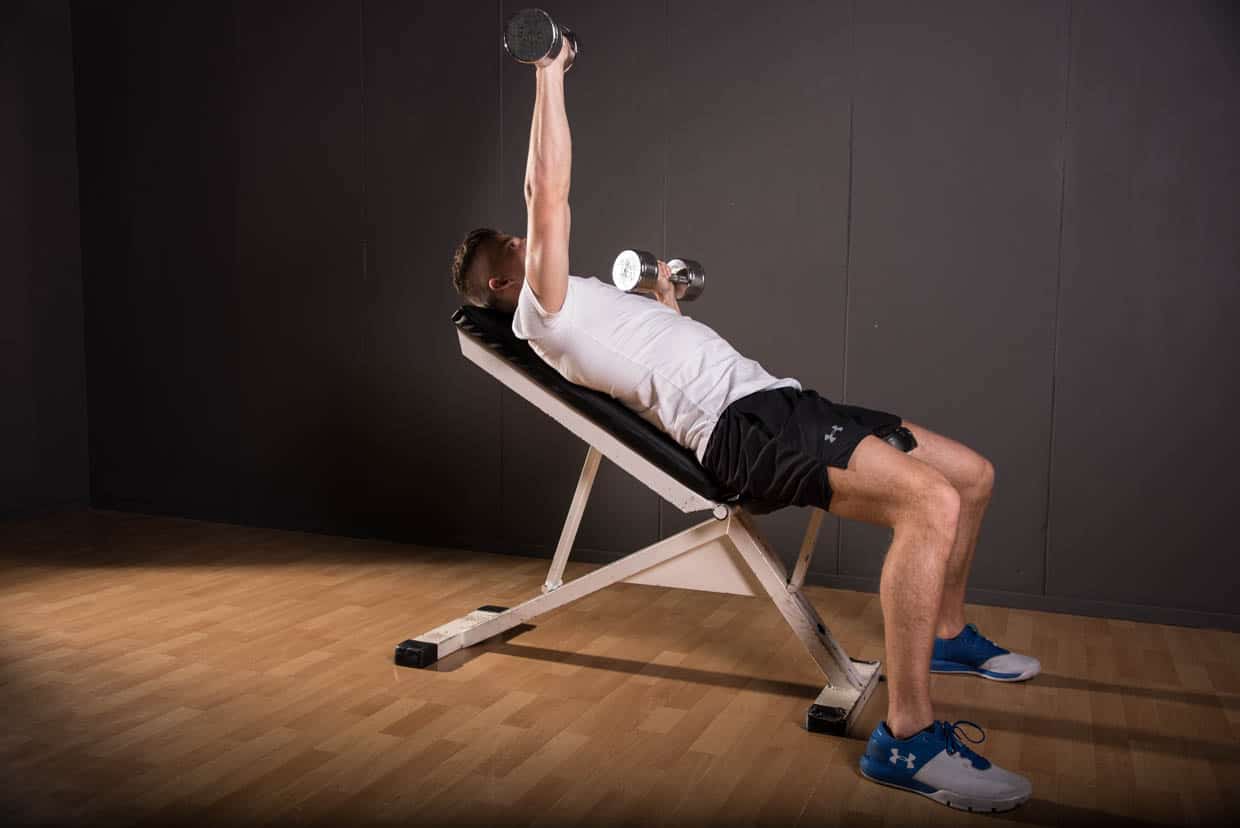
Unilateral dumbbell incline bench press execution
-
1
Drive explosively with your right arm by pulling your shoulder and upper arm upward and (almost) extending your arm. Ensure that your forearm and hand remain aligned throughout the movement. The back of your hand should form a straight line with your forearm (to prevent wrist injuries).
-
2
Lower the dumbbell in a controlled manner. Depending on your shoulder mobility, lower your elbow until it is beside your torso, or lower it slightly farther.
-
3
Repeat on the left.
Unilateral dumbbell incline bench press
Active muscles:
- Pectoralis major (large chest muscle)
- Pectoralis minor (depending on execution)
- Anterior deltoid (front fibers of the shoulder muscle)
- Triceps brachii
- Serratus anterior
- Coracobrachialis
Stabilizing muscles:
- Rotator cuff (stabilizing shoulder muscles: supraspinatus, subscapularis, teres major, teres minor)
- Serratus
- Trapezius
- Biceps brachii
- Latissimus dorsi
- Core muscles
Unilateral dumbbell incline bench press preparation
- Choose the appropriate dumbbell weight for the desired number of repetitions.
- Sit on the end of the bench in an incline position, with the dumbbells upright on your knees.
- Lie back and, in the same movement, bring the dumbbells one at a time toward your chest with your knees. Place your feet back on the floor.
- Rotate your hands into a pronated position (thumbs pointing inward) and your elbows outward. This is your starting position.
Unilateral dumbbell incline bench press technique
Performing the exercise with one arm at a time requires the core muscles to work harder to stabilize your body. Performing it alternately partly limits this effect because your other hand is also holding a dumbbell.
The greater need for stabilization can make this exercise more functional for certain athletes. However, it also means that the chest muscles are less isolated. If strength and muscle mass are your primary goals, performing the exercise with both hands simultaneously therefore seems advisable.
Bench position:
Many studies have examined the effect of different bench positions.
Because of the different circumstances under which they are conducted, they sometimes show different results. Nevertheless, we can identify a general trend in these studies and point out possible exceptions.
Flat vs incline & decline
An incline bench increases activation of the fibers of the chest muscles that run from the clavicle to the upper arm. The involvement of the fibers of the chest muscles that run from the sternum to the arm is lower. This means you primarily train the upper part of the chest. In terms of surface area, this is approximately one-third of the chest muscle.
A decline bench increases the involvement of the lower fibers of the chest muscles, while the upper part has to work less. These lower fibers account for approximately two-thirds of the surface area of the chest.
Although this is supported by multiple studies, some studies show different effects.
Dumbbells vs barbells:
The dumbbell bench press has advantages and disadvantages compared with the barbell, depending on the goal. For example, the shoulder muscles may have to work harder to stabilize the weight. Unlike with a barbell, you must not only prevent the weight from tilting forward or backward. With dumbbells, you must also prevent inward and outward tilting.
According to some studies, dumbbells require greater involvement of the pectoralis major and biceps and less involvement of the triceps compared with the barbell bench press.
Working with dumbbells can also make it easier to push yourself to the limit without a training partner. After all, there is no bar to worry about. However, dropping the dumbbells on the floor beside you at the end of the exercise does nobody any favors, including yourself. You may have performed the exercise perfectly and then sustain a shoulder injury while putting the weights down.
Tip: After the last repetition, rotate your hands back to a neutral position (thumbs toward your face). At the same time, bring your knees toward the dumbbells. Now rock yourself upright as if in one motion so that you return to the starting position, seated with the dumbbells on your knees. In the same movement, you can immediately stand up to put the dumbbells away. This relieves your arms, shoulders, and chest when you are already fatigued and prevents shoulder injuries (and broken toes belonging to other gym visitors).
Alternatives:
- Incline barbell bench press
- Incline dumbbell bench press
- Smith machine bench press
Run your fitness business with more structure
- Planning, member management and coaching in one platform
- Built for coaches, studios and gyms
- Fewer separate tools, more overview