Single-Arm Landmine Press
The landmine press, also called jammer press in some cases, is a ballistic exercise that is best compared with the movement used in shot put. It is a compound exercise in which the whole body must coordinate to perform the task as effectively as possible. It can therefore also be considered a ‘functional’ exercise.
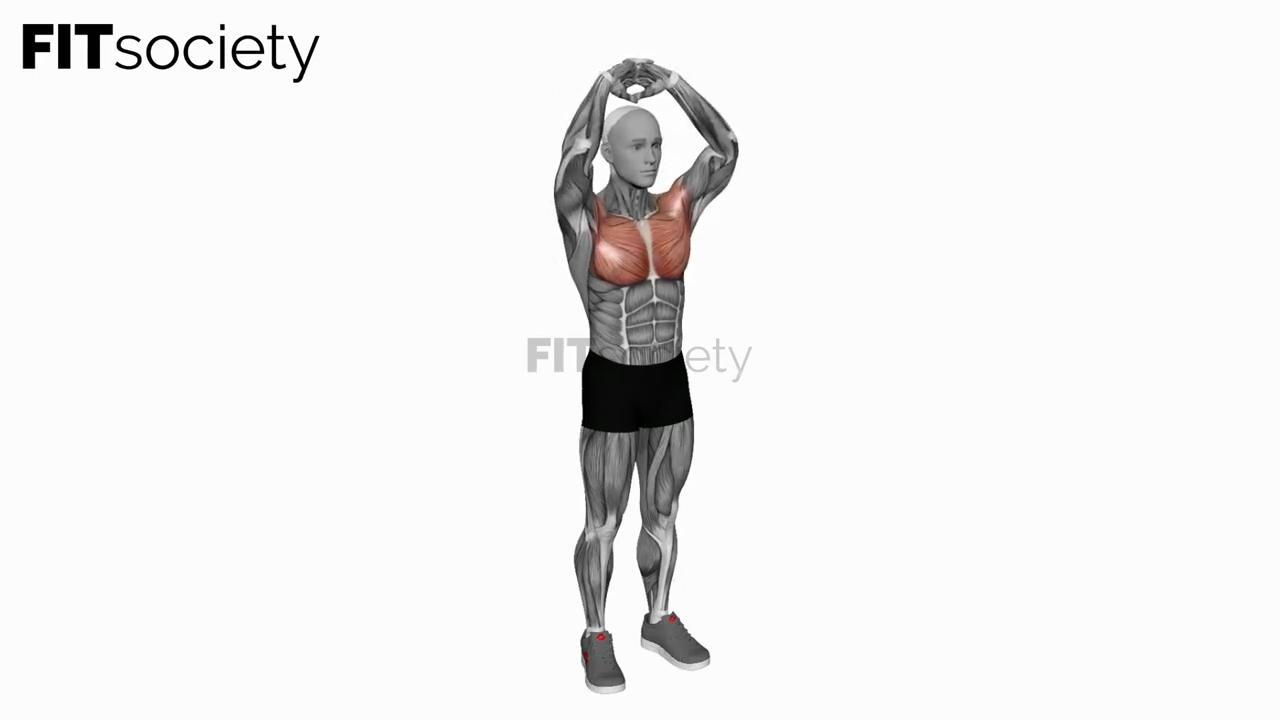
The pectoralis major and shoulders are engaged when raising the upper arms.
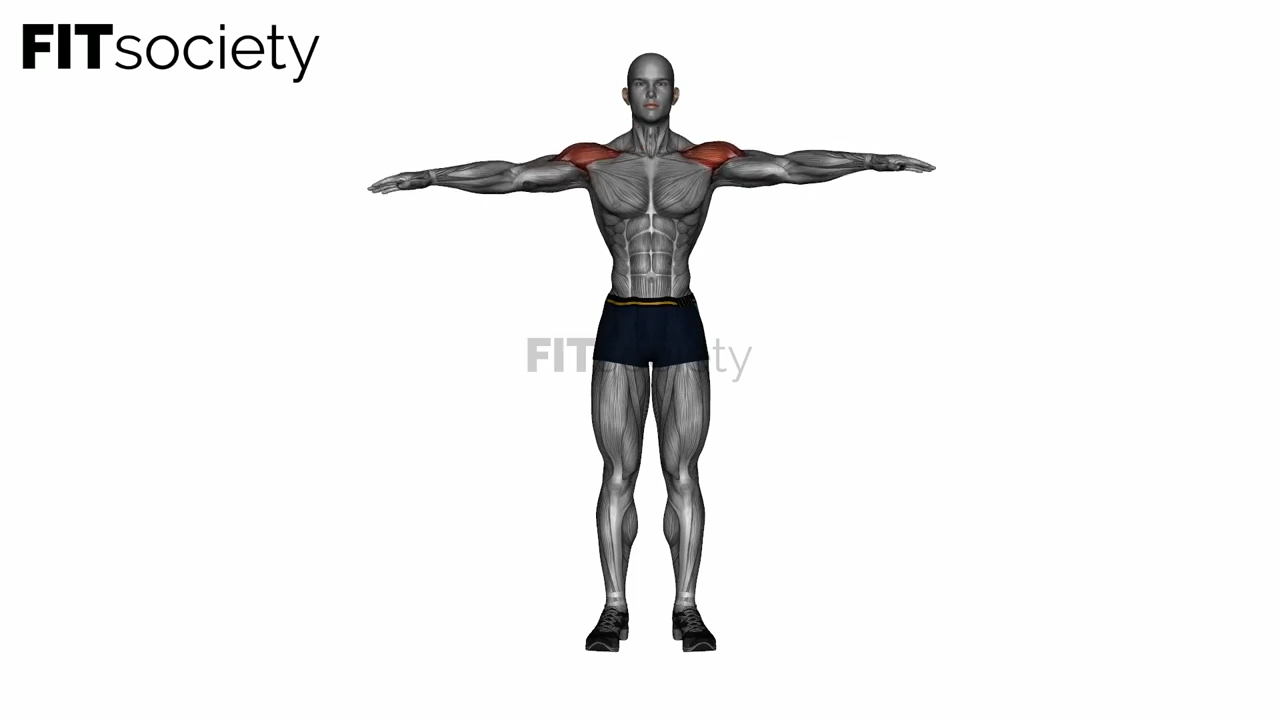
In addition to the deltoid itself, various muscles around the shoulder joint are recruited to stabilize it. These include smaller stabilizing muscles such as the four rotator cuff muscles, as well as the larger trapezius and deeper muscles that pull the shoulder joint backward and upward.
In the arms, the triceps play an active role by extending the arms, while the biceps have a stabilizing role.
Core muscles such as the abdominal muscles and the muscles along the spine keep the torso upright. The obliques are engaged to rotate from the waist.
The legs initiate the movement. The legs act first, after which the upper body extends this action. The exercise can be performed with a barbell positioned at an angle or in a holder specifically intended for this purpose.
There are various possible movement variations.
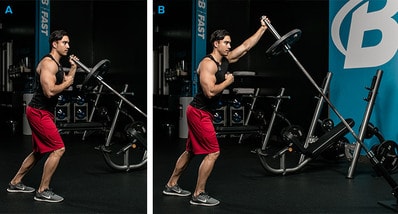
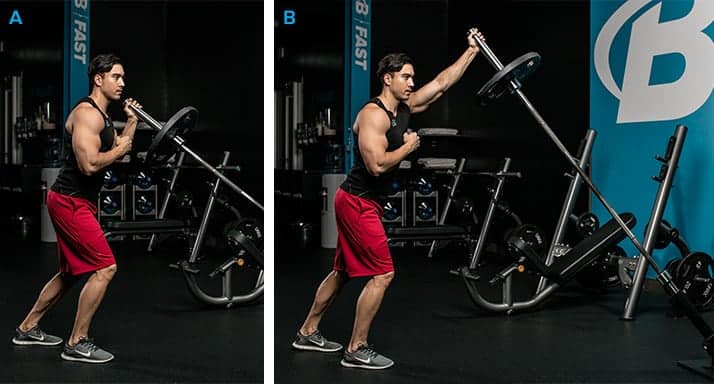
Execution of the landmine press (one arm)
-
1
Bend your legs slightly and rotate your hip outward to the left.
-
2
Drive up with your legs while rotating your hip inward again.
-
3
Extend the movement by pressing the bar upward until the arm is almost straight.
-
4
Lower the bar again by bending the arm.
-
5
Extend the movement by rotating your hip outward and bending through your legs.
-
6
Repeat.
Landmine press (one arm)
Muscles involved:
Shoulder joint:
teres minor)
Arms
Abdomen:
(Lower) back and spine:
Preparation for the landmine press (one arm)
- Place a barbell with one end in a corner or in a holder intended for this purpose.
- Place the desired weight on the other end.
- Stand in front of the end of the barbell with your feet shoulder-width apart. Your feet are positioned just in front of the end of the bar, depending on the variation.
- Bend your legs as in a deadlift and pick up the bar with both hands.
- Bring the bar toward your left shoulder and rotate your fingers outward during this movement.
- Release with your right hand. The weight is now fully supported by the bent left arm.
Landmine press (one arm) technique
As mentioned, the landmine press can be called a ‘functional’ exercise. This often means that the required cooperation between the different muscles can be translated relatively easily into everyday movements. The jammer press can be performed in various ways. ‘The best’ method therefore depends on which movement you primarily expect to perform in everyday practice.
As an athlete, your sport may require specific movements that you can potentially translate into a specific execution of the landmine press. For a shot-putter, for example, the execution described above would not be optimal. Having the feet next to each other is not how you best put the shot. In that case, you would want the leg on the side of the working arm positioned behind you. A fighter would also want one leg in front and one leg behind. Which leg that is depends on the punch being trained.
Alternatives
Run your fitness business with more structure
- Planning, member management and coaching in one platform
- Built for coaches, studios and gyms
- Fewer separate tools, more overview