Overhead Press
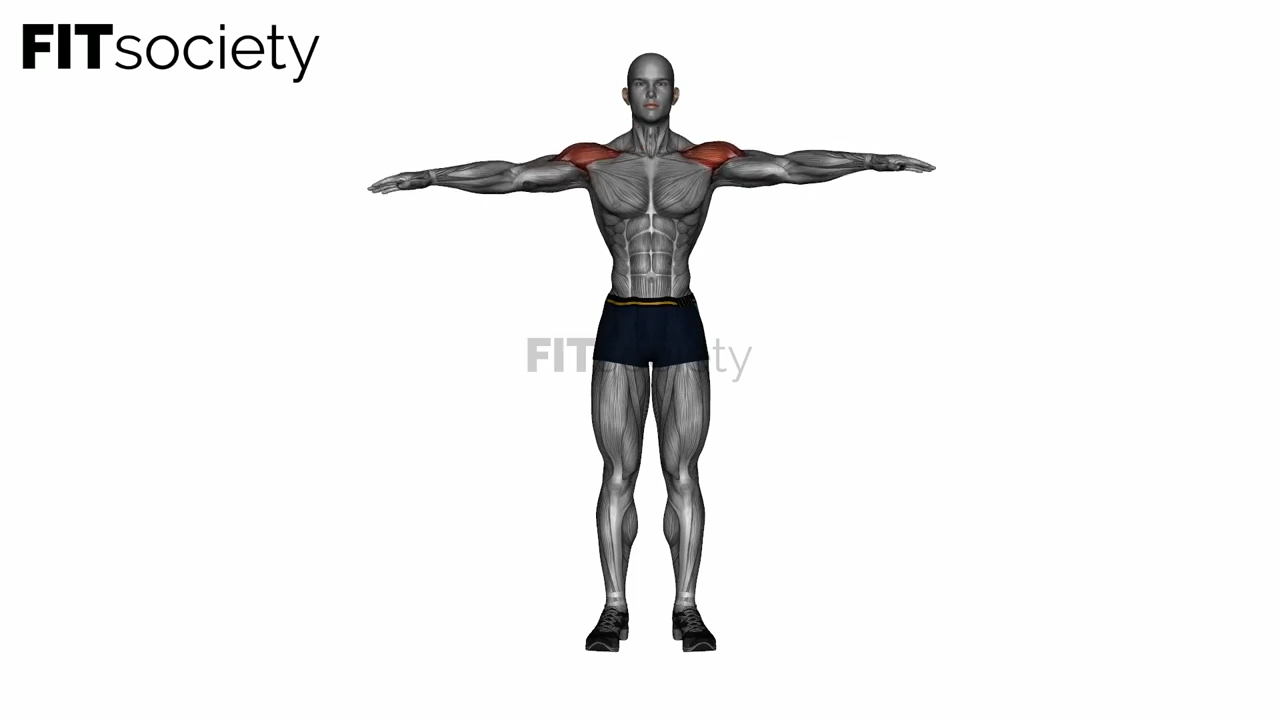
The barbell shoulder press, also sometimes called overhead press or 'military press', is an exercise that works all three 'heads of the deltoid' (but not to the same extent). This is the deltoid-shaped muscle responsible for lifting the upper arm.
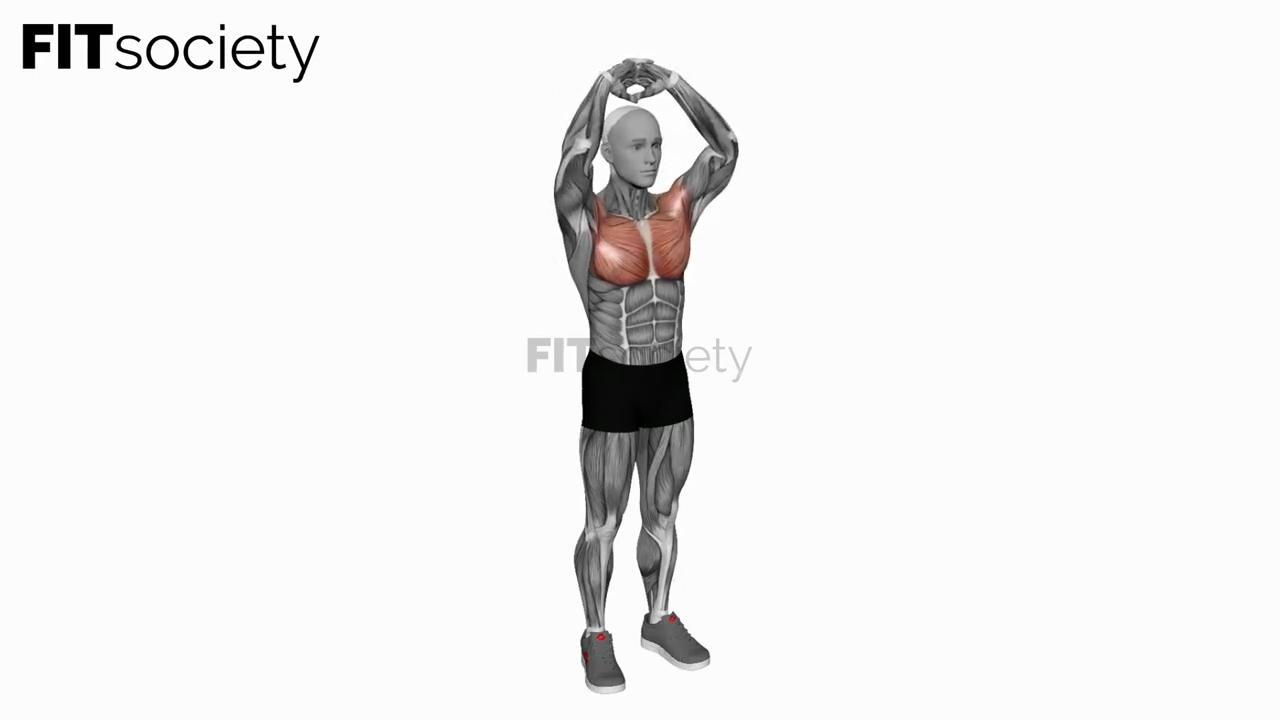
The pectoralis major assists in lifting the arms. Especially the fibers that run from the clavicle to the upper arm, also known as the 'upper chest'.
In addition to the deltoid itself, various muscles around the shoulder joint are engaged to stabilize it. Smaller stabilizing muscles such as the four rotator cuff muscles, as well as the larger trapezius and deeper muscles that pull the shoulder joint backward and upward.
In the arms, the triceps play an active role by extending the arms, while the biceps have a stabilizing role in keeping the forearms in the correct position. The muscles in the forearms themselves then stabilize the wrist joint to control the barbell.
Core muscles such as the abdominal muscles and the muscles along the spine keep the torso upright. Depending on the variation (standing, seated with or without back support), their involvement may be greater or lesser.
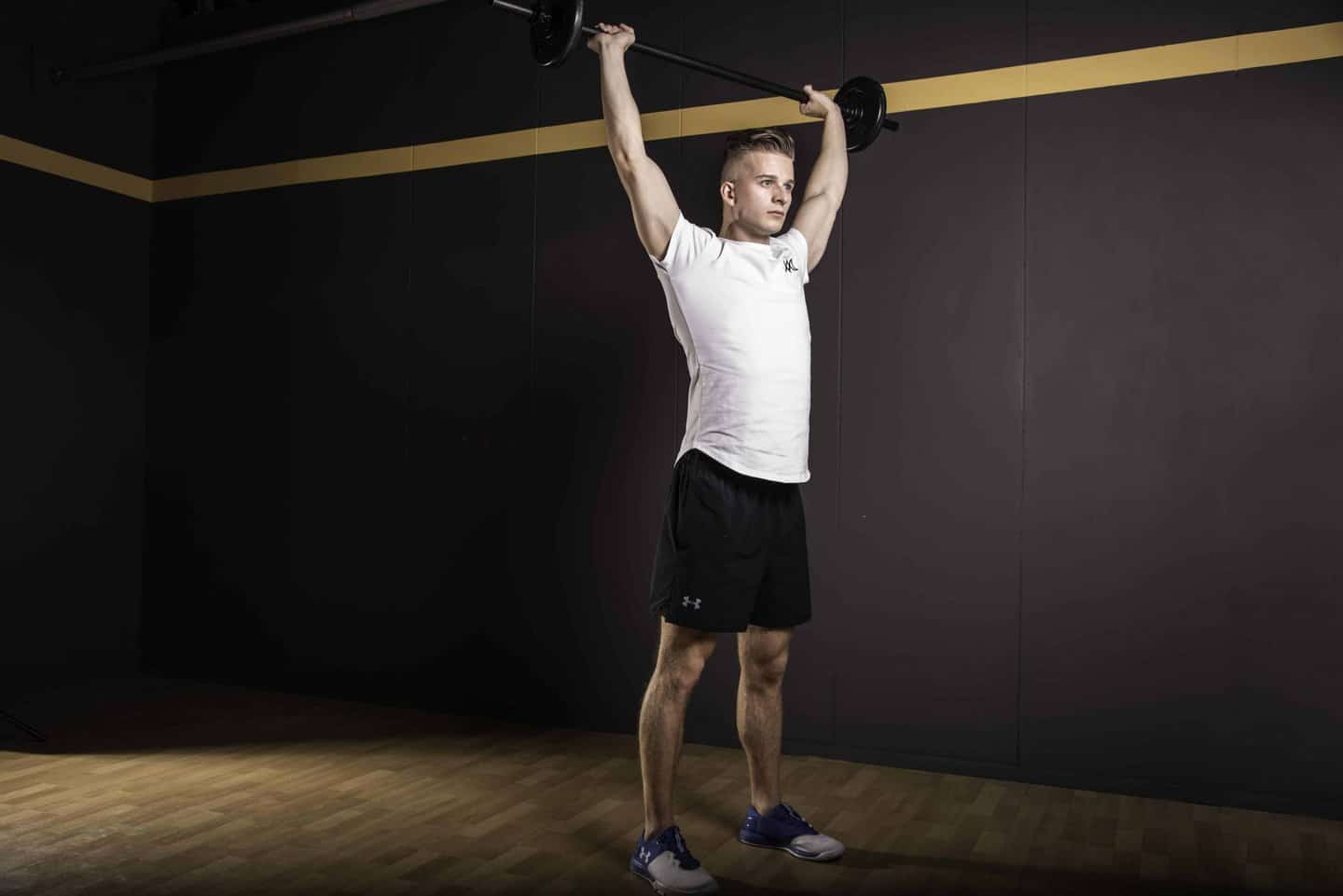
Overhead press execution
-
1
Focus on the elbows and push them straight upward until the arms are almost extended.
-
2
Lower the arms back down under control until the hands are level with the ears.
-
3
Repeat.
Overhead press
Muscles involved:
Shoulder joint:
- Deltoid
- Rotator cuff (subscapularis, supraspinatus, infraspinatus and the
teres minor)
- Trapezius
- Rhomboid
- Levator scapulae
Arms
- Triceps
- Biceps
- Forearm muscles
Abdomen:
- Rectus abdominis (rectus abdominal muscle)
- Obliquus externus abdominis (external oblique muscle)
- Obliquus internus abdominis (internal oblique muscle)
- Transversus abdominis (transverse abdominal muscle, 'corset muscle')
(Lower) back and spine:
- Erector spinae
- Lumbar multifidus
- Quadratus lumborum
Overhead press preparation
- Place a barbell in the supports of the squat rack, slightly below chest height.
- Step up to the barbell and let it rest on the upper chest.
- Place the hands evenly on the barbell. Position them approximately so that the forearms are perpendicular to the barbell. Check the markings to ensure that you are centered and that the hands are evenly spaced.
- Stand upright so that the barbell is lifted from the supports, then carefully take a few small steps backward.
Overhead press technique
The barbell shoulder press is also sometimes called the overhead press and sometimes military press. Nevertheless, the three do not all mean the same thing.
An overhead press is simply an exercise in which you press something overhead. The barbell shoulder (but also dumbbell) press is therefore a form of overhead press.
The military press is the name of an exercise that is almost never performed anymore. The name is now often incorrectly given to the exercise that is actually the barbell shoulder press.
Some people regard the military press as the barbell shoulder press, but with an adjustment. In the military press you should keep the legs and upper body still, whereas in the overhead press you would be allowed to use the hips to create momentum. This is incorrect, although the misunderstanding is understandable.
The true military press was originally performed with the heels together. As if standing at attention, hence the name. A more difficult stance to remain stable in than when the feet are hip- or shoulder-width apart. This therefore requires more attention and work from the core muscles and stabilizing muscles around the shoulder joint.
Moreover, this narrow stance makes it considerably more difficult to generate force from the legs. This therefore quickly results in a barbell shoulder press performed with much stricter form than when the feet are positioned wider apart. This does not mean that the military press is stricter in the same stance; it is a different stance that enforces stricter form.
The three heads of the deltoid
The deltoid-shaped shoulder muscle pulls on the upper arms from three directions. During the shoulder press, all three of these “heads” of the shoulder muscle are engaged. However, it is primarily the front head (pars clavicularis) that does the most work, followed by the lateral head (pars acromialis). The rear head (pars spinalis) is engaged considerably less.
The shoulder press can be performed in various ways that may shift the load between the heads, but not by much. In most cases, the front of the shoulder makes three times as much effort as the side, which in turn makes an average of three times as much effort as the rear.
In front of or behind the head?
The behind-the-neck press is rather controversial, with passionate advocates and opponents. Due to a lack of data, this discussion will not be settled (yet). There is only one study that performed EMG measurements on one person to measure muscle tension during both variations.
That study shows that there is little difference in peak tension between performing the barbell in front of the head or behind the head. In terms of average tension, however, the behind-the-neck variation would be 'the winner'. All heads show higher average tension, but the difference is greatest in the middle and rear heads.
Opponents then discuss the increased risk of injury. The shoulders must be externally rotated further, which may place too much load on some of the smaller stabilizing muscles of the rotator cuff. However, research on this is lacking.
At most, this exercise can therefore be cautioned against in cases of existing shoulder complaints or limited mobility of the shoulder joint. You could also prefer the barbell shoulder press because of its higher level of difficulty.
Seated or standing?
Research has shown that when the shoulder press is performed standing, the shoulders (all three heads) exert more effort. The researchers point to the additional need to stabilize when the exercise is performed standing. This would mean that the standing variation is 'more effective' at engaging the shoulder muscles.
Another possibility, however, is that the seated variation is often cheated. The standing variation forces you to stand upright so that you do not fall backward. This limits the possible contribution of the chest muscles. On a bench with a backrest, the backrest is often adjusted too far back. The buttocks are then shifted somewhat forward, causing an even greater backward lean. The shoulders then need to exert less effort because the chest, especially the upper portion, can contribute more.
Dumbbells or barbells?
In the same study, the shoulder press with dumbbells was found in all cases to engage the shoulders (all three heads) more intensely than the variation with a barbell in front of the head. Here too, the greater need to stabilize was mentioned as a possible cause.
In addition to the shoulder muscles having to perform more stabilizing work with dumbbells, the exercise's range of motion is also greater. At the top of the movement, the hands can move toward each other with dumbbells, at the point where the barbell variation has reached its endpoint.
Alternatives
- Dumbbell shoulder press
- Seated barbell shoulder press
- Shoulder press machine
Run your fitness business with more structure
- Planning, member management and coaching in one platform
- Built for coaches, studios and gyms
- Fewer separate tools, more overview