Machine Shoulder Press
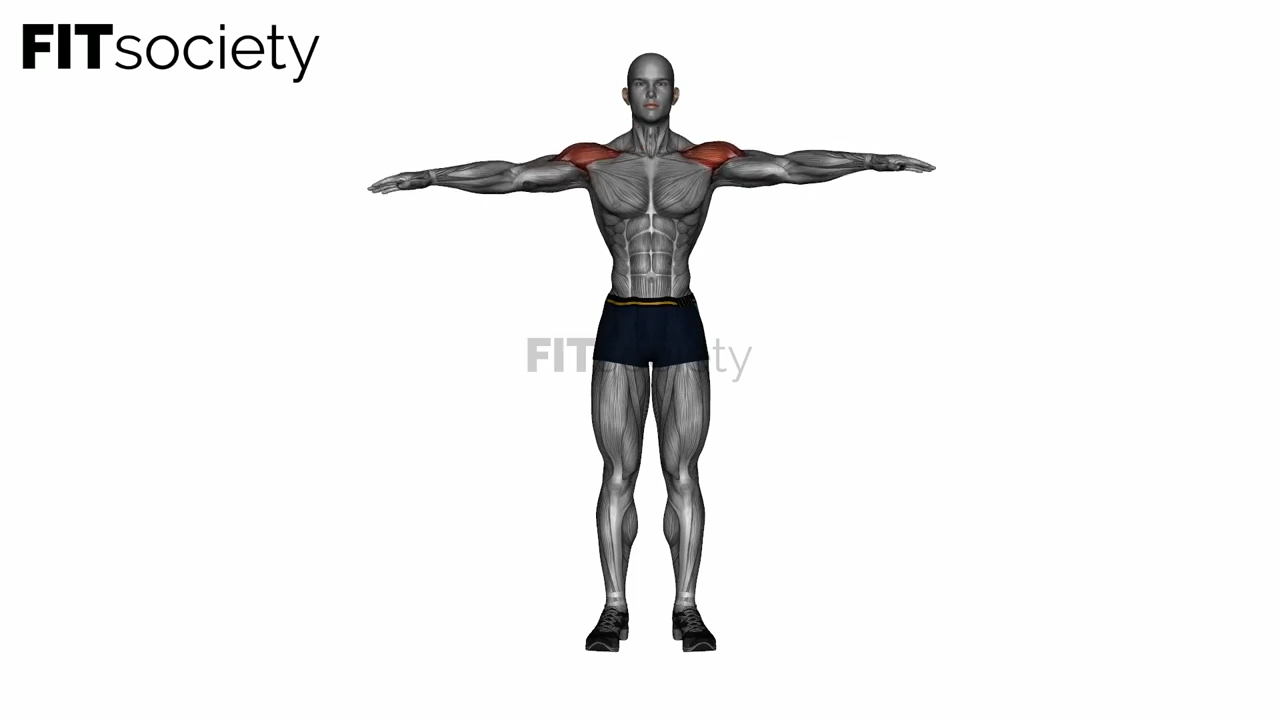
The shoulder press is an exercise that works all three heads of the deltoid (but not to the same extent). This is the deltoid-shaped muscle responsible for lifting the upper arm.
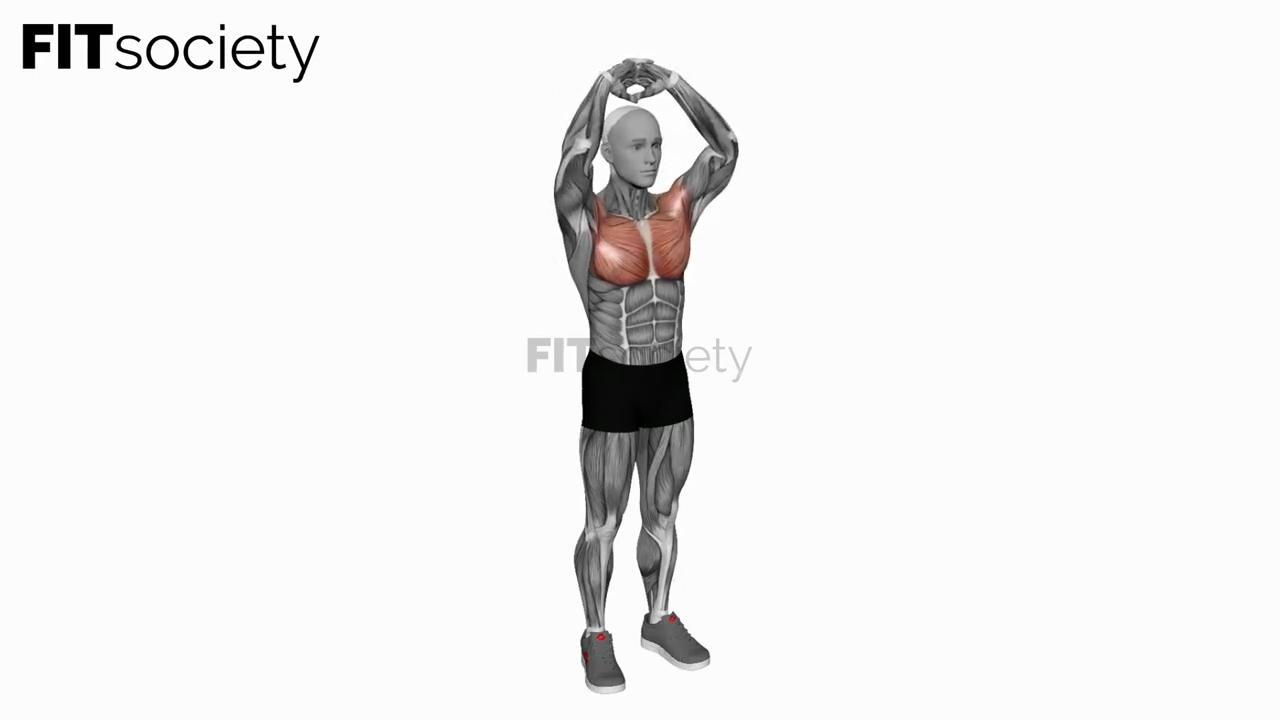
The pectoralis major assists in lifting the arms. In particular, the fibers that run from the clavicle to the upper arm, also known as the upper chest.
In addition to the deltoid itself, various muscles around the shoulder joint are recruited to stabilize it. These include smaller stabilizing muscles such as the four rotator cuff muscles, as well as the larger trapezius and deeper muscles that pull the shoulder joint backward and upward.
In the arms, the triceps play an active role by extending the arms, while the biceps have a stabilizing role in keeping the forearms in the correct position. The muscles in the forearms themselves then stabilize the wrist joint to control the dumbbells.
Core muscles such as the abdominal muscles and the muscles along the spine keep the torso upright. Depending on the execution (standing, seated with or without back support), their involvement may be greater or lesser.
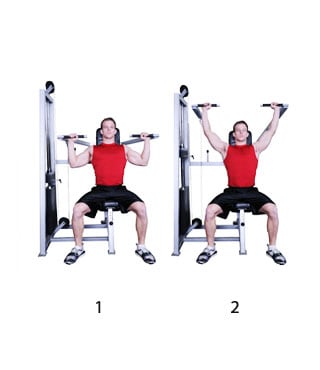
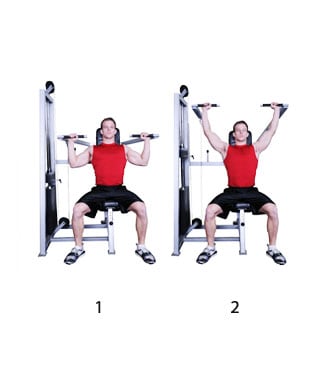
Machine shoulder press execution
-
1
Focus on your elbows and push them straight upward until they are above shoulder height. At the end of the movement, the arms are almost fully extended.
-
2
Lower your arms back down in a controlled manner until your hands are level with your ears.
-
3
Repeat.
Machine shoulder press
Muscles involved:
Shoulder joint:
- Deltoid
- Rotator cuff (subscapularis, supraspinatus, infraspinatus, and teres minor)
- Trapezius
- Rhomboid
- Levator scapulae
Arms
- Triceps
- Biceps
- Forearm muscles
Abdomen:
- Rectus abdominis (straight abdominal muscle)
- External oblique (external oblique abdominal muscle)
- Internal oblique (internal oblique abdominal muscle)
- Transversus abdominis (transverse abdominal muscle, 'corset muscle')
(Lower) back and spine:
- Erector spinae
- Lumbar multifidus
- Quadratus lumborum
Machine shoulder press setup
- Set the seat to the correct height. Make sure your hands are at shoulder height when you grip the handles.
Machine shoulder press technique
The three heads of the deltoid
The deltoid-shaped shoulder muscle pulls on the upper arms from three directions. During the shoulder press, all three of these "heads" of the shoulder muscle are engaged. However, it is primarily the front head (pars clavicularis) that does most of the work, followed by the outer head (pars acromialis). The rear head (pars spinalis) is engaged considerably less.
The shoulder press can be performed in different ways that can shift the load between the heads, but not by much. In most cases, the front of the shoulder produces three times as much effort as the side, which in turn produces on average three times as much effort as the rear.
Free weights or machine?
There does not appear to be any research comparing muscle activity between the shoulder press performed on a machine or with free weights.
In general, however, free weights require more stabilizing work and therefore result in higher muscle activity. They would therefore be preferred over machines. Machines, however, enforce a fixed movement path and stabilize the body to a greater extent. This makes it easier to concentrate fully on the primary muscles during the exercise.
Alternatives
- Barbell shoulder press
- Dumbbell shoulder press
- Shoulder press machine
- Smith shoulder press
Run your fitness business with more structure
- Planning, member management and coaching in one platform
- Built for coaches, studios and gyms
- Fewer separate tools, more overview