Handstand Shoulder Press Between Benches
The shoulder press is an exercise that works all three heads of the deltoid (but not to the same extent). This is the deltoid-shaped muscle responsible for lifting the upper arm.
In the handstand variation, body weight provides the resistance. A major disadvantage of performing it on the floor is the very short range of motion. After all, your head cannot pass through the floor. That is why you can perform this exercise between two benches, allowing your head to move further downward. However, this does increase the risk of accidents. The high difficulty level means relatively few people can perform this exercise correctly. Not for beginners.
The pectoralis major helps lift the arms (in this case, push them downward). This especially applies to the fibers that pull from the clavicle toward the upper arm, also known as the upper chest.
In addition to the deltoid itself, various muscles around the shoulder joint are engaged to stabilize it. These include smaller stabilizing muscles such as the four rotator cuff muscles, as well as the larger trapezius and deeper muscles that pull the shoulder joint backward and upward.
The triceps play an active role in the arms, extending them, while the biceps have a stabilizing role in keeping the forearms in the correct position. The muscles in the forearms themselves stabilize your entire body and therefore have to do a lot of work.
Core muscles such as the abdominal muscles and muscles along the spine keep the torso straight and stable.
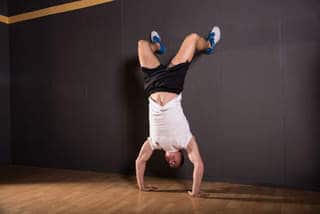
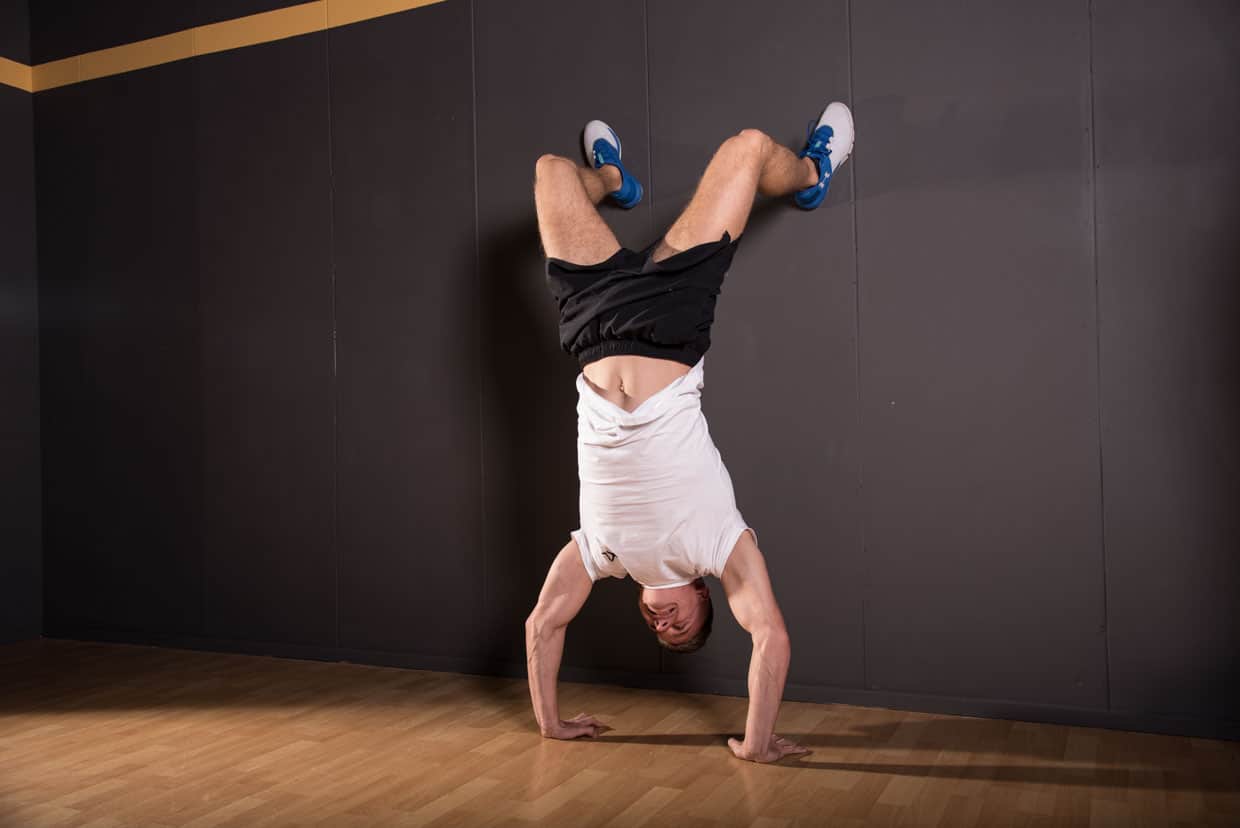
Handstand shoulder press execution
-
1
Lower yourself slowly and in a controlled manner until your shoulders reach the height of your hands.
-
2
Push yourself back up until your arms are almost straight.
Handstand shoulder press
Muscles involved:
Shoulder joint:
- Deltoid
- Rotator cuff (subscapularis, supraspinatus, infraspinatus and the
teres minor)
- Trapezius
- Rhomboid
- Levator scapulae
Arms
- Triceps
- Biceps
- Forearm muscles
Abdomen:
- Rectus abdominis (straight abdominal muscle)
- External oblique (external oblique abdominal muscle)
- Internal oblique (internal oblique abdominal muscle)
- Transversus abdominis (transverse abdominal muscle, ‘corset muscle’)
(Lower) back and spine:
- Erector spinae
- Lumbar multifidus
- Quadratus lumborum
Handstand shoulder press setup
- Place two benches perpendicular to the wall. Keep a distance between them that is slightly wider than shoulder-width. Use benches with a sturdy surface for sufficient stability.
- Get into a handstand against the wall with just enough distance between your hands and the wall to stay balanced (approximately one foot away). The benches make it more difficult to reach this position. If necessary, have a partner help you.
- Your heels should be against the wall, so do not place your feet flat against the wall.
- Look at the floor.
Handstand shoulder press technique
Try to use the wall for support as little as possible. Let your heels slide along it as lightly as possible. The less contact you have with the wall, the easier it becomes to perform the exercise yourself. Of course, that is easier said than done for many people. Therefore, first practice the handstand until you can easily remain in a handstand for 10 to 20 seconds with as little support as possible.
The exercise can optionally be performed with a pair of helping hands instead of a wall. This does require the necessary communication. It can be quite unpleasant if your arms give out while your partner continues holding your feet.
Alternatives
- Pike push-up
- Barbell shoulder press
- Shoulder press machine
- Barbell behind-the-neck press
Run your fitness business with more structure
- Planning, member management and coaching in one platform
- Built for coaches, studios and gyms
- Fewer separate tools, more overview