Cable Shrug
Shrugs target the upper and middle fibers of the trapezius, the diamond-shaped muscle in the upper back (between the shoulder blades). These fibers pull the shoulder blades upward and backward.
The forearm flexors provide the necessary gripping strength in the fingers. The core muscles in the abdomen and back stabilize the spine.
In this variation, you use the cable for the necessary resistance.
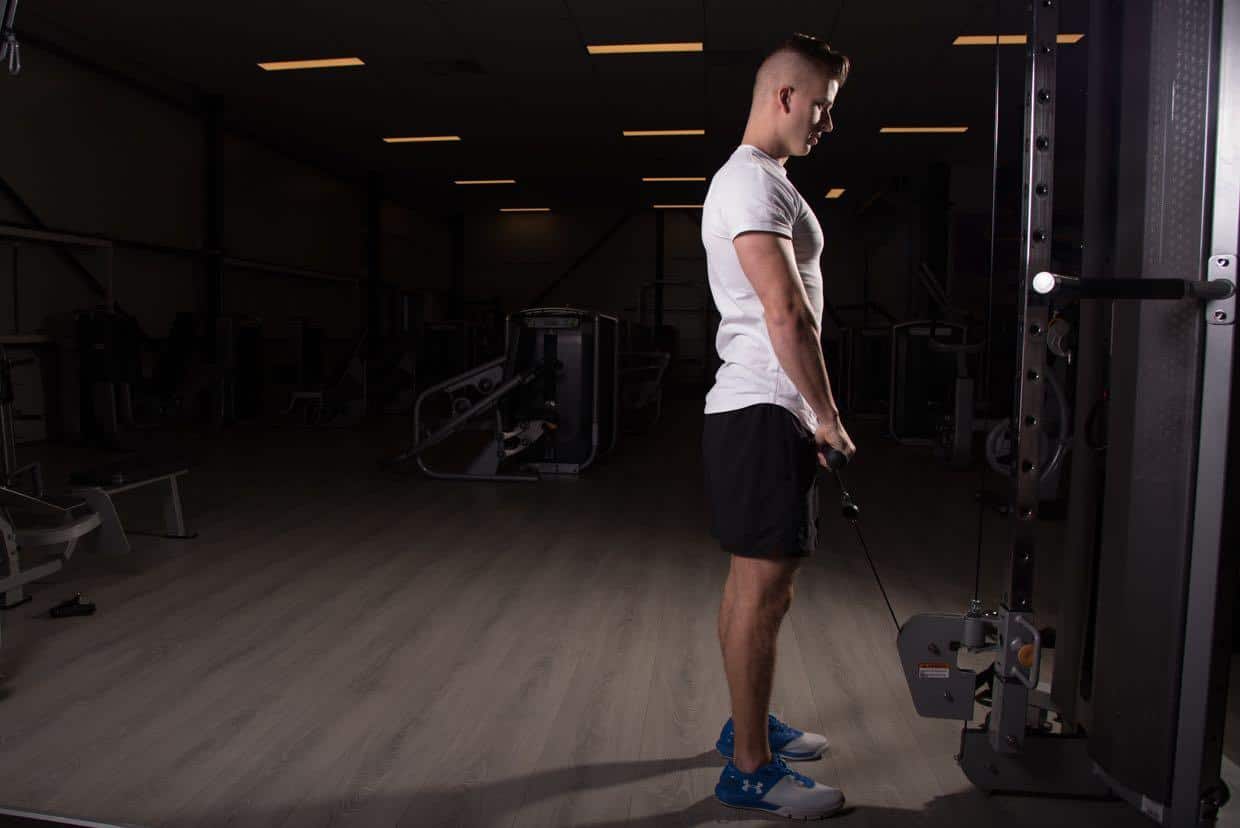
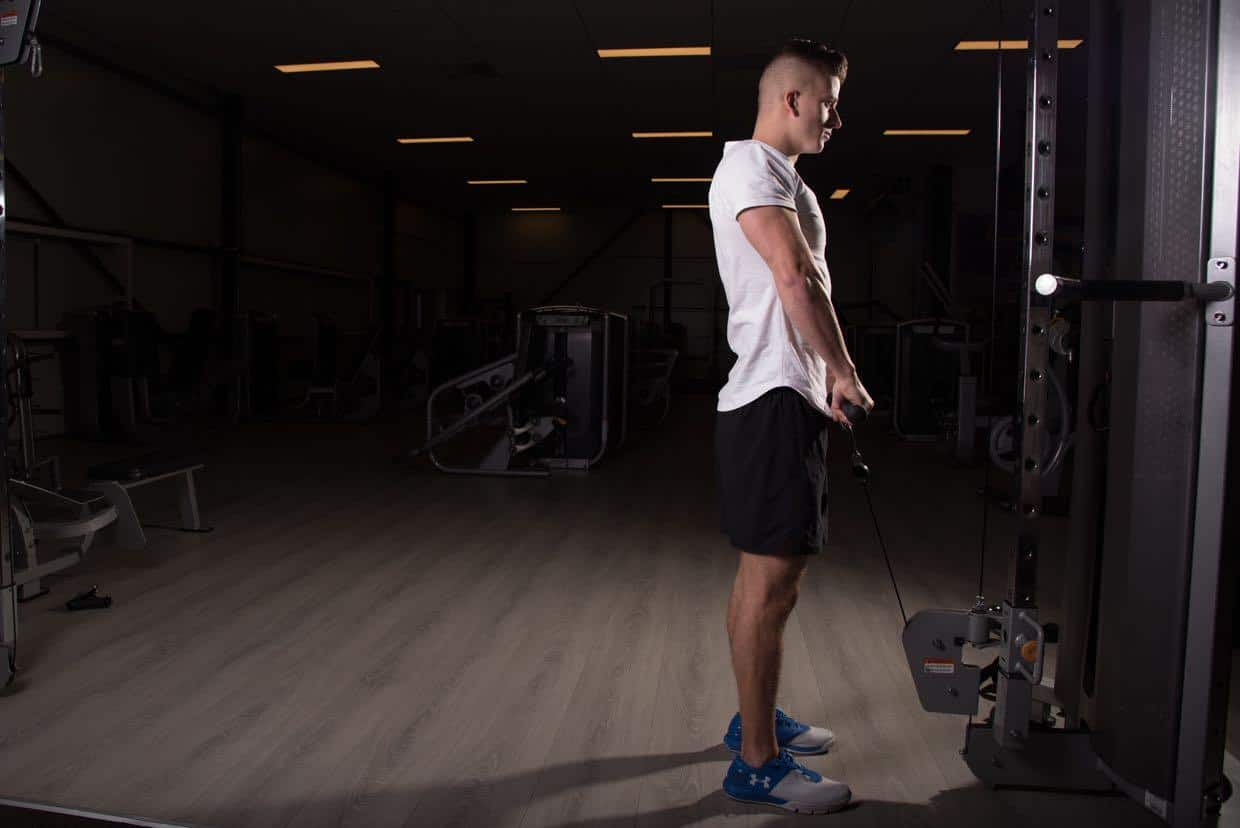
Cable shrug
Muscles involved:
Back and shoulders:
- Trapezius (especially the upper fibers and, to a lesser extent, the middle fibers)
- Deltoid (especially the posterior head)
Forearms
- Flexors
Abdomen:
- Rectus abdominis (straight abdominal muscle)
- Obliquus externus abdominis (external oblique muscle)
- Obliquus internus abdominis (internal oblique muscle)
- Transversus abdominis (transverse abdominal muscle, 'corset muscle')
Lower back and spine:
- Erector spinae
- Lumbar multifidus
- Quadratus lumborum
Cable shrug setup
- Set the pulley to the lowest position.
- Attach a wide bar.
- Select the desired weight.
- Stand facing the cable rack.
- Grip the bar with your hands shoulder-width apart using a pronated grip (palms facing down and backward).
- Stand upright.
Performing the cable shrug
- Raise the shoulder blades as high as possible. The bar slides along the body.
- Hold the bar briefly at the highest point.
- Lower the shoulder blades and bar back to the lowest point in a controlled manner.
- Repeat.
Cable shrug technique
A few common mistakes when performing shrugs:
- Bending the arms: You are training the trapezius. These muscles are only responsible for pulling the shoulder blades upward, backward, and/or downward. By bending the arms and pulling the bar farther upward, you are actually combining two exercises: shrugs and upright rows. The problem is that in upright rows, the shoulder muscles have to do more work than the trapezius. This means that you have to adjust the weight and number of repetitions to the capacity of the shoulders, while the trapezius can perform more work.
- Rolling the shoulders: You regularly see people roll their shoulders backward at the top of the movement (or forward in behind-the-back shrugs). This does not add anything to the effectiveness of the movement! Gravity pulls the weight downward, not backward or forward. Therefore, you do not add resistance. This also applies when performing the exercise on the cable rack. When rolling forward in behind-the-back shrugs, it would not matter if there were resistance in that direction. Pulling the shoulders forward is not a function of the trapezius. Besides not making the exercise more effective, the risk of injury is also higher. Keep it simple: Straight up and straight down.
- Bending forward: Protect your spine by remaining upright instead of bending over the bar.
- Avoid hyperextending the spine: Do not lean too far backward either, thereby avoiding unnecessary pressure on the spinal discs.
- Raise the shoulder blades instead of bringing the head downward: The range of motion of shrugs is already short, so do not make it unnecessarily shorter. This also prevents unnecessary neck complaints.
A few tips:
- Use straps: Using so-called straps, bands that you can wrap around your wrists and the barbell (or dumbbell), may quickly prove necessary. The ability of the fingers to hold the barbell can often be lower than the ability of the trapezius to raise the bar. The fingers may give out while the trapezius could still handle more repetitions.
- Optionally use a weightlifting belt to protect the spine. Because of the potentially heavy weight that can be used, high pressure may develop on the spine.
- Start from an easy position: Have the barbell ready at a position just below the lowest point of the exercise's range of motion (as described). Avoid having to begin and end with a heavy deadlift.
In front of or behind the back?
Shrugs with a barbell can be performed in front of or behind the body. There appears to be little data available on the activity of the different parts of the trapezius in these different variations.
Some claim (probably incorrectly) that performing shrugs behind the back activates the middle fibers more. This is the part that mainly adds thickness to the middle of the back. The upper fibers also add 'height': the triangle of fibers that runs from the shoulder blades to the neck. You would supposedly target these mainly by holding the bar at the front. Looking at the function and direction of the different parts of the trapezius, this theory does not seem very plausible.
The diamond-shaped muscle in the upper back pulls the shoulder blades from three different directions: from above, from the middle, and from below. In both variations of the shrug, you pull the shoulder blades upward, thus engaging the upper part of the trapezius. The middle fibers become active when the shoulder blades are pulled backward. This seems more likely when the weight is in front of the shoulder blades. If the bar is already behind or directly below the shoulder blades, they no longer need to be brought backward. It therefore seems more logical that the middle of the trapezius is activated sooner when the bar is held in front of the body.
A practical consideration for men may be that holding the bar behind the back is somewhat more comfortable.
How far from the cable rack?
When performing the exercise on the cable rack, you can introduce an additional variable. The standard execution is to stand as close to the rack as possible. The bar is then pulled as straight upward as possible, and you mainly focus on the upper fibers.
The farther you step away from the rack, the more the shoulder blades can also be pulled backward (with resistance). This makes the middle fibers work harder.
Alternatives
- Dumbbell shrugs
- Trap bar shrug
- Smith machine shrug
- Barbell shrugs
Run your fitness business with more structure
- Planning, member management and coaching in one platform
- Built for coaches, studios and gyms
- Fewer separate tools, more overview