Cable One-Arm Front Raise
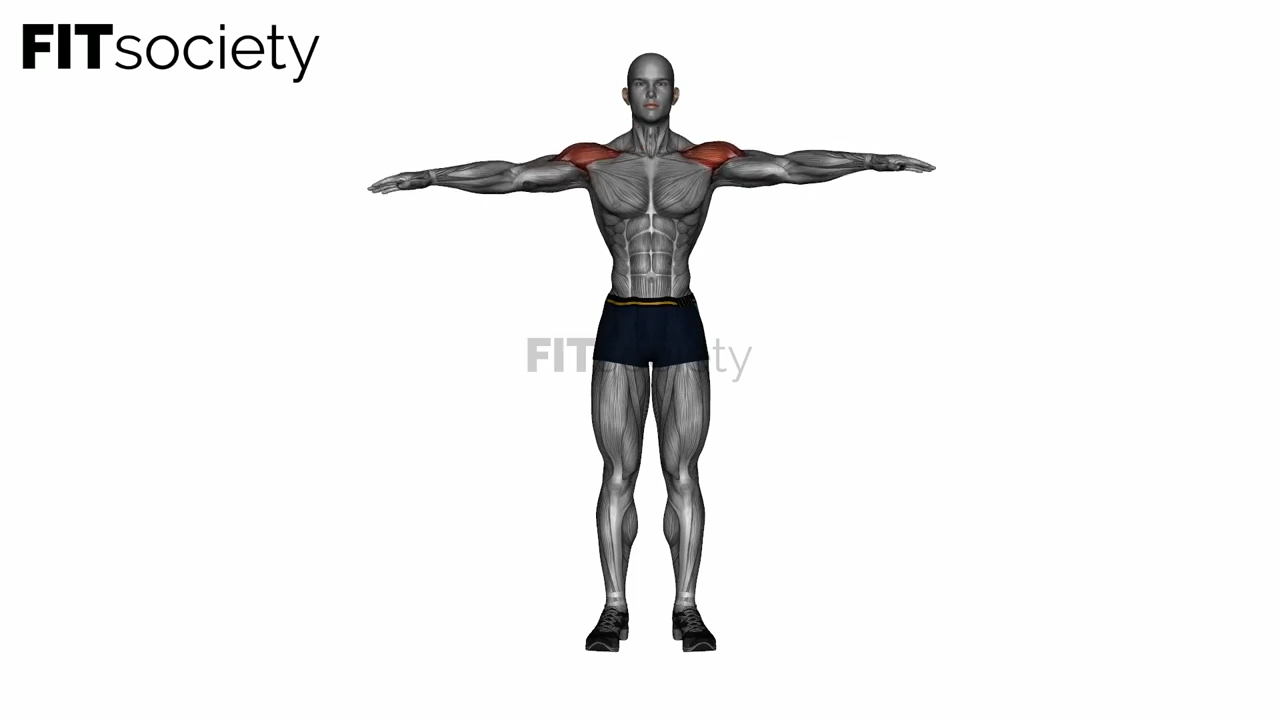
Front raises are primarily performed to place more emphasis on the anterior head of the deltoid (shoulder muscle).
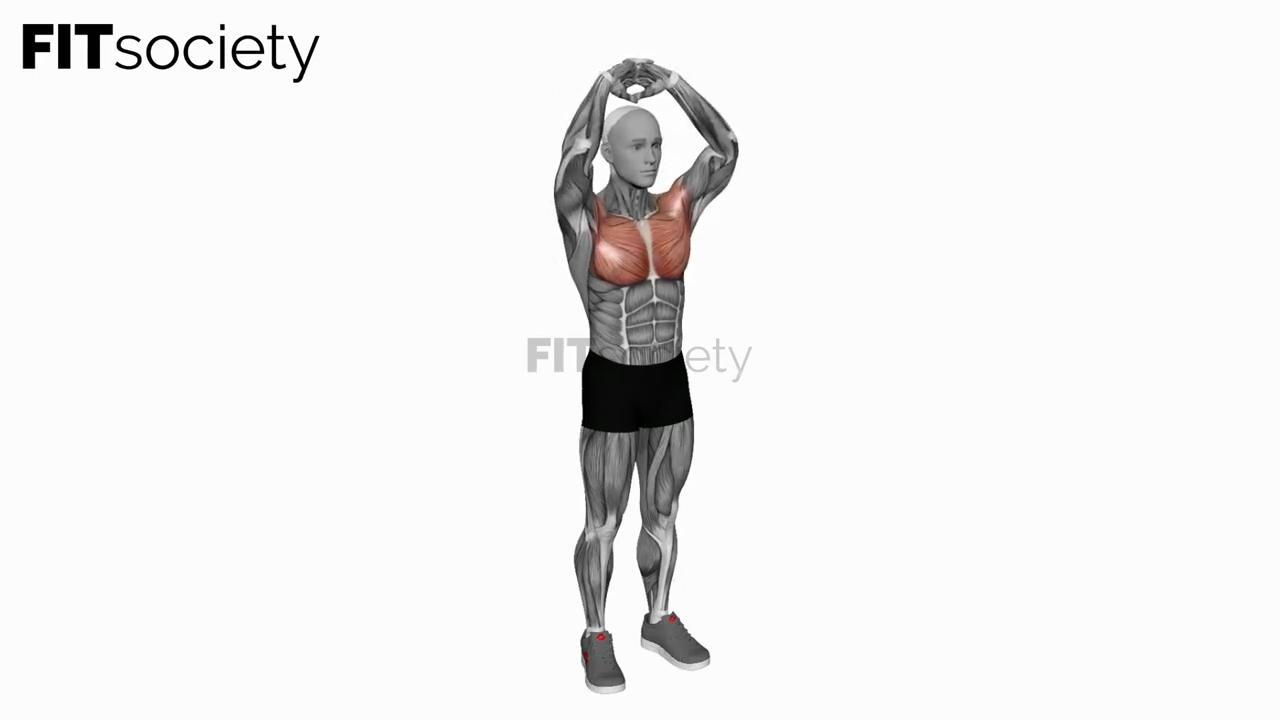
The pectoralis major assists in raising the arms. This particularly involves the fibers that run from the clavicle to the upper arm, also known as the 'upper chest'.
In addition to the deltoid itself, various muscles around the shoulder joint are recruited to stabilize it. These include smaller stabilizing muscles such as the four rotator cuff muscles, as well as the larger trapezius, which pulls the shoulder joint upward.
In the arms, the biceps and triceps provide stabilization to keep the position of the forearm relative to the upper arm constant. The muscles in the forearms then stabilize the wrist joint to control the dumbbells or bar.
Core muscles such as the abdominal muscles and muscles along the spine keep the torso upright. Depending on the execution (standing, seated with or without back support), their involvement may be greater or smaller.
In this variation, front raises are performed with a cable and one arm at a time.
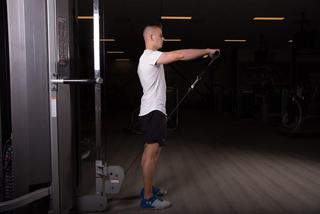
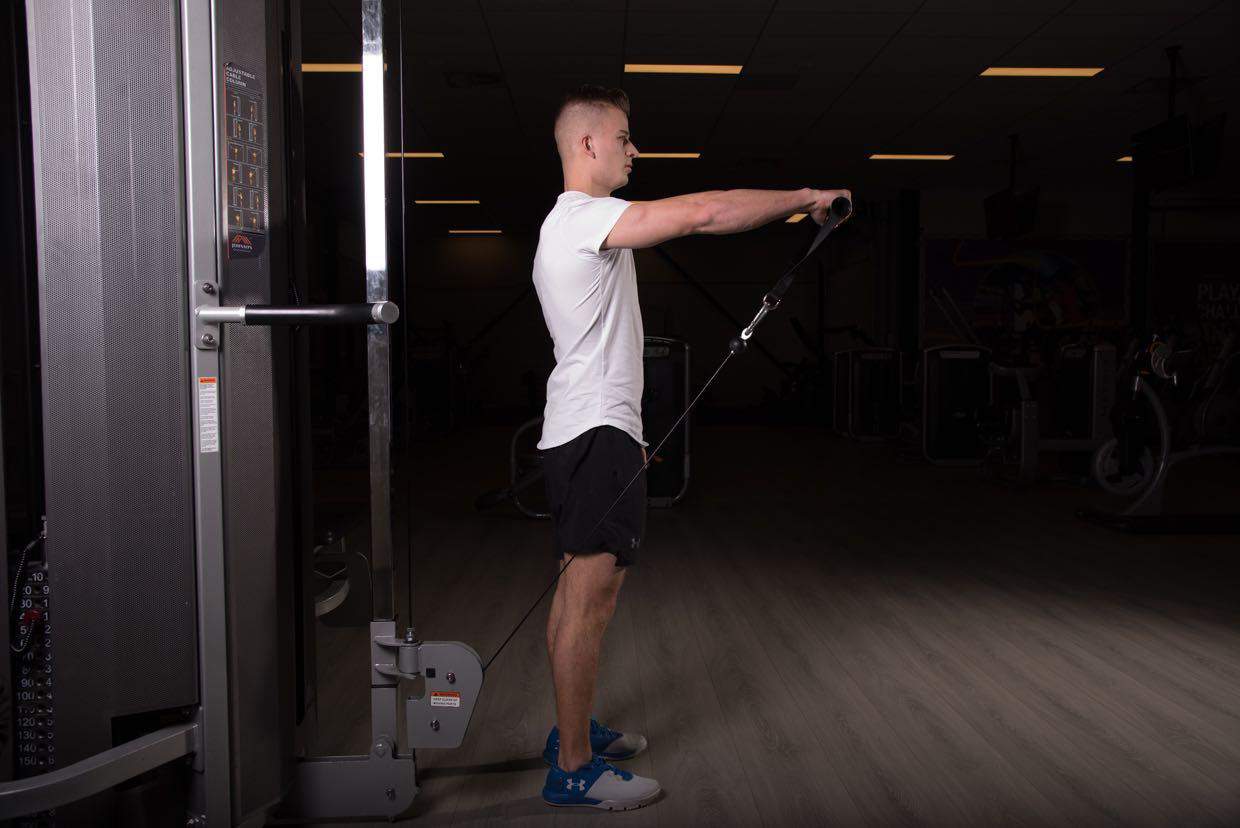
Cable one-arm front raise execution
-
1
Raise the arm forward and upward. Maintain the same slight bend in the arm. Keep the rest of your body as still as possible.
-
2
Finish at the height just before you feel pinching in the shoulders. Slightly above shoulder height should be a safe height for most people.
-
3
Hold the weight here for 1–2 counts.
-
4
Lower the arm back to the starting position in a controlled manner over 2–3 counts.
Cable one-arm front raise
Muscles involved:
Shoulder joint:
- Deltoid (especially anterior head)
- Rotator cuff (subscapularis, supraspinatus, infraspinatus, and teres minor)
- Trapezius
- Levator scapulae
Chest:
- Pectoralis major (especially upper portion)
Arms
- Triceps
- Biceps
- Forearm muscles
Abdomen:
- Rectus abdominis (rectus abdominis muscle)
- Obliquus externus abdominis (external oblique muscle)
- Obliquus internus abdominis (internal oblique muscle)
- Transversus abdominis (transverse abdominal muscle, 'corset muscle')
Lower back and spine:
- Erector spinae
- Lumbar multifidus
- Quadratus lumborum
Cable one-arm front raise setup
- Set the cable pulley to the lowest position and select the desired weight.
- Attach a single handle to the cable.
- Stand with your back toward the cable machine so that the working arm is in front of the pulley.
- Grip the handle with your palm facing backward*
- Keep your arms slightly bent and stand upright.
Cable one-arm front raise technique
"For the front of the shoulder"
The deltoid muscle pulls on the upper arms from three directions. Front raises are usually performed by people who want to train the front of the shoulder. Two important points can be made here:
- Front raises are not the exercise that activates the anterior shoulders the most.
- Turning the hands, and therefore the shoulders, inward further reduces activation of the front of the shoulder.
Regarding the last point: Due to the design of most single handles on a cable machine, you are often forced to keep the thumb turned inward or outward. With a neutral grip, the cable would have to follow an awkward path along the handle. With the hands turned inward, the exercise is therefore less effective for the front of the shoulder. You could also turn the hand outward (palms facing forward). However, this places more stress on the biceps and chest muscles.
The partially forced hand position is therefore a disadvantage. However, the cable's resistance is an advantage. The barbell shoulder press (and even the barbell behind-neck press) would activate the anterior head of the shoulder more. According to relatively scarce EMG data, the bench press itself also appears to demand more from the anterior head of the shoulders than front raises.
However, those comparisons were made by looking at execution with free weights. A cable provides very different resistance from free weights. In the front raise, this applies especially to the beginning of the exercise. Unfortunately, no EMG data appears to be available for this.
Arms bent or straight
The straighter the arms are, the farther the hands are from you, and the heavier the weight they hold becomes. Front raises with straight arms can therefore be heavier than using a slightly heavier weight with bent arms. Normally, the goal is to make it harder through proper execution, which would mean straightening the arms as much as possible.
However, the more you straighten the arms, the greater the stress on the elbow joint and the muscles that must stabilize it. Bending the arms slightly more can make it easier to focus fully on the upper arms.
Alternatives
- (two-arm) Cable front raises
- Barbell front raises
- Dumbbell front raises
Run your fitness business with more structure
- Planning, member management and coaching in one platform
- Built for coaches, studios and gyms
- Fewer separate tools, more overview