Arnold Press
About the Arnold press
The shoulder press is an exercise that works all three heads of the deltoid (but not to the same extent). This is the deltoid muscle responsible for lifting the upper arm.
The Arnold press (or Arnie press) is a variation of the standard dumbbell shoulder press developed by Arnold Schwarzenegger. This variation places even more emphasis on the front of the shoulders. In addition, muscles that rotate the upper arms outward play a greater role. These include the smaller muscles of the rotator cuff (teres minor and infraspinatus). Because these stabilizing muscles are often trained considerably less than the shoulder muscle itself, this creates a risk of shoulder injuries.
Muscles involved
Shoulder joint
- Deltoid (extra emphasis on the anterior head)
- Rotator cuff (subscapularis, supraspinatus, infraspinatus, and teres minor)
- Trapezius
- Rhomboids
- Levator scapulae
Arms
- Triceps
- Biceps
- Forearm muscles
Abdomen
- Rectus abdominis (straight abdominal muscle)
- External oblique (external oblique abdominal muscle)
- Internal oblique (internal oblique abdominal muscle)
- Transversus abdominis (transverse abdominal muscle, corset muscle)
Lower back & spine
- Erector spinae
- Lumbar multifidus
- Quadratus lumborum
Setting up for the Arnold press
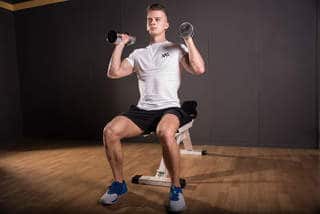
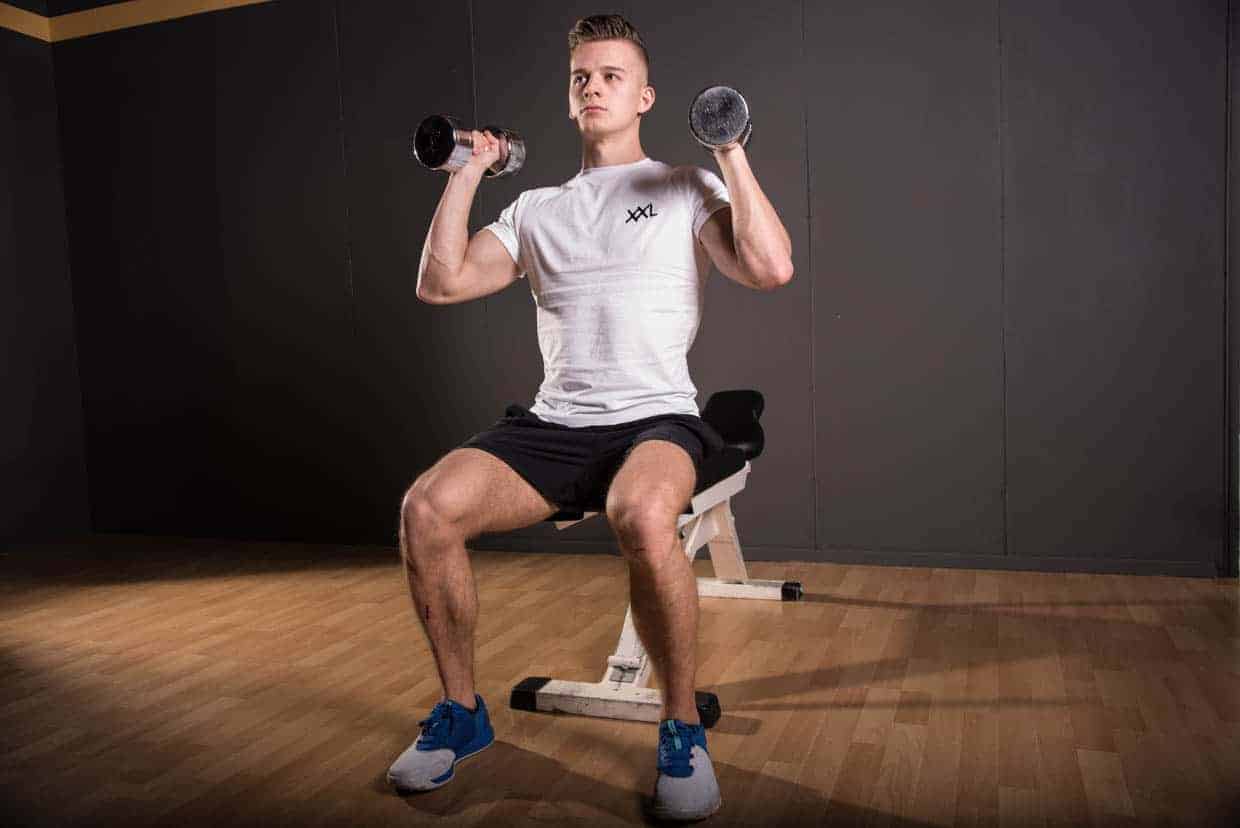
- Sit on a bench with the backrest (almost) completely upright and the dumbbells on your knees.
- Raise your knees one at a time and bring the dumbbells into their starting position: Your palms are turned toward your face. Your hands are approximately level with your chin. Your elbows are slightly in front of and beside your torso.
- If necessary, press your glutes back against the backrest. They may tend to slide forward when raising the dumbbells. If your waist has shifted too far forward, you are leaning too far back and the chest muscles take over a greater part of the load from the shoulders.
Performing the Arnold press
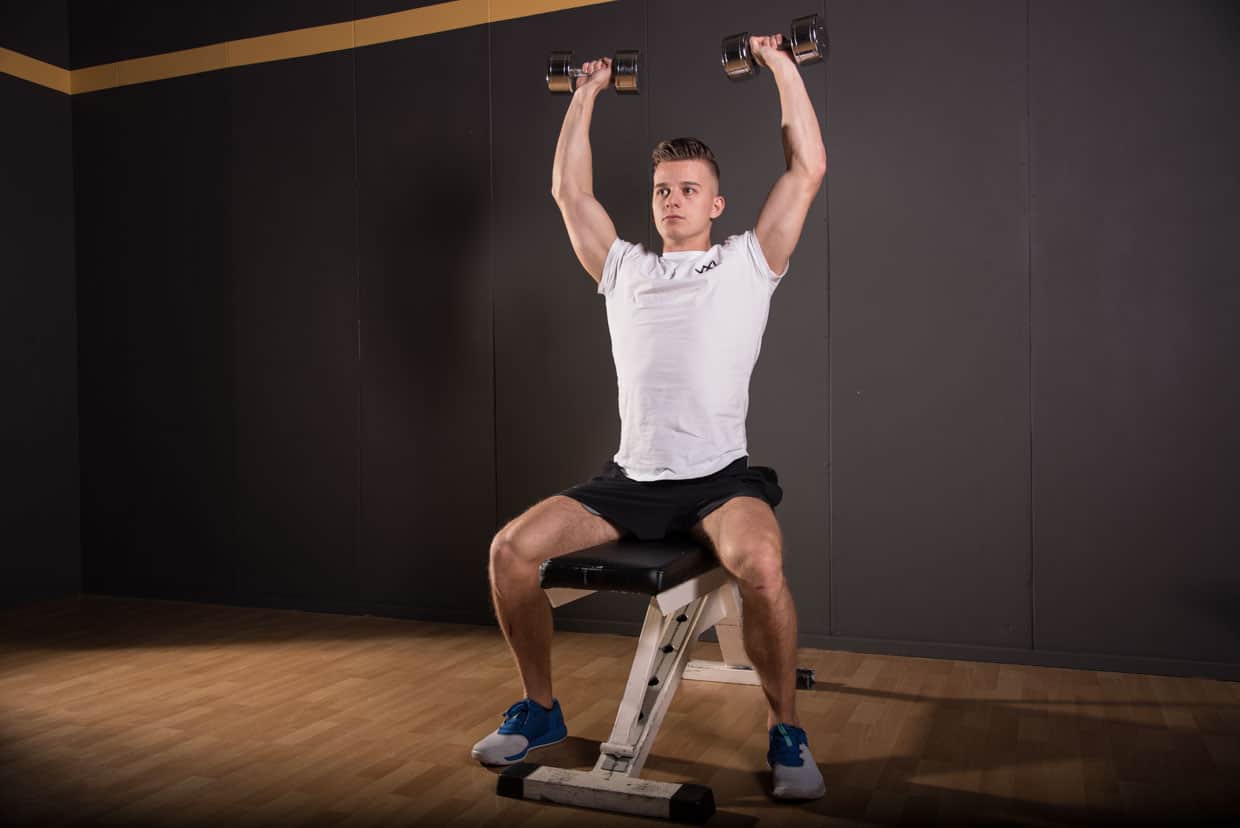
- Focus on your elbows and push them upward and simultaneously outward until they are beside (instead of in front of) your torso. Your palms rotate inward and forward during this movement. At the same time, extend your arms. The movement ends with your arms almost completely extended and your palms facing forward.
- Lower your elbows back in a controlled manner while rotating them inward again and bending your arms again. Maintain tension at the bottom. Therefore, do not let the dumbbells or elbows come completely against your torso.
- Repeat.
Arnold press technique
The three heads of the deltoid
The deltoid shoulder muscle pulls on the upper arms from three directions. During the shoulder press, all three heads of the shoulder muscle are worked. However, it is mainly the anterior head (pars clavicularis) that performs the most work, followed by the lateral head (pars acromialis). The posterior head (pars spinalis) is worked considerably less. The shoulder press can be performed in different ways that can shift the load per head, but not by much. In most cases, the front of the shoulder exerts three times as much effort as the side, which in turn exerts an average of three times as much effort as the rear. The Arnold press therefore places even more emphasis on the front of the shoulders.
Seated or standing
Research has shown that when performing the shoulder press standing, the shoulders (all three heads) exert greater effort. The researchers point to the additional need for stabilization when the exercise is performed standing. This would mean that the standing version is more effective at working the shoulder muscles.
Another possibility, however, is that people often cheat during the seated version. The standing version forces you to stand upright so that you do not fall backward. This limits the possible contribution of the chest muscles. On a bench with a backrest, you often see that the backrest is set at too steep an angle. Then the person slides the glutes slightly forward, leaning even farther back. The shoulders then have to exert less effort because the chest, especially the upper portion, can contribute more.
Dumbbells or barbells?
The same study showed that the dumbbell shoulder press worked the shoulders (all three heads) harder in every case than the barbell version. Here too, the greater need for stabilization was mentioned as a possible cause.
In addition to the shoulder muscles having to perform more stabilizing work with dumbbells, the exercise's range of motion is also greater. With dumbbells, the hands can move toward each other at the top of the movement at the point where the barbell exercise has reached its endpoint.
Alternatives
- Dumbbell shoulder press
- Seated barbell shoulder press
- Shoulder press machine
- Front raises
Run your fitness business with more structure
- Planning, member management and coaching in one platform
- Built for coaches, studios and gyms
- Fewer separate tools, more overview