Golf Squat
The squat is one of the best-known exercises for the legs. It is a compound exercise; an exercise that involves multiple joints and muscle groups. This is evident from the long list of muscles involved, as mentioned above.
The golf squat is a variation of the squat that requires greater engagement of the upper-body muscles, such as the shoulders and biceps. The trapezius elevates the heads of the shoulders while the shoulders themselves raise the extended arms. The biceps are engaged to keep the arms extended.
In addition, the oblique abdominal muscles are more actively engaged because of the rotation in the movement. Finally, the coordination of all these muscles is trained. Therefore, the golf squat is often used as a functional or sport-specific exercise. The movement can translate to many movements in a wide range of sports.
The golf squat can be performed with dumbbells or kettlebells.
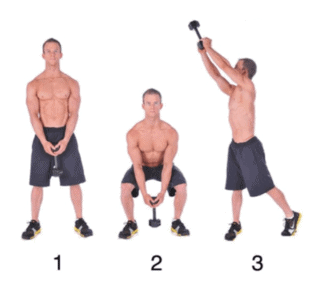
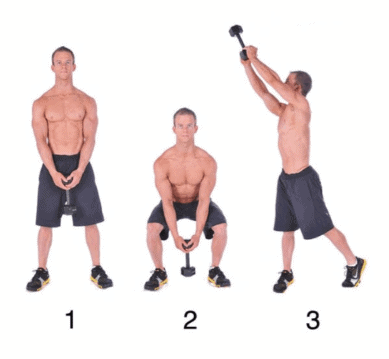
Golf Squat execution
-
1
Grasp a dumbbell in the middle with one hand over the other. Hold it in front of you with your arms hanging and almost fully extended.
-
2
Stand with your feet approximately shoulder-width apart.
-
3
Lower yourself slowly as if sitting on a chair that could be pulled away at any moment. Finish at the point where the (top of the) thighs are parallel to the floor.
-
4
Push yourself up and shift your weight by rotating from the waist onto one foot while swinging the dumbbell toward the ceiling in the same direction. Your other foot finishes supported on the toes to make the movement as long as possible.
-
5
Return the dumbbell in a controlled manner to the starting position.
-
6
Repeat on the other side.
Golf Squat
Muscles involved:
Legs:
- Quadriceps (vastus lateralis, vastus medialis, vastus intermedius, and rectus femoris)
- Hamstrings
Glutes:
- Gluteus maximus, medius, and minimus
Pelvis:
- Iliacus (hip flexor)
- Psoas major (hip flexor)
Calves:
- Gastrocnemius
- Soleus
Abdominals:
- Rectus abdominis (straight abdominal muscle)
- Obliquus externus abdominis (external oblique abdominal muscle)
- Obliquus internus abdominis (internal oblique abdominal muscle)
- Transversus abdominis (transverse abdominal muscle, ‘corset muscle’)
(Lower) back and spine:
- Erector spinae
- Lumbar multifidus
- Quadratus lumborum
Other:
- Deltoideus
- Biceps brachii
- Trapezius
Golf Squat technique
Safety
- Flying dumbbells are never a pleasant sight in the gym. It goes without saying that you should ensure a good grip during this exercise. If necessary, a single wrist strap connecting the wrist and dumbbell can be used. The second hand is then placed around it. If you want to perform the golf squat very dynamically, this can provide the necessary security.
- Be aware of your space! The golf squat is a relatively unfamiliar exercise. People around you in the gym will therefore not quickly expect the sideways swing. A dumbbell in someone's face is also not a pleasant sight.
Alternatives
- Air squat
- Side lunges
- Dumbbell squat
Run your fitness business with more structure
- Planning, member management and coaching in one platform
- Built for coaches, studios and gyms
- Fewer separate tools, more overview