Cable Standing Hip Extension
The cable standing hip extension is an exercise for the glutes, lower back, and hamstrings. The name indicates that it involves extension of the leg. Normally, this means bringing a forward-positioned thigh (flexion) back into line with the torso (extension). In this exercise, that occurs through a very small range of motion. The leg pulling on the cable is only slightly brought forward at the start. There is therefore barely any flexion, and consequently only a small range of motion involving extension.
However, because you bend forward during the exercise while the leg is brought further backward, it must be kept under tension to keep the torso and leg aligned. During this part of the exercise, there is therefore mainly isometric tension. By comparison, in the cable bent over hip extension, you perform the entire exercise bent forward. This results in more flexion at the start and a larger range of motion. In addition, there is more emphasis on concentric and eccentric contractions, the dynamic contractions.
To bring the torso itself into motion, the rectus femoris in the supporting leg plays an important role. This is one of the quadriceps muscles.
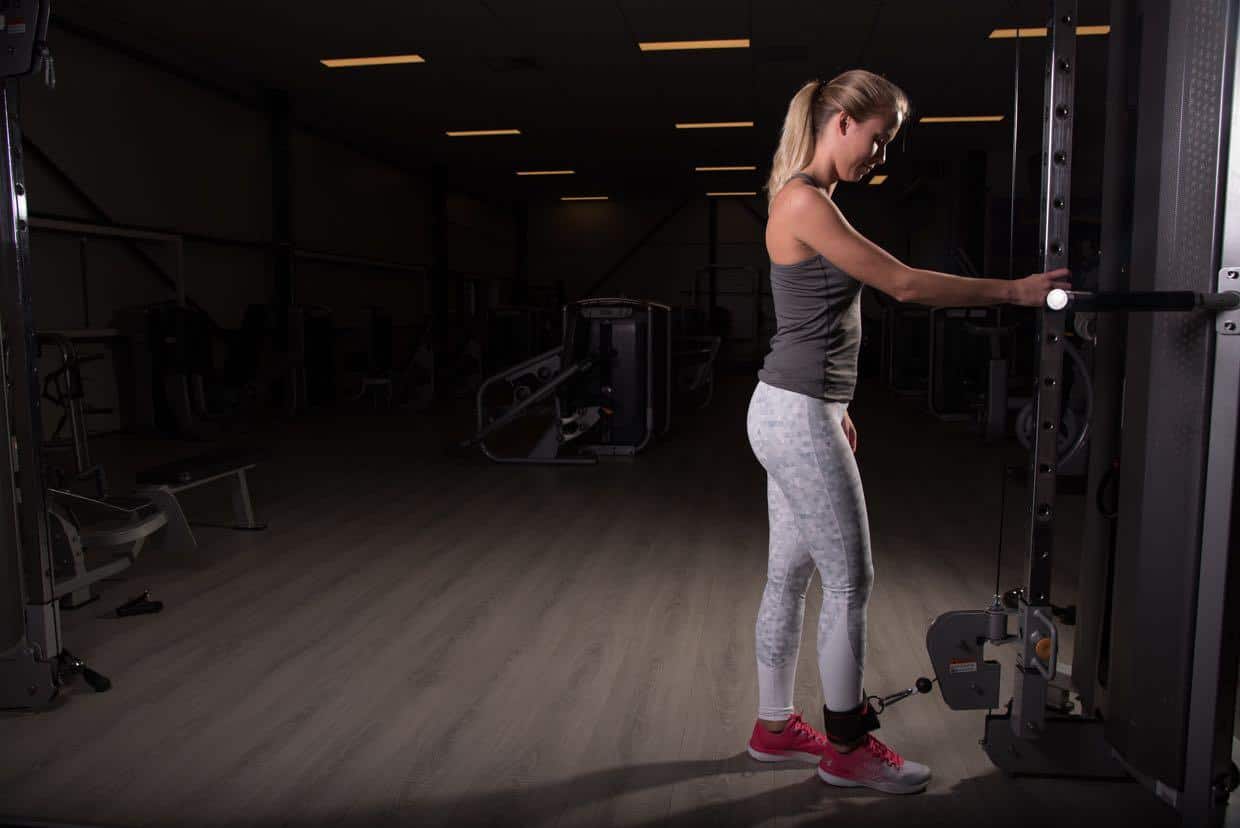
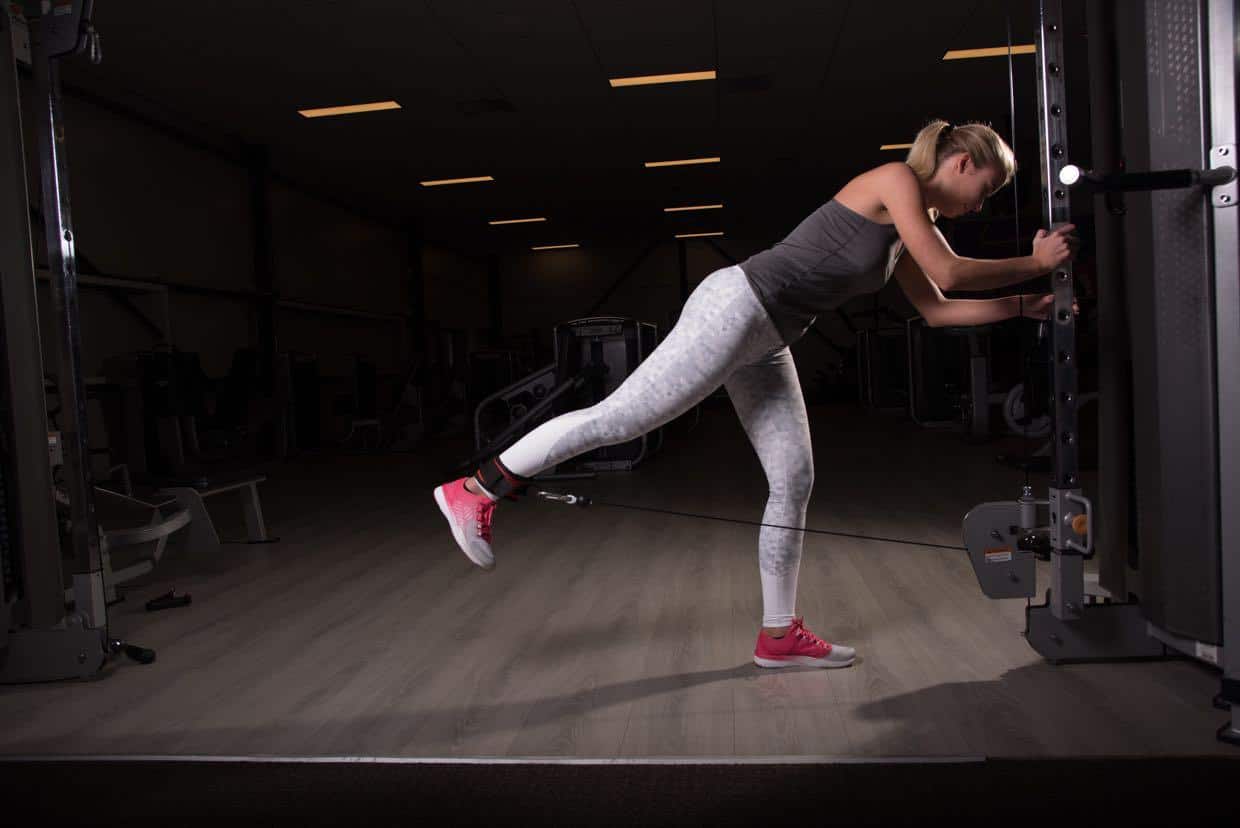
Cable standing hip extension execution
-
1
Bring your slightly bent leg backward in a wide arc until the leg and torso form a straight line.
-
2
Then tilt your upper body forward in a smooth movement, ensuring that the leg extended forward at the start remains in a straight line with the upper body. Maintain the natural curve of your back to prevent unnecessary engagement of the abdominal muscles.
-
3
Tilt back in a controlled manner until you are standing upright, and bring the leg with the cable forward again in one movement to the starting position. Avoid losing tension on the cable.
-
4
Repeat.
Cable standing hip extension
Main muscles:
- Erector spinae ('back extensor')
- Hamstrings (biceps femoris, semitendinosus, semimembranosus)
- Gluteal muscles (gluteus maximus, medius, and minimus)
- Rectus femoris
Cable standing hip extension setup
- Place the pulley of the cable machine in the lowest position and attach it to the ankle with a designated strap.
- Choose the desired weight.
- Stand far enough away from the machine and hold onto the machine with your arms slightly bent.
- Lift your foot (with the cable) slightly and extend it forward. This is your starting position, and there should already be tension on the cable in this position. Depending on the length of the cable and your distance from the machine, you may be able to bring the foot quite far forward or barely forward at all before losing tension on the cable.
Cable standing hip extension technique
Be careful not to turn the extension into hyperextension. Bringing the leg too far backward and upward can cause risky compression of the vertebrae in the lower back. Forcing yourself to hold your foot at the top of the movement for a second will reduce the chance of hyperextension (as it will become too heavy to hold).
The tendency toward hyperextension may actually be greater in this variation than in the variation in which you remain bent forward throughout the entire movement. Because there is now a small range of motion involving (dynamic) extension, you may quickly want to make it larger by swinging the leg further backward. From the moment your leg is directly below the torso, the emphasis is on bringing the torso forward while keeping the leg that was brought back in the same line as the torso.
Alternatives
- Cable bent over hip extensions
- Hip Thrust
- Bird dog
- Fire hydrant
Run your fitness business with more structure
- Planning, member management and coaching in one platform
- Built for coaches, studios and gyms
- Fewer separate tools, more overview