Single-Leg Decline Push-Up
The push-up is a well-known compound exercise for the upper body and core muscles. Because of the plank position, the muscles in the lower back, glutes, and legs (especially the hamstrings) must work to keep the back and legs aligned. These muscles therefore mainly have a stabilizing function, as they do primarily in everyday life.
The muscles in the chest (especially the pectoralis major), shoulders (especially the front), and arms (especially the triceps) have a more active role. The chest and shoulder muscles work hard to pull the upper arms forward, while the triceps engage to extend the arms.
In this ‘decline’ variation, relatively more emphasis is placed on the upper fibers of the chest muscles and the front of the shoulders. In addition, because less weight is supported by the feet, this variation is more difficult than the regular push-up.
By lifting one leg, more emphasis is placed, among other things, on the rectus femoris of the supporting leg. The external oblique muscles must also work harder to stabilize your body. The glutes and hamstrings must now also work to keep the raised leg elevated
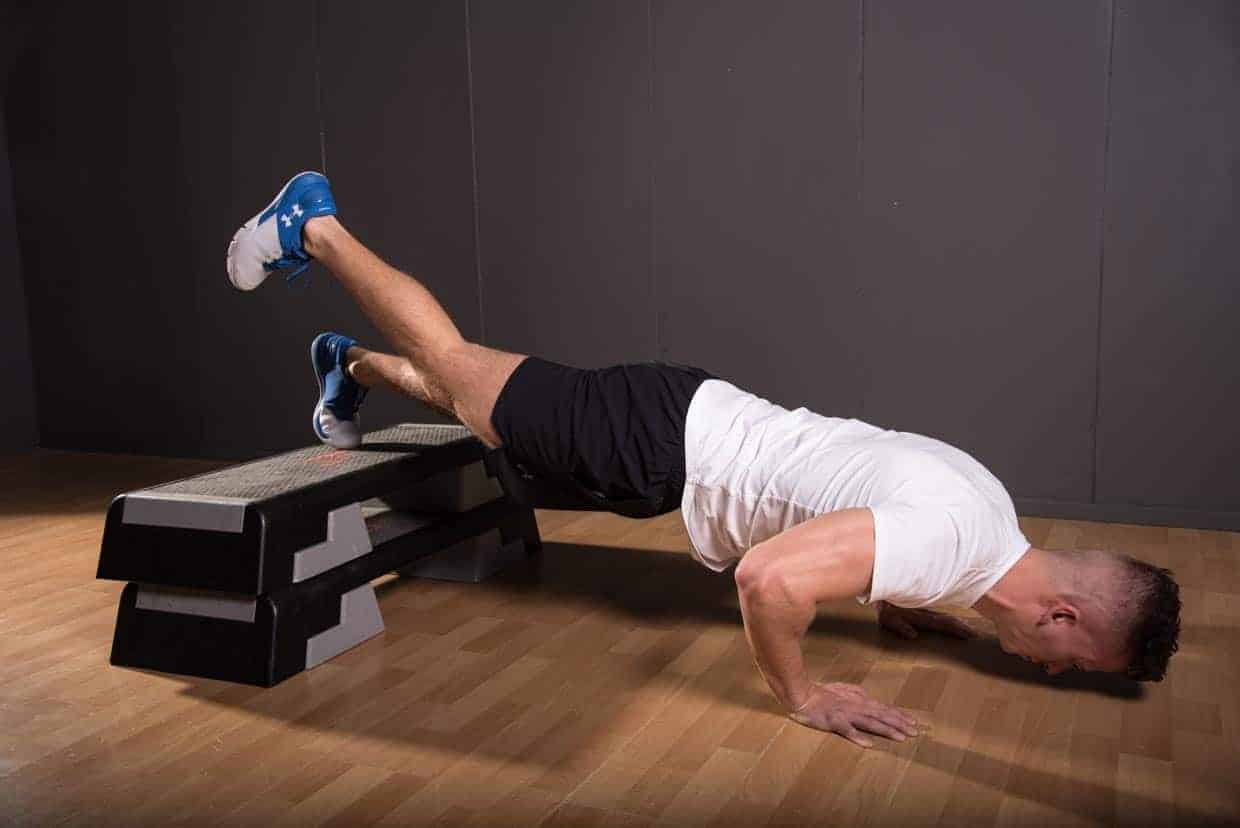
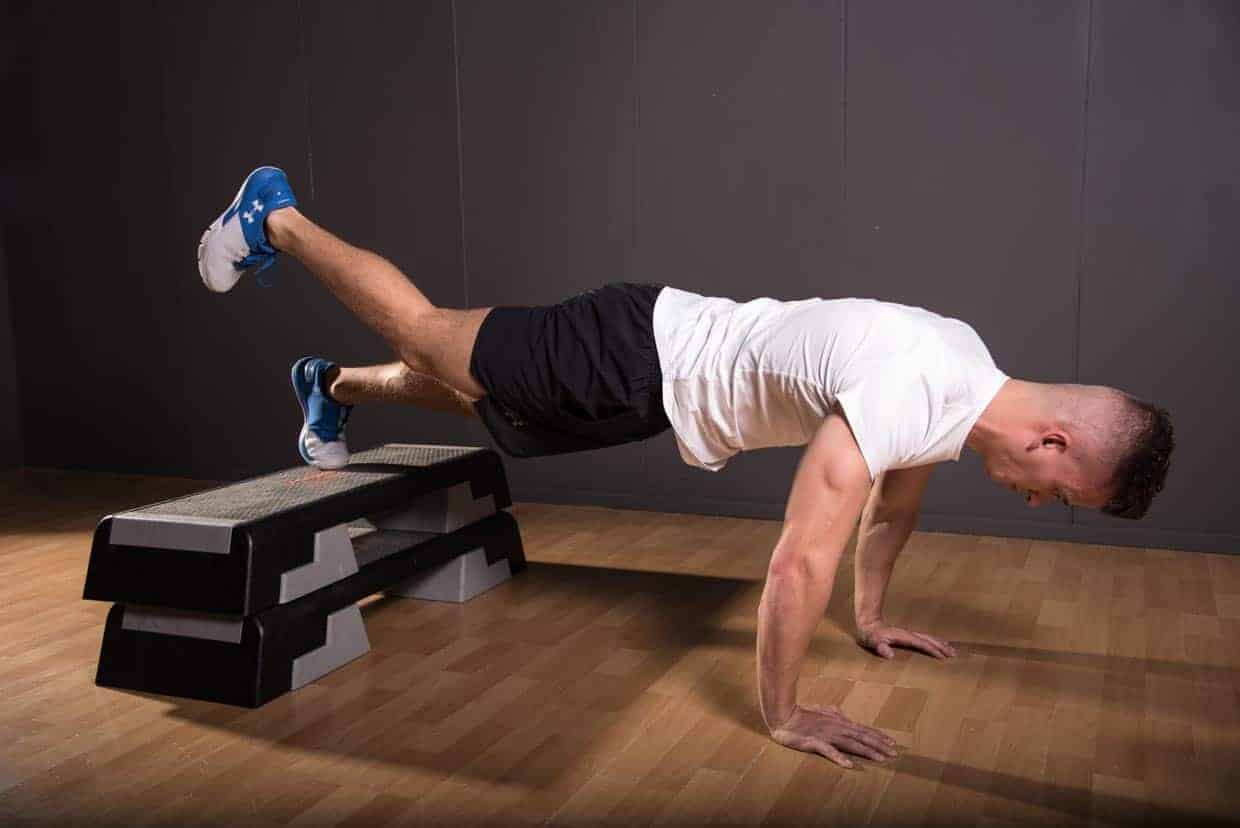
Decline Push-Up Execution
-
1
Assume a plank position with straight arms and your feet placed on an elevation.
-
2
Place your hands shoulder-width apart or wider (depending on your goal) on the floor.
-
3
Keep your head in a neutral position by looking down.
-
4
Lift one of your feet to approximately one foot-length high. This is your starting position.
-
5
Lower yourself in a controlled manner by bending your arms, with your elbows moving backward. Hover just above the floor.
-
6
Push yourself explosively upward until your arms are almost straight.
Decline Push-Up
Active muscles:
- Pectoralis major (large chest muscle)
- Anterior deltoid (front fibers of the shoulder muscle)
- Triceps brachii
- Serratus anterior
- Coracobrachialis (coracobrachialis muscle)
Stabilizing muscles:
- Rotator cuff (stabilizing shoulder muscles, supraspinatus, subscapularis, teres major, teres minor)
- Serratus
- Trapezius
- Biceps brachii
- Latissimus dorsi
- Erector spinae
- Hamstrings
- Abdominal muscles
- Gluteal muscles
Decline Push-Up Technique
You can alternate the raised leg with each repetition or each set. If you do this per set, the additional load on the glutes and hamstrings of the raised leg is mainly isometric. By doing this with each repetition, the effort becomes more dynamic.
Use push-up bars if this position is painful for your wrist. In this variation, this means that the feet should be raised higher to remain in the decline position.
Alternatives
- Kneeling Push-Up
- Clap Push-Up
- Bench Press
- Cable Chest Press
Run your fitness business with more structure
- Planning, member management and coaching in one platform
- Built for coaches, studios and gyms
- Fewer separate tools, more overview