Pec Deck Machine Fly
So-called fly exercises are popular exercises for isolating the chest muscles as much as possible. The primary function during this exercise is pulling the upper arms forward through the pectoralis major. Because the arms maintain the same curve throughout the movement, the triceps are required much less than during the bench press. The biceps must still be kept under constant tension to keep the arms in a slightly bent position.
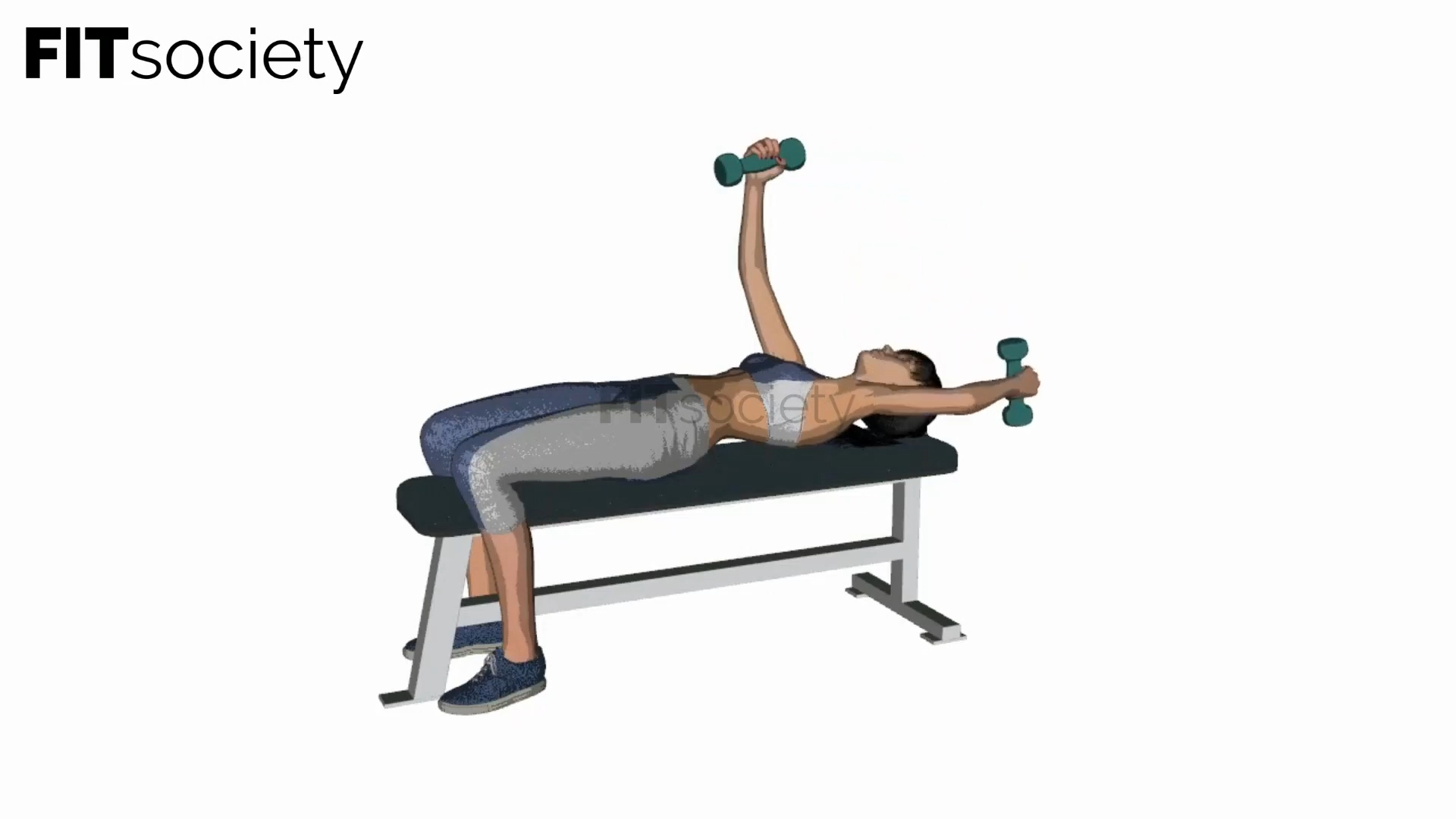
Flyes can be performed with dumbbells, machines, or cables. The pec deck fly is the variation that uses a machine to perform the movement.
An advantage of the cable and machine variations is the constant tension that is maintained at the end of the exercise. In the lying dumbbell variation, this tension is lost at the end of the movement.
Performing the exercise on a machine requires less stabilizing work, making it easier to concentrate on the chest muscles. The fixed movement path prevents major errors, making it a suitable exercise for beginners.
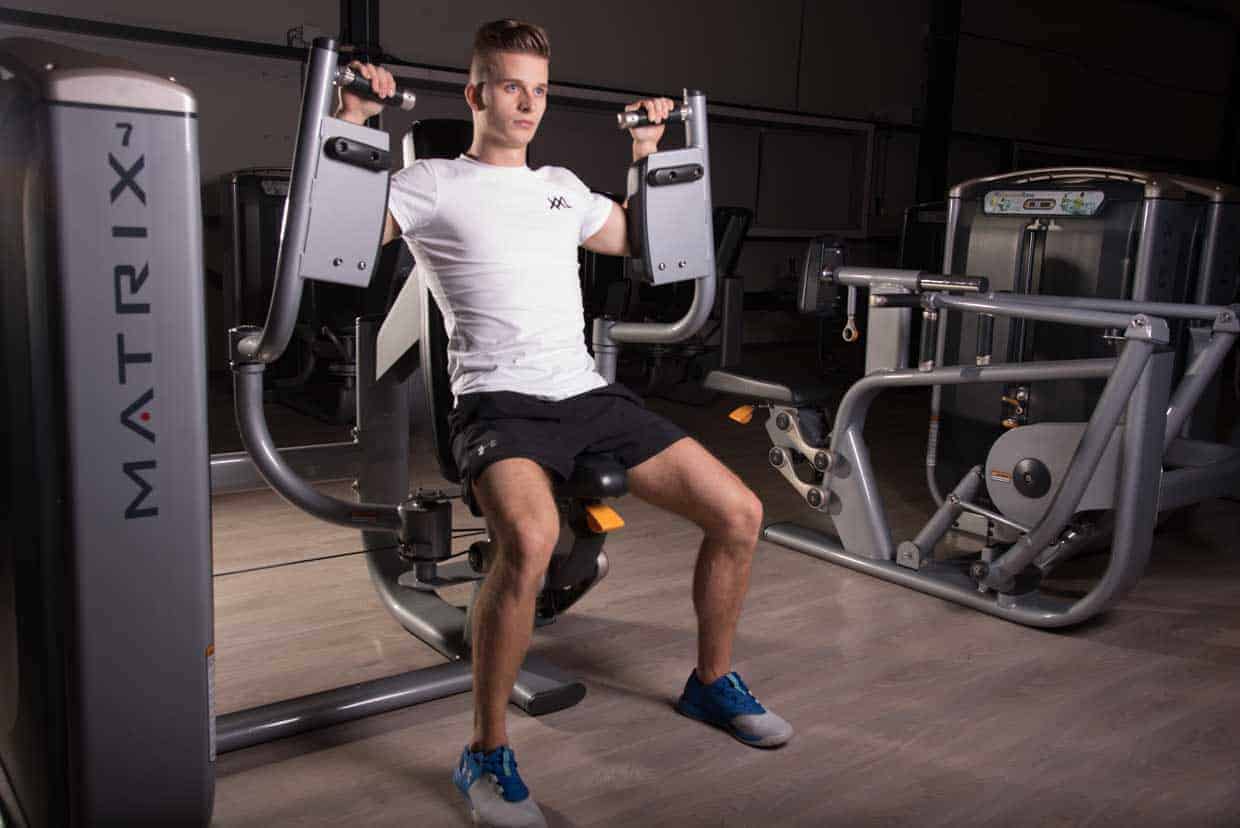
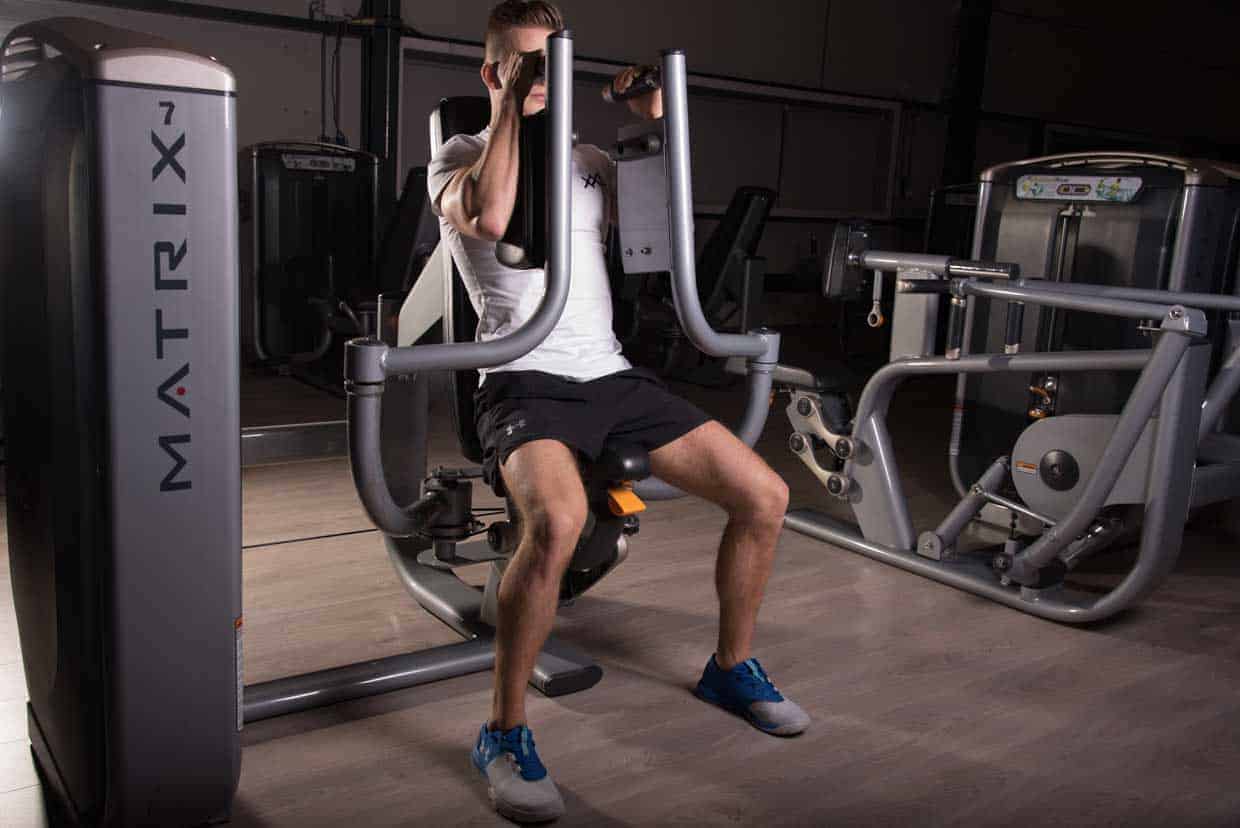
Pec Deck Machine Fly execution
-
1
Bring the arms forward and inward. Emphasize pulling and pushing from the elbows.
-
2
Return the hands to the starting position under control.
Pec Deck Machine Fly
Active muscles:
- Pectoralis major
- Anterior deltoid
- Serratus anterior
- Coracobrachialis
Stabilizing muscles:
- Rotator cuff (stabilizing shoulder muscles, supraspinatus, subscapularis, teres major, teres minor)
- Biceps brachii
- Serratus
- Trapezius
- Triceps brachii
- Latissimus dorsi
- Core muscles
Pec Deck Machine Fly setup
- Set the seat to the correct height. When the handles are gripped, the elbows should be slightly below chest height.
- Check that the lock is functioning so that you do not have to begin and end the exercise from a fully stretched position.
- Keep your back pressed against the backrest throughout the exercise.
Pec Deck Machine Fly technique
Because the pectoralis major is compressed in the center of the chest at the end of the movement, it is sometimes thought that this exercise trains the 'inner' chest. However, regarding the fiber direction of the pectoralis major, there is no 'inner' chest (nor an 'outer' chest). The part of the fibers close to the sternum also does not appear to be capable of being activated separately by specific exercises. You train this muscle along the entire length of its fibers.
One of the most common mistakes in this exercise is setting the seat too low. This causes the elbows to be positioned too high relative to the shoulders. As a result, the shoulders have to work harder. Combined with the fact that they are externally rotated, this can cause shoulder complaints.
Do not bring the elbows too far back at the beginning and end of the movement. They should not move far beyond the torso. A safe starting point is to bring them to slightly in front of the torso. Depending on shoulder mobility, you can move them slightly farther back for a greater range of motion. Because of the externally rotated position, the range of motion will be smaller than with dumbbell or cable fly exercises.
Alternatives
- Dumbbell fly
- Cable crossover fly
- Cable seated fly
- Cable lying fly
Run your fitness business with more structure
- Planning, member management and coaching in one platform
- Built for coaches, studios and gyms
- Fewer separate tools, more overview