Paused Bench Press
The bench press, or “bench pressing,” is one of the most popular exercises in strength training. It is also one of the three powerlifting exercises, alongside the squat and deadlift. It is a compound exercise that engages several large muscle groups. The chest muscles and front shoulder muscles are used to pull the upper arm forward and inward. The triceps are used to extend the arms.
The paused bench press is a variation. The barbell is held at the bottom of the movement for several seconds before being pressed up again.
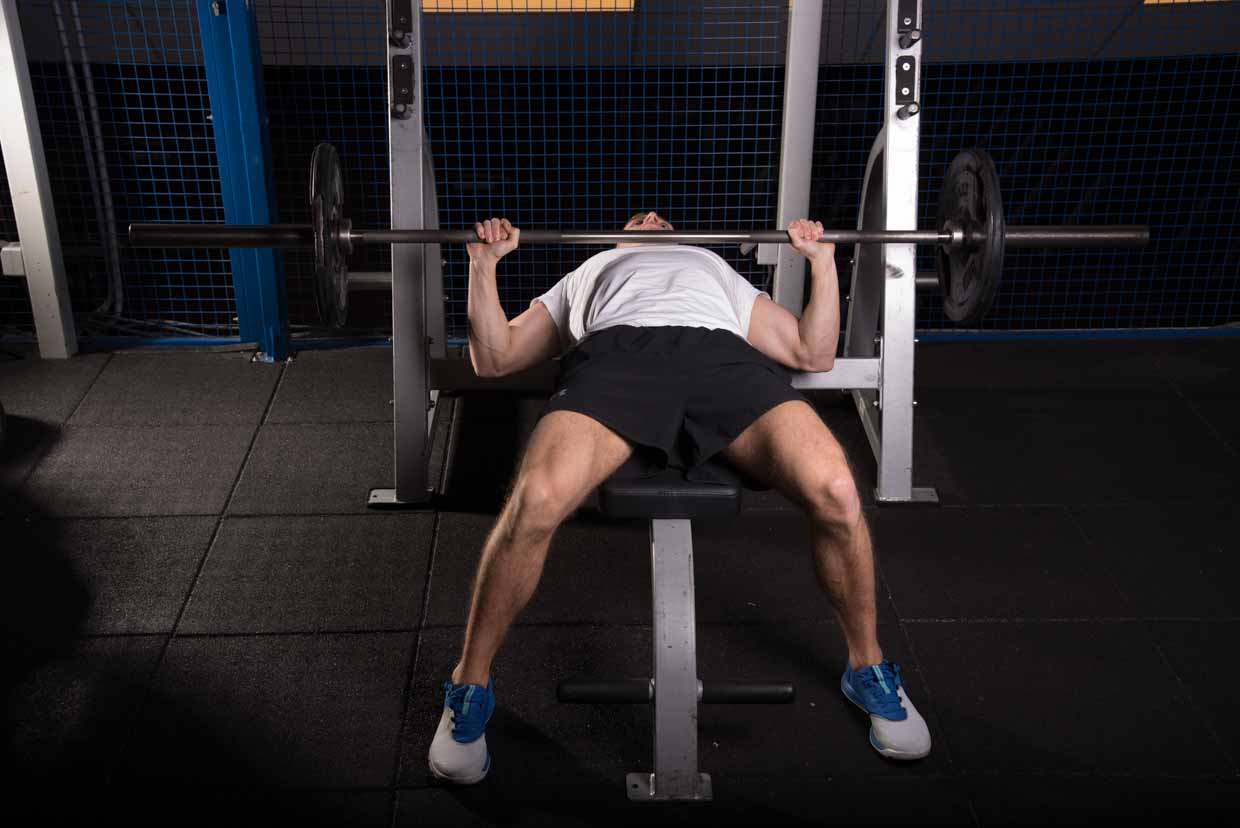
Paused Bench Press execution
-
1
Grip the barbell at the desired grip width (see notes).
-
2
Make sure your forearms and hands are aligned. The back of your hand should form a straight line with your forearm (to prevent wrist injuries).
-
3
Unrack the barbell by extending your arms. Move the barbell forward in a controlled manner so that it is no longer above your face but above your chest. This is your starting position.
-
4
Lower the weight in a controlled manner. Depending on shoulder mobility, lower your elbows until they are beside your torso, or lower them further until the barbell hangs just above your chest.
-
5
Hold the weight in this position for several seconds (e.g. 3) while keeping everything under tension.
-
6
Press explosively to bring the weight back up until your arms are almost extended.
-
7
Repeat by lowering the weight in a controlled manner.
Paused Bench Press
Active muscles:
- Pectoralis major (chest muscle)
- Pectoralis minor (depending on execution)
- Anterior deltoid (front fibers of the shoulder muscle)
- Triceps brachii
- Serratus anterior
- Coracobrachialis (coracobrachialis muscle)
Stabilizing muscles:
- Rotator cuff (stabilizing shoulder muscles, supraspinatus, subscapularis, teres major, teres minor)
- Serratus
- Trapezius
- Biceps brachii
- Latissimus dorsi
- Core muscles
Paused Bench Press setup
- Place a barbell at the correct height on the supports. Choose a height approximately halfway through the exercise’s range of motion. Placing it too high can cause problems during an exhausted final rep.
- Choose the appropriate weight for the desired number of repetitions. Secure it with collars.
- Lie down on the bench. The barbell should be approximately level with your eyes.
Paused Bench Press technique
This variation of the bench press can be performed in different ways. For example, the length of time the barbell is held at the bottom position may vary. Some people hold the weight just above the chest, while others lightly place it on the chest. In the first case, tension is maintained; in the other, it temporarily decreases. Which method is “best” depends on the reason for pausing during this exercise.
Pausing at the bottom changes the exercise in several ways:
- Less use is made of the elasticity of muscles and attachments. The muscles have to work harder, making the exercise more challenging.
- Time under tension can increase. Time under tension is one of the variables involved in increases in muscle strength and mass.
For the latter point, it naturally depends on whether all tension is maintained by holding the barbell just above the chest. In both cases, you notice that pressing the weight up is more difficult because you cannot use momentum. The muscles rely less on elasticity and have to work much harder at the most difficult point of the exercise. This can therefore be a good method for increasing your bench press strength.
Safety:
Bench pressing and squatting are the most classic ways to get into trouble in the gym. The number of repetitions you perform is a balance between safety and effectiveness in every set. Do you try one more repetition to exhaust your muscles as much as possible? Or do you choose certainty because it looks so ridiculous when you try to crawl out from under a barbell while calling for help?
This applies especially to this paused variation. You hold the weight still at the most difficult point of the exercise, increasing the chance of “failure.”
Working with a partner or a “spotter” gives you a little more margin in this decision. It is important that you have a spotter who can actually provide sufficient assistance if necessary, knows when it is needed and to what extent. Also communicate beforehand exactly what is expected of the spotter. Help with lifting the barbell out of the rack or not? Keep their hands close to the bar from the first repetition or only when necessary? Continue communicating during the exercise as well. The most unpleasant accidents often happen because of miscommunication.
Alternatives
- Dumbbell bench press
- Incline bench press
- Smith machine bench press
Run your fitness business with more structure
- Planning, member management and coaching in one platform
- Built for coaches, studios and gyms
- Fewer separate tools, more overview