Dumbbell Decline Fly
So-called fly exercises are popular exercises for isolating the chest muscles as much as possible. The primary function during this exercise is pulling the upper arms forward using the pectoralis major. Because the arms maintain the same curvature throughout the movement, the triceps are required much less than during the bench press. The biceps must remain under continuous tension to keep the arms in a slightly bent position.
Flyes can be performed with dumbbells, but also with machines or cables.
In this decline variation, more emphasis is placed on the lower and middle fibers of the pectoralis major and less on the upper fibers. The front of the shoulders is also loaded less.
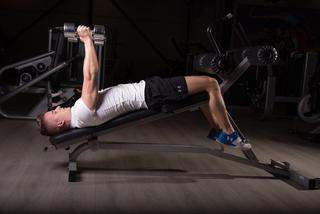
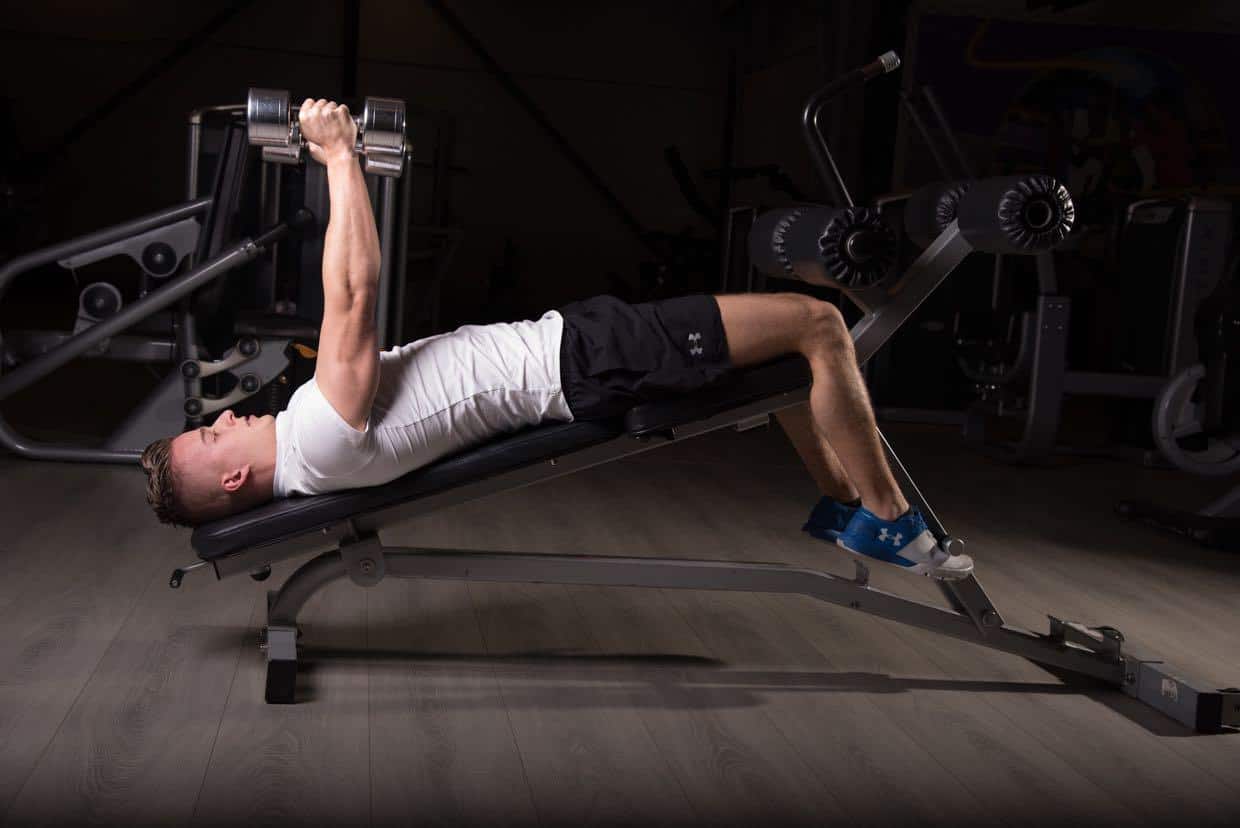
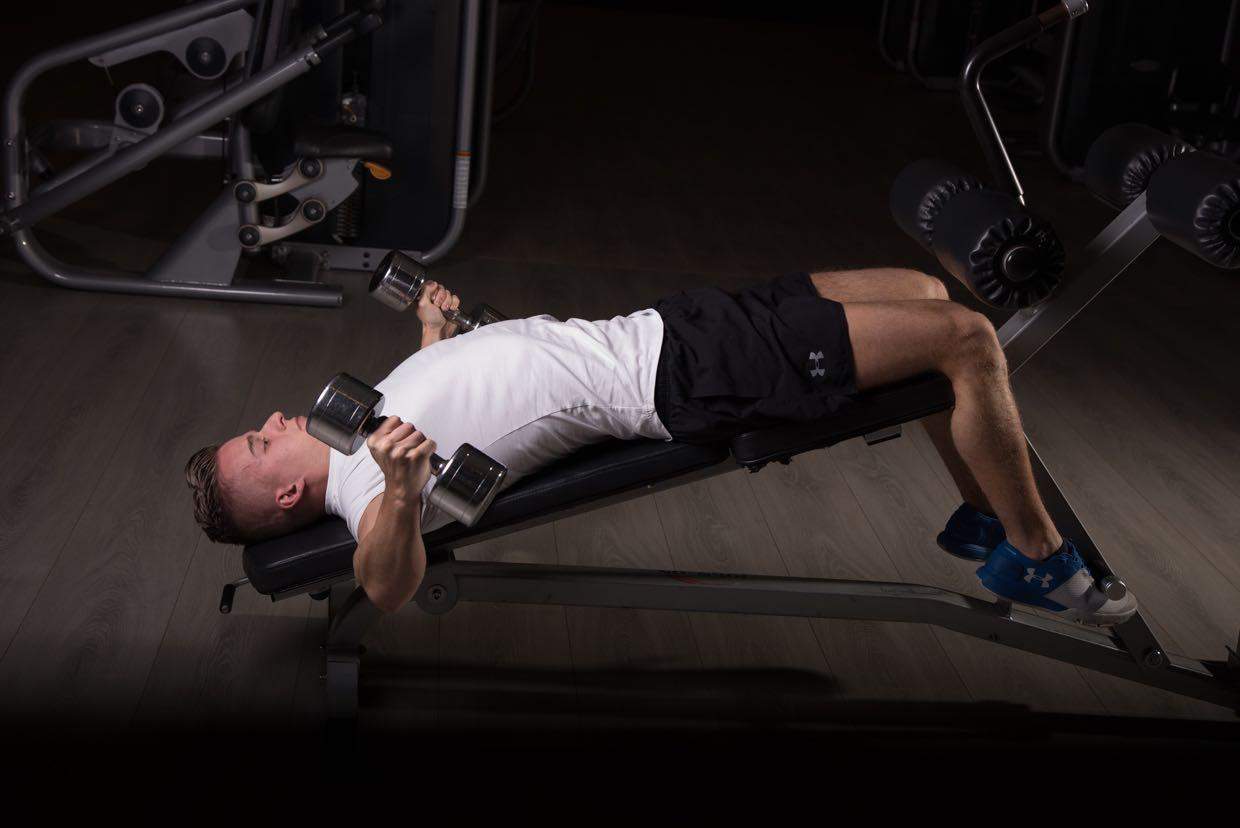
Dumbbell Decline Fly execution
-
1
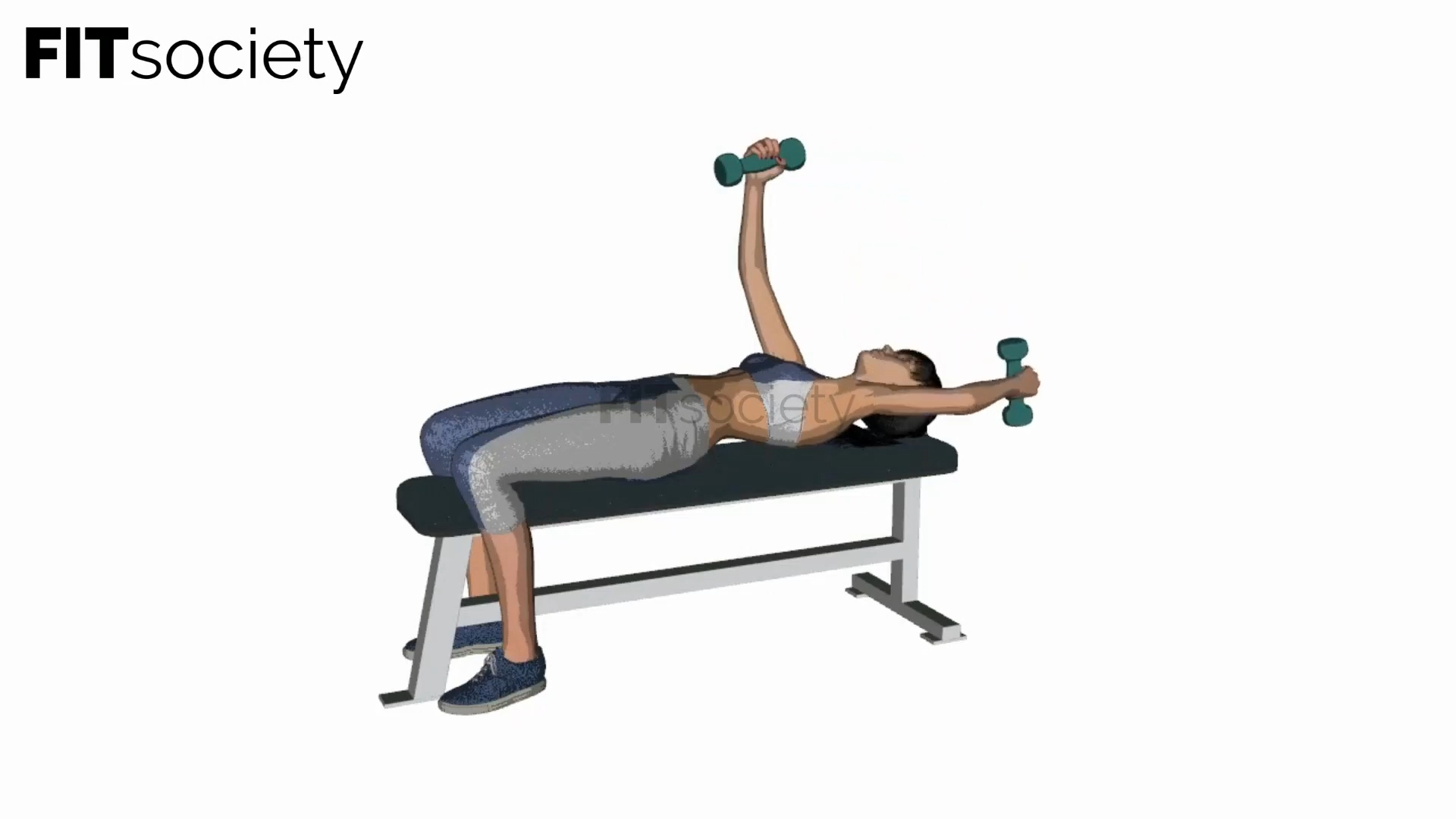
Move your arms out to the sides as if you want to embrace someone. Depending on your shoulder mobility, your hands finish slightly in front of or beside your torso. Because of the bend in your arms, your elbows are slightly farther toward the floor.
-
2
Bring your hands back together as if embracing a (large) person.
Dumbbell Decline Fly
Active muscles:
- Pectoralis major
- Anterior deltoid
- Serratus anterior
- Coracobrachialis
Stabilizing muscles:
- Rotator cuff (stabilizing shoulder muscles, supraspinatus, subscapularis, teres major, teres minor)
- Biceps brachii
- Serratus
- Trapezius
- Triceps brachii
- Latissimus dorsi
- Core muscles
Dumbbell Decline Fly setup
- Choose dumbbells of the appropriate weight for the desired number of repetitions.
- Check the angle of the bench.
- Sit at the end of the decline bench with the dumbbells upright on your knees.
- Make sure the tops of your feet are in contact with the foot pad.
- Lie back.
- Keep your hands in a pronated position (thumbs pointing toward your face). Keep your elbows close to your sides.
- Press both arms straight out (toward the center of your abdomen and chest). Maintain a slight bend in your arms. This is your starting position.
Dumbbell Decline Fly technique
Having a partner hand you the weights for the exercise and take them from you afterward can be very helpful with the downward-sloping bench.
The decline position may take some getting used to. This is especially true when the arms are (almost) straight and you bring them upward in the same line as on a flat bench. Because of the tilted position, gravity pulls the dumbbells not only downward but also backward. The (almost) straight arms should be perpendicular to the floor, not perpendicular to the torso. Therefore, direct them more toward the abdomen than toward the chest.
One of the most common mistakes in this exercise is bending and straightening the arms. Do not straighten your arms when bringing your hands backward; keep them under tension. This prevents you from having to bend them extra again on the way forward, thereby preventing excessive engagement of the biceps and their (distal) attachment.
Another common mistake is intending to perform a dumbbell fly but turning it into a dumbbell chest press. The hands then begin with the palms facing the feet instead of each other. The movement itself is then more of a forward push, as in the bench press, rather than an embracing movement.
Keep your elbows below shoulder level in the starting and ending positions. This prevents excessive engagement and a shoulder position prone to injury.
Do not bring your elbows too far back at the beginning and end of the movement. They should not come far beyond the torso. A safe starting point is bringing them to the torso. Depending on your shoulder mobility, you can move slightly farther back for a greater range of motion.
Alternatives
- Dumbbell fly (flat bench)
- Dumbbell incline fly
- Cable seated fly
- Cable lying fly
Run your fitness business with more structure
- Planning, member management and coaching in one platform
- Built for coaches, studios and gyms
- Fewer separate tools, more overview