Weighted Pull-Ups
Pull-ups are a very effective way to train the back muscles using body weight as resistance. For some people, however, body weight is no longer sufficient to provide the appropriate resistance. For example, when you can perform more than 20 repetitions with your body weight while aiming to build muscle mass or develop maximal strength. In that case, you want to perform fewer repetitions with more weight.
The easiest way is with a so-called dipping belt. You wear this around your waist with one or more weight plates attached to the chain. You do not need to place the chain tightly around your waist. Gravity keeps it resting against your lower back.
However, not everyone has a dipping belt, and one is not available in every gym. An alternative is to use a short bar with a weight plate hanging from it. You then rest the bar in the backs of your knees.
Execution with bar and weight plate:
If you are going to perform pull-ups with extra weight, you already know how regular pull-ups are performed. This explanation is therefore limited to working with the extra weight using the bar, as this may prove difficult the first time.
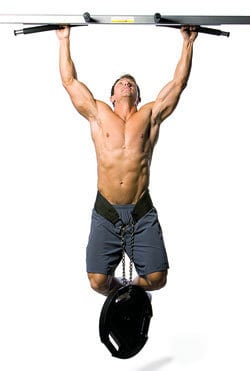
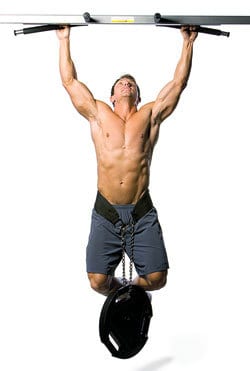
Weighted pull-up execution
-
1
Take a short bar normally used in a cable station (for example, for triceps pressdowns or cable biceps curls).
-
2
Take a weight plate of the desired weight and slide it to the center of the bar so that the whole setup resembles an alternative ab roller.
-
3
Stand ready with the bar and weight plate at the place where you want to perform your pull-ups.
-
4
Using one hand, bring the bar with the weight plate behind you and place it against the backs of your knees. Make sure it is actually pressed against the knee hollows. The weight plate should then be vertical between your knees.
-
5
Now lift one foot backward and bring it toward your glutes so that the bar is clamped in place.
-
6
Now move into your starting position. Depending on what you are pulling yourself up on, this may prove difficult. If you do this on an elevated platform, you will now need to place yourself on the platform using your hands in a dip movement and supporting yourself on one leg.
-
7
Grasp the pull-up rack with one hand, then with the other.
-
8
Your legs are now free, and you can hang, after which you immediately bring your other foot backward toward your glutes.
-
9
Cross your feet over each other so that the bar and weight plate are secured.
-
10
Begin the pull-up.
Weighted pull-ups
Primary muscles:
- Latissimus dorsi (the large back muscle)
- Trapezius (trapezius muscle, especially the lower part)
- Deltoids (the deltoid shoulder muscle, especially the rear part)
- Rhomboids (diamond-shaped muscles beneath the trapezius)
- Biceps brachii, brachialis, and brachioradialis (elbow flexion)
- Rotator cuff (stabilizing shoulder muscles: supraspinatus, subscapularis, teres major, and teres minor)
Weighted pull-up technique
This method of adding weight is very practical because you can perform it in almost any gym. The weight is also easier to control than when you try to clamp a dumbbell between your lower legs. With heavier weights, the load on the hamstrings can become too great a distraction from the exercise. A dipping belt therefore remains the best option.
Alternatives
- Lat pulldown
- Wide-grip pull-ups
Run your fitness business with more structure
- Planning, member management and coaching in one platform
- Built for coaches, studios and gyms
- Fewer separate tools, more overview