Walk Out
Although the exercise is listed here under hamstrings, it is a full-body (bodyweight) exercise. The hamstrings mainly work together with the glutes and lower back during the very last part of the exercise, which is comparable to a straight-leg deadlift. Therefore, it is a relatively small part of the exercise that targets these muscles, and you perform it using your body weight. There are therefore more suitable exercises for specifically training these muscles.
If you are looking for an exercise that works both the lower and upper body, the walk-out is an option. While walking forward and backward on your hands, the shoulders, chest, and arm muscles are primarily engaged. During this movement, the core muscles are active to stabilize the body.
The walk-out can also be performed with a push-up variation, which engages the chest and triceps even more.
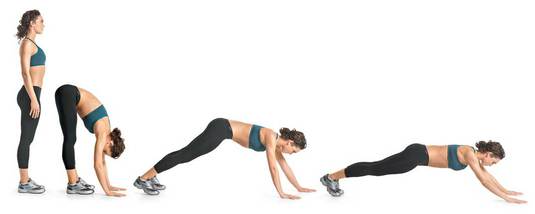
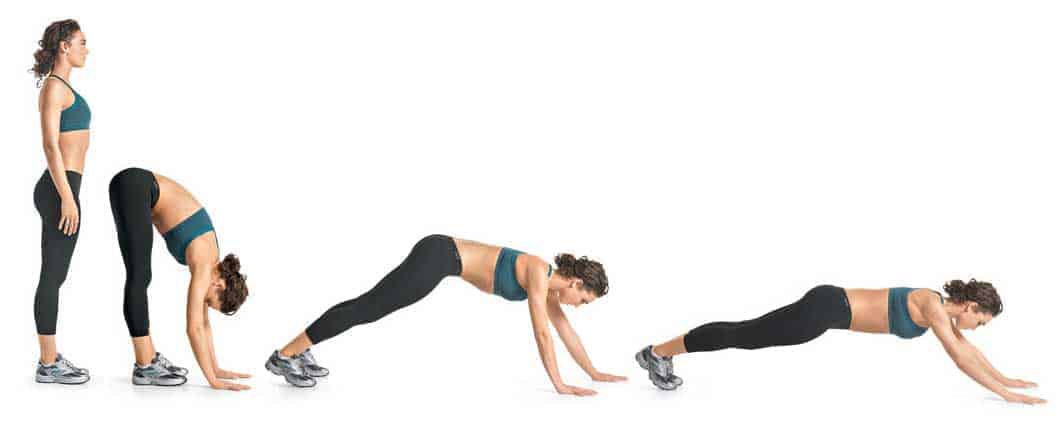
Walk-out execution
-
1
Stand upright
-
2
Bend forward with your legs as straight as possible to place your hands on the floor as close to your feet as possible. If your hamstrings are too stiff for this, you can start slightly farther forward and on your fingertips.
-
3
Now walk your hands forward step by step until your hands are directly under your shoulders or even farther toward, or beyond, your head. Your abdominal muscles will be especially heavily challenged here.
-
4
Now walk yourself back step by step until your hands are again positioned directly in front of your feet.
-
5
Straighten yourself from 'the top of your back' again. First straighten the back itself from its forward-curved position, and only then raise it from the hips until you are standing upright.
Walk-out
Muscles involved:
Legs:
- Quadriceps (vastus lateralis, vastus medialis, vastus intermedius, and rectus femoris)
- Hamstrings
- Sartorius
Glutes:
- Gluteus maximus, medius, and minimus
Pelvis:
- Iliacus (hip flexor)
- Psoas major (hip flexor)
Calves:
- Gastrocnemius
- Soleus
Abdomen:
- Rectus abdominis (rectus abdominis muscle)
- External oblique (external oblique muscle)
- Internal oblique (internal oblique muscle)
- Transversus abdominis (transverse abdominal muscle, 'corset muscle')
(Lower) back and spine:
- Erector spinae
- Lumbar multifidus
- Quadratus lumborum
Back and neck:
- Trapezius
- Rhomboids
- Levator scapulae
Shoulders:
- Deltoids
- Rotator cuff (subscapularis, supraspinatus, infraspinatus, and
- teres minor).
Chest:
- Pectoralis major
- Pectoralis minor
Arms:
- Biceps
- Triceps
Walk-out technique
Instead of finishing with straight arms while moving forward, you can also perform a push-up at this point to engage the chest and triceps more. If you want to place more emphasis on your abdominal muscles, walk as far forward as possible. Your abdominal muscles will then have to work hard to keep your upper body straight and prevent your hips from dropping.
Run your fitness business with more structure
- Planning, member management and coaching in one platform
- Built for coaches, studios and gyms
- Fewer separate tools, more overview