Trap Bar Squat
The squat is one of the best-known exercises for the legs. It is a compound exercise; an exercise that involves multiple joints and muscle groups. This is also evident from the long list of muscles involved, as mentioned above.
There can be many differences in the way the squat is performed, such as with or without added weight, the type of weight, and where this weight is placed. The trap bar is a special bar that makes it possible to take the exact midpoint as the position, instead of a barbell that must be placed in front of or behind the body.
By lifting the trap bar from underneath, the movement is actually more of a trap bar deadlift. This is also what the exercise is often called. This is partly because there is also a variation in which the trap bar is held at shoulder height, in which case it is more of a trap bar squat.
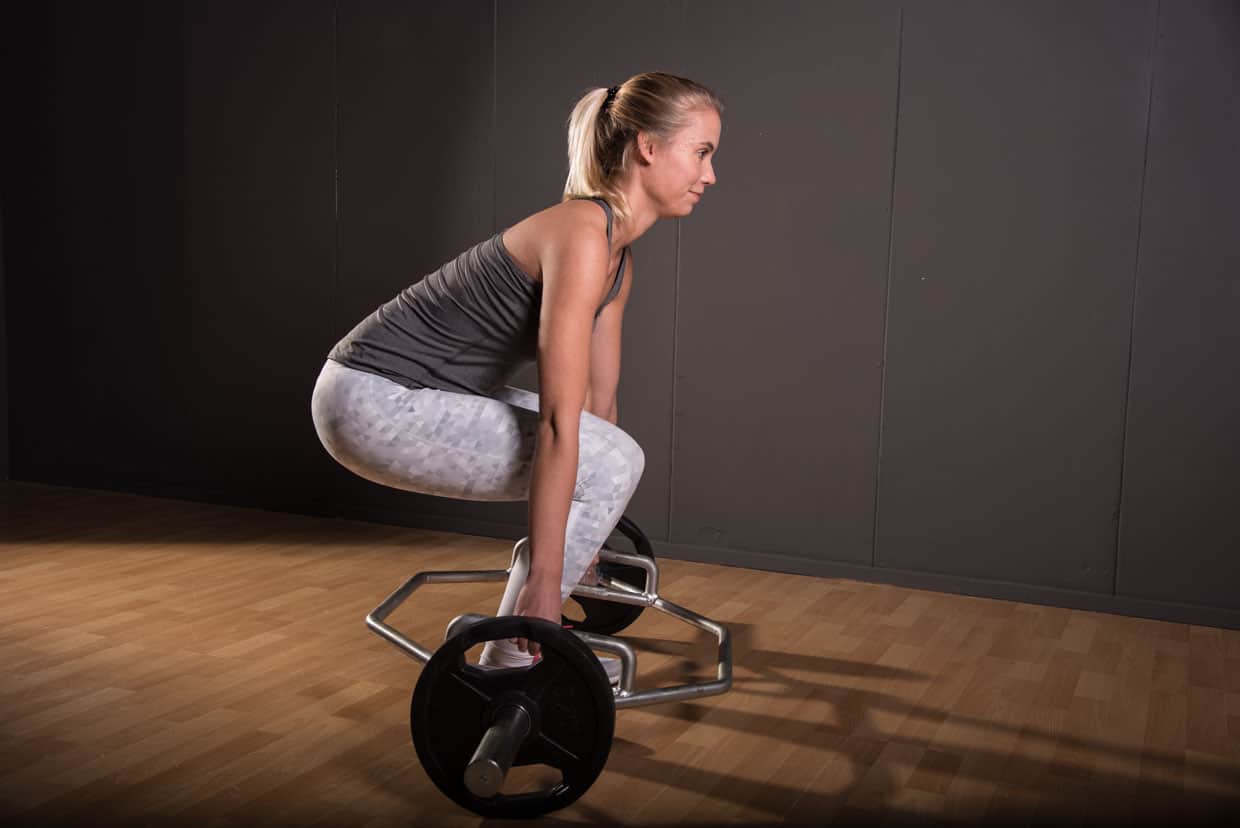
Trap bar squat
Muscles involved:
Legs:
- Quadriceps (vastus lateralis, vastus medialis, vastus intermedius, and rectus femoris)
- Hamstrings
Glutes:
- Gluteus maximus, medius, and minimus
Pelvis:
- Iliacus (hip flexor)
- Psoas major (hip flexor)
Calves:
- Gastrocnemius
- Soleus
Abdomen:
- Rectus abdominis (rectus abdominis muscle)
- Obliquus externus abdominis (external oblique muscle)
- Obliquus internus abdominis (internal oblique muscle)
- Transversus abdominis (transverse abdominal muscle, 'corset muscle')
Lower back and spine:
- Erector spinae
- Lumbar multifidus
- Quadratus lumborum
How to perform the trap bar squat
- Stand with your feet approximately shoulder-width apart in the middle of the trap bar.
- Lower yourself by bending your knees and grasp the trap bar.
- Push yourself upward by forcefully pressing your feet into the floor to reach the starting position.
- Lower yourself slowly as if sitting on a chair that could be pulled away at any moment. Finish at the point where the tops of your thighs are parallel to the floor.
- Push yourself upward by forcefully pressing your feet into the floor again.
Trap bar squat technique
Safety
- Increase the weight gradually. The squat involves multiple large muscle groups and joints, all of which must be prepared for the required exertion.
Technical execution:
There is much discussion about the correct technical execution of the different forms of the squat. Many studies have examined the involvement of different muscles and the stress on the different joints.
How deep should you squat, and how wide should your feet be? How far should you lean forward from the hips/lower back, and how should you hold the barbells (low or at the front of the shoulders as in a dumbbell front squat)?
For weightlifters, there are rules that answer some of these execution questions based on regulations. In other cases, however, the purpose of the squat and the dimensions and mobility of the person performing it may result in different executions.
A coach should be able to explain which execution is most suitable for you. On fitsociety.nl you can find several articles that discuss this in detail. For good background knowledge about the execution, we therefore refer you to these articles.
Five common mistakes while squatting
Weightlifting shoes: Benefits when squatting
Alternatives
- Smith machine squat
- Barbell back squat
- Dumbbell front squat
Run your fitness business with more structure
- Planning, member management and coaching in one platform
- Built for coaches, studios and gyms
- Fewer separate tools, more overview