Squat
The squat is one of the best-known exercises for the legs. It is a compound exercise; an exercise that involves multiple joints and muscle groups. This is also evident from the long list of muscles involved, as listed above.
There can be many differences in how the squat is performed, such as with or without added weight, the type of weight, and where the weight is placed. A “normal” squat usually refers to the barbell back squat, squatting with the barbell placed behind the head. This is the most popular form of squatting and one of the three powerlifting exercises, alongside the deadlift and bench press.
Squat execution
-
1
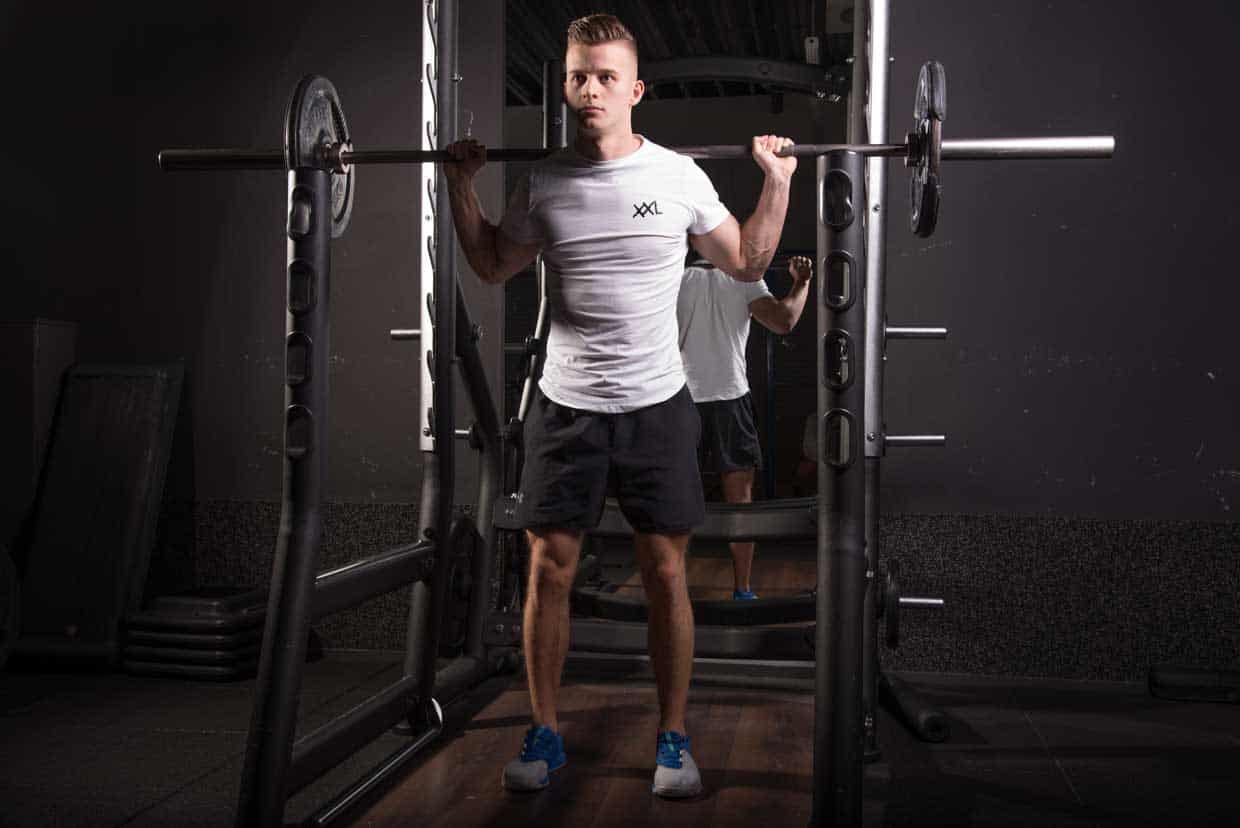
Place the barbell with the selected weight in the squat rack hooks (secure the plates). Choose a height at which you can easily step out with the weight, approximately level with the bottom of the chest (see “Safety”!).
-
2
Step under the barbell and place it across the upper back or at neck level (see below).
-
3
Make sure you are positioned exactly in the middle of the barbell. Position your head in the center and place your hands parallel on the barbell by looking at the markings on the barbell.
-
4
Stand with your feet approximately shoulder-width apart.
-
5
Push yourself upward to lift the barbell out of the hooks and carefully take a few small(!) steps backward to give yourself room for the exercise.
-
6
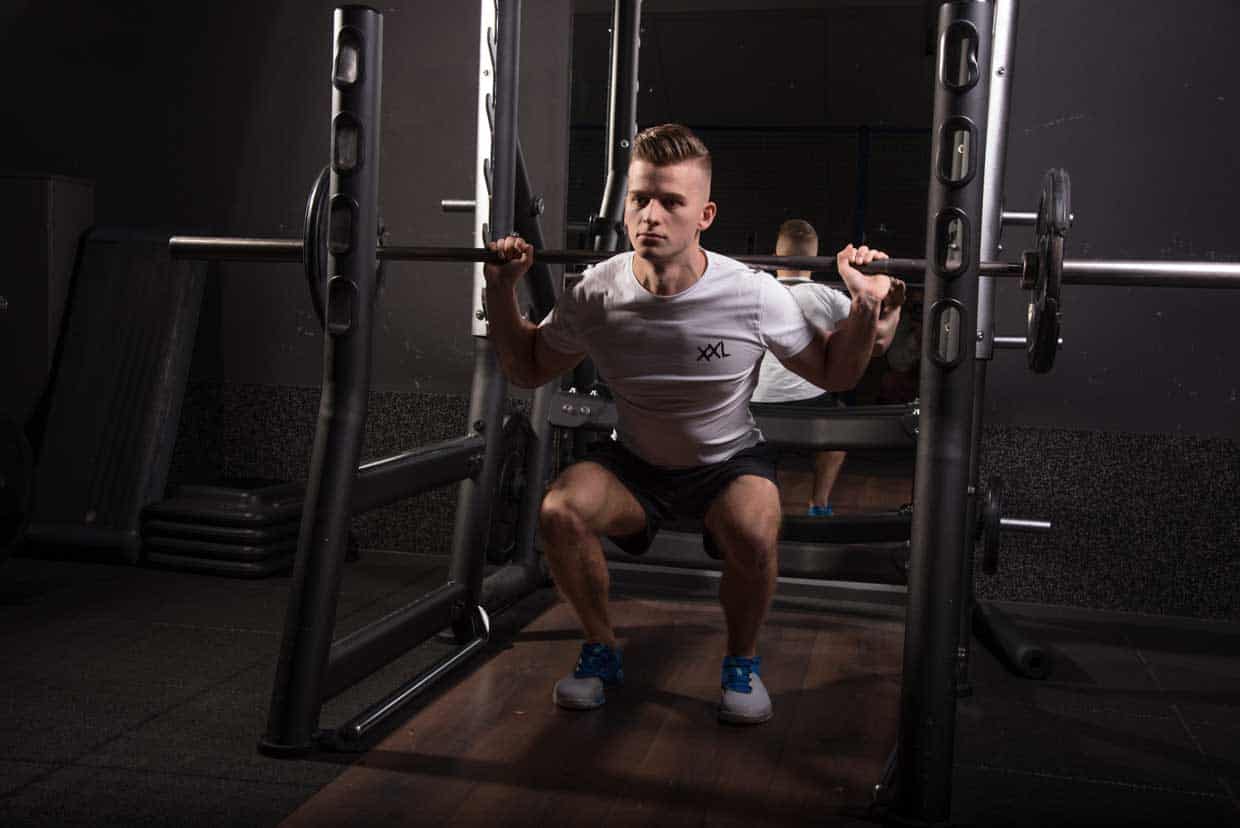
Lower yourself slowly as if sitting on a chair that could be pulled away at any moment. Finish at the point where the (top of the) legs are parallel to the floor.
-
7
Push yourself upward by pressing your feet firmly into the floor.
(Barbell Back) Squat
Muscles involved:
Legs:
- Quadriceps (vastus lateralis, vastus medialis, vastus intermedius, and rectus femoris)
- Hamstrings
Glutes:
- Gluteus maximus, medius, and minimus
Pelvis:
- Iliacus (hip flexor)
- Psoas major (hip flexor)
Calves:
- Gastrocnemius
- Soleus
Abdomen:
- Rectus abdominis (straight abdominal muscle)
- External oblique (external oblique abdominal muscle)
- Internal oblique (internal oblique abdominal muscle)
- Transversus abdominis (transverse abdominal muscle, “corset muscle”)
(Lower) back and spine:
- Erector spinae
- Lumbar multifidus
- Quadratus lumborum
Squat technique
Safety
- Make sure the plates are secured.
- Do not place the hooks supporting the barbell too high. On a final heavy repetition, you should not have to stand completely upright to return it to the hooks.
- Ensure there is a possible resting point (the crossbars of the rack) for the barbell, at a point slightly lower than where it reaches its lowest position. It is reassuring to know that you can push yourself to the limit without worrying about the weight on your neck. Therefore, stand inside the squat rack and not in front of it.
- Do not take large steps backward with the barbell at the start of the exercise; take small steps instead.
- Increase the weight gradually. The squat involves several large muscle groups and joints, all of which must be prepared for the required effort.
Technical execution
There is much discussion about the correct technical execution of the different forms of the squat. Many studies have examined the involvement of different muscles and the load on different joints.
How deep should you squat, and how wide should your feet be? How far do you bend forward from the hips/lower back, and where do you place a barbell, in the neck or lower on the upper back? A higher barbell position, for example, also causes it to move slightly farther forward. As a result, you do not have to lean as far forward to remain balanced, and you therefore work less from the lower back.
For weightlifters, there are rules that answer some of these questions about execution based on regulations. In other cases, however, the purpose of the squat and the dimensions and mobility of the person performing it can result in different executions.
A coach should be able to explain which execution is most suitable for you. At fitsociety.nl you can find several articles that discuss this in detail. For good background knowledge about the execution, we therefore gladly refer you to these articles.
Five common mistakes during squatting
Weightlifting shoes: Benefits when squatting
Alternatives
- Smith machine squat
- Front squat
- Dumbbell squat
Run your fitness business with more structure
- Planning, member management and coaching in one platform
- Built for coaches, studios and gyms
- Fewer separate tools, more overview