Barbell Split Squat
The barbell split squat can be compared to lunges. The difference is that you do not step forward or back. You first perform a full set with one leg in front and then repeat it with the other leg. This can make proper execution easier. After all, you only need to concentrate on pushing yourself up while maintaining your balance becomes easier.
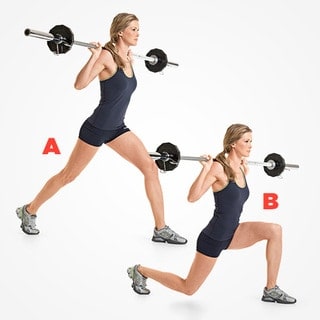
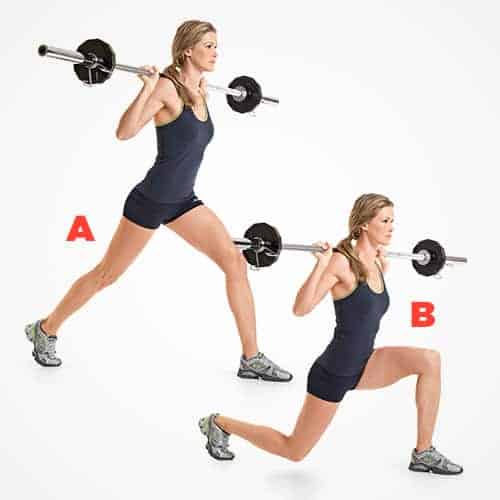
Barbell Split Squat Execution
-
1
Place the barbell with the selected weight in the squat rack’s hooks (secure the plates). Choose a height at which you can easily step out with the weight (approximately at the level of the bottom of the chest; see ‘Safety’!).
-
2
Step under the barbell and place it across your upper back or at neck level (see below).
-
3
Make sure you are positioned exactly in the middle of the barbell. Place your head in the center and position your hands evenly on the barbell (by looking at the markings on the barbell).
-
4
Stand with your feet approximately shoulder-width apart.
-
5
Push yourself up to lift the barbell out of the hooks and carefully take a few small(!) steps backward to give yourself room for the exercise.
-
6
Now place one foot forward or backward to assume your starting position. Keep your feet shoulder-width apart for sufficient balance. Also step far enough forward or backward. When you reach the bottom position of the exercise, both knees should form a 90-degree angle.
-
7
Begin the exercise by lowering yourself under control until your rear knee almost touches the ground.
-
8
Push yourself straight up from your front leg until you cannot go any farther (the point at which you would otherwise have to bring your rear leg forward).
Barbell Split Squat
Targeted muscles:
Legs:
- Quadriceps (vastus lateralis, vastus medialis, vastus intermedius, and rectus femoris)
- Hamstrings
Glutes:
- Gluteus maximus, medius, and minimus
Pelvis:
- Iliacus (hip flexor)
- Psoas major (hip flexor)
Calves:
- Gastrocnemius
- Soleus
Abdominals:
- Rectus abdominis (straight abdominal muscle)
- Obliquus externus abdominis (external oblique abdominal muscle)
- Obliquus internus abdominis (internal oblique abdominal muscle)
- Transversus abdominis (transverse abdominal muscle, ‘corset muscle’)
Lower back and spine:
- Erector spinae
- Lumbar multifidus
- Quadratus lumborum
Barbell Split Squat Technique
Safety
- Make sure the plates are secured.
- Ensure there is a possible resting point (the rack’s safety bars) for the barbell at a position slightly lower than where it reaches its lowest point. It is reassuring to know that you can go all out without worrying about the weight on your neck. Therefore, stand inside the squat rack, not in front of it.
Split Squat vs. Lunge
Because you only come up and do not step forward or backward, it takes less effort to maintain your balance than with lunges. This can make it easier to focus entirely on the muscle contractions. It also becomes easier to keep your torso upright. However, this means you perform a smaller range of motion than with lunges.
Alternatives
- Smith Machine Squat
- Front Squat
- Dumbbell Squat
Run your fitness business with more structure
- Planning, member management and coaching in one platform
- Built for coaches, studios and gyms
- Fewer separate tools, more overview