Barbell Split Jerk
The split jerk is the final part of an Olympic weightlifting movement (clean and jerk). This part of the exercise primarily targets the stabilizing capacity of the shoulder joint. The lower body acts to get the weight upward, while the upper body then has to stabilize the weight.
In addition to the deltoid itself, the stabilizing muscles of the shoulder joint do a great deal of work. These include the rotator cuff muscles, as well as the trapezius.
Core muscles such as the abdominal muscles and the muscles along the spine keep the torso under control. The glutes and quadriceps push you upward from the lowest point of the exercise.
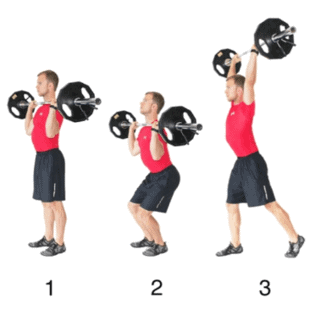
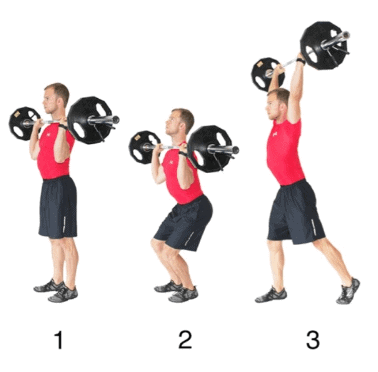
Barbell split jerk execution
-
1
Bend slightly through the legs (‘approximately a quarter squat’)
-
2
Drive yourself and the barbell straight upward.
-
3
When your body reaches its highest point, move one foot backward with the leg nearly straight while placing the other foot in front of you in one movement. The front foot is flat on the floor, and the rear foot is supported on the ball of the foot. During this movement, your body shifts slightly forward. Meanwhile, extend your arms to keep the weight at its highest point.
-
4
The weight is now supported by the extended arms with the barbell directly above the shoulders.
-
5
Now step back with the front leg and bring the rear leg in to place both feet next to each other again (hip- or shoulder-width apart). The order does not matter. The most important thing is to move the upper body as little as possible forward or backward during this movement.
-
6
Lower the barbell and let it rest again on the upper chest and shoulders.
Barbell split jerk
Muscles involved:
Shoulder joint:
teres minor)
Arms
Abdomen:
(Lower) back and spine:
Legs:
Barbell split jerk setup
The easiest way to get into the starting position is to place the barbell in the squat rack slightly below chest height. However, you can also begin with the so-called clean (as in weightlifting). In that exercise, you bring the barbell upward as follows:
- Stand directly in front of the barbell with your feet hip- or shoulder-width apart.
- Lower through your legs as for a deadlift.
- Grasp the barbell with your hands slightly wider than shoulder-width apart.
- Stand up as in an explosive deadlift.
- As you stand up, pull the barbell upward in the same movement so that it moves from hip height to (upper) abdominal height.
- As the barbell is brought to this height, lower through your legs again so that the upper chest comes underneath the barbell. Your hands rotate around the barbell during this movement so that they can support it from underneath. The barbell thus comes to rest on the upper chest and front of the shoulders, with the palms facing upward and the fingers pointing backward.
- Lower slightly further in the same movement as in a (half) front squat.
- Stand up as in a front squat.
Barbell split jerk technique
Olympic weightlifting naturally has a long history. The split jerk is the final part of the so-called clean and jerk. This exercise has gained a great deal of popularity in recent years, partly or primarily due to the rise of CrossFit, in which the clean and jerk is often trained.
There are several variations. In the split jerk, one foot moves forward while the other moves backward. Among other things, this can make it easier to stabilize the weight forward and backward.
In the squat jerk, the feet remain next to each other (hip-/shoulder-width apart). To get underneath the barbell with extended arms, you must lower deeply through the legs as in a full squat. This requires more leg strength and high shoulder mobility (because in the squat you are bent forward, but must keep your arms straight overhead). Because you lower so deeply, you do have more time to get underneath the barbell.
In the power jerk, the feet also remain next to each other, but you lower much less deeply (more like a half squat). This therefore requires somewhat less shoulder mobility. However, to get underneath the barbell with extended arms, you must bring it farther upward. This requires more explosive strength, hence the name of this variation.
With the split jerk, you get relatively low without having to lean far forward or bend deeply through the knees. For most people, this is therefore the easiest or most achievable variation.
Alternatives
Run your fitness business with more structure
- Planning, member management and coaching in one platform
- Built for coaches, studios and gyms
- Fewer separate tools, more overview