Trap Bar Romanian Deadlift
The deadlift is also known as the king of all exercises. Looking at the list of muscles involved above, you can infer why.
- The calf muscles bring the lower legs, which extend forward, back into alignment above the ankles when you stand up and also provide stabilization throughout the entire movement.
- The quadriceps work hard to extend the knees.
- The hamstrings and glutes work to bring the upper body upright by aligning the thighs and back.
- The erector spinae, which runs along the spine, helps straighten the back.
- The abdominal muscles mainly provide stabilization (the rectus abdominis acting as an antagonist to the erector spinae and the oblique abdominals braking lateral tilting).
- The muscles in the upper back and neck engage to pull the shoulders upward and backward.
The Romanian deadlift falls between a normal deadlift and the straight leg deadlift. In the straight leg deadlift , the legs remain almost straight, so the quadriceps are barely engaged (only to stabilize). The hamstrings are stretched more and therefore loaded more. You also bend farther forward from the back, which places more load on the lower back and glutes.
In the Romanian deadlift, the knees are bent slightly more, but not as far as in a normal deadlift. As a result, the quadriceps are loaded slightly less than in a normal deadlift, but not relieved as much as during the straight leg deadlift.
This variation uses the trap bar. This is a special bar that allows you to position yourself precisely in the center instead of using a barbell that must be positioned in front of or behind the body.
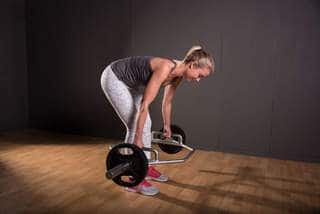
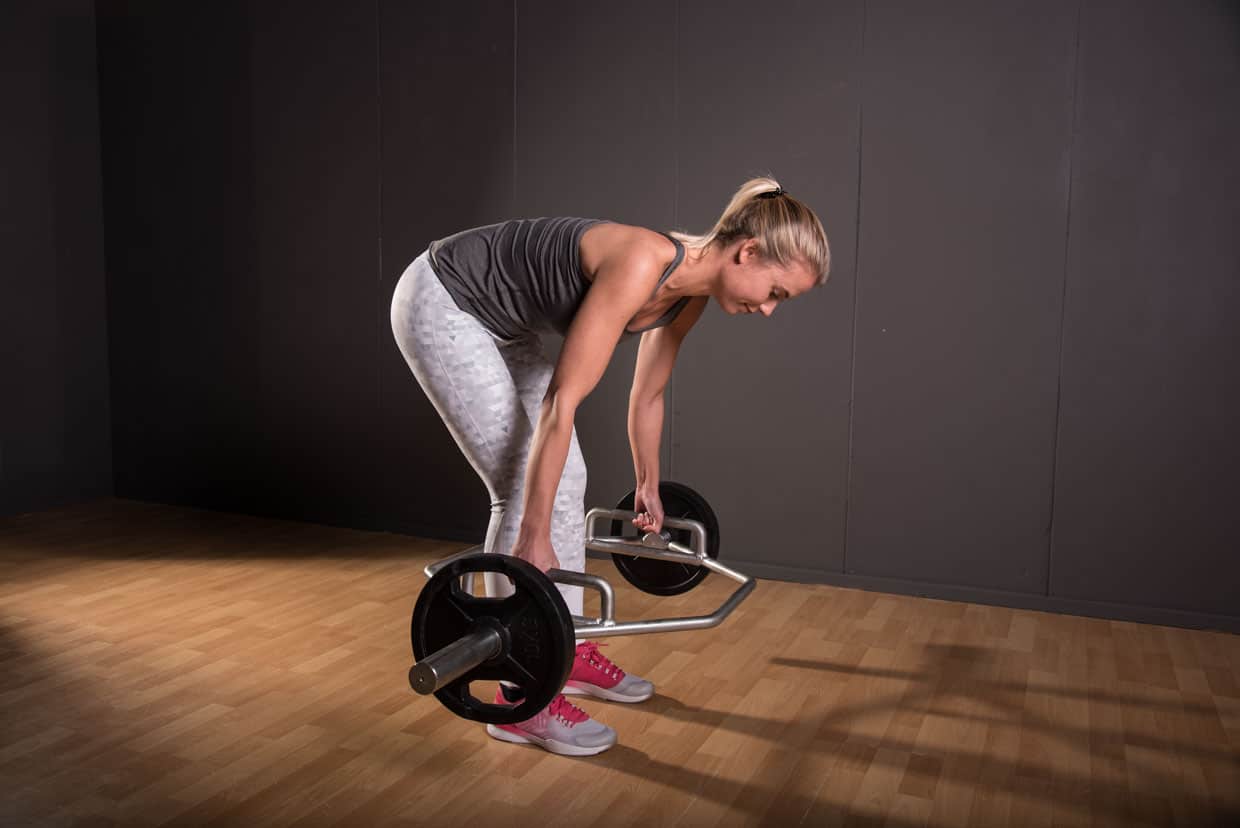
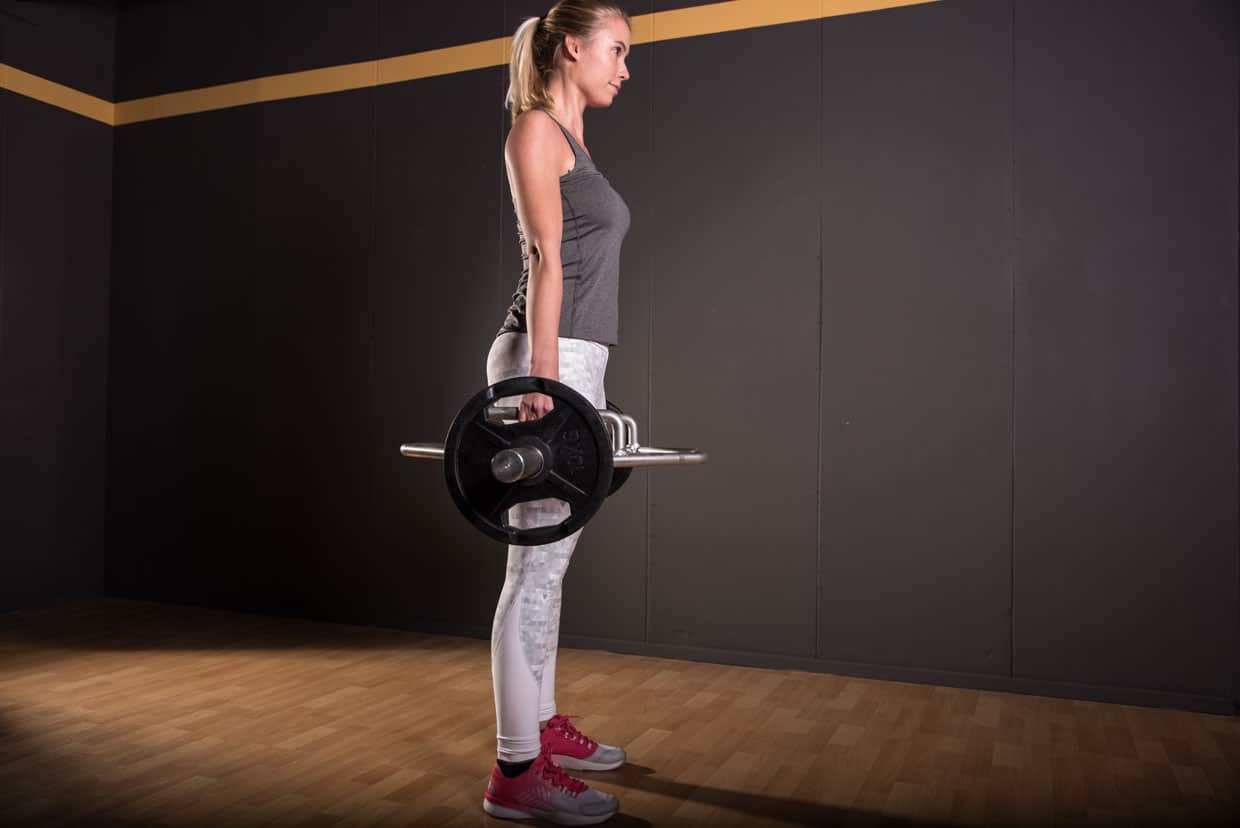
Trap bar Romanian deadlift execution
-
1
Stand with your feet approximately shoulder-width apart in the center of the trap bar.
-
2
Lower yourself by bending your knees and grip the trap bar.
-
3
Push yourself up by pressing your feet forcefully into the floor to reach the starting position.
-
4
Move your glutes backward and your chest forward. Keep your back slightly more arched than its natural curvature. Allow your knees to bend slightly, but not as far as in a normal deadlift (approximately halfway).
-
5
Continue until the plates almost touch the floor (or until you feel the greatest possible stretch in the hamstrings).
-
6
Raise yourself again by pushing your pelvis forward and pulling your back up (see notes). Continue until your back is upright with its natural curve. Just as when you normally stand upright. Do not extend it too far and therefore do not create an excessive arch in your back at the end of the movement (no hyperextension).
-
7
Repeat.
Trap bar Romanian deadlift
Muscles involved:
Legs:
- Hamstrings
- Quadriceps (vastus lateralis, vastus medialis, vastus intermedius and rectus femoris)
Glutes:
- Gluteus maximus, medius and minimus
Pelvis:
- Iliacus (hip flexor)
- Psoas major (hip flexor)
Calves:
- Gastrocnemius
- Soleus
Abdomen:
- Rectus abdominis (straight abdominal muscle)
- Obliquus externus abdominis (external oblique abdominal muscle)
- Obliquus internus abdominis (internal oblique abdominal muscle)
- Transversus abdominis (transverse abdominal muscle, 'corset muscle')
(Lower) back and spine:
- Erector spinae
- Lumbar multifidus
- Quadratus lumborum
Back and neck:
- Trapezius
- Rhomboideus
- Levator scapulae
Trap bar Romanian deadlift technique
The Romanian deadlift places more emphasis on the hamstrings, lower back and glutes than the normal deadlift.
The farther forward you tilt, the greater the stretch on the hamstrings. This also applies to the degree to which you keep the legs straight. To avoid bending the legs farther than desired and to avoid falling forward, move your glutes backward from the ankles (and not the knees).
Alternatives
- Barbell Romanian deadlift
- Barbell deadlift
- Barbell straight leg deadlift
- Dumbbell straight leg deadlift
Run your fitness business with more structure
- Planning, member management and coaching in one platform
- Built for coaches, studios and gyms
- Fewer separate tools, more overview