Stiff-Leg Deadlift
The deadlift is also known as the king of all exercises. Looking at the list of involved muscles above, you can infer why.
- The calf muscles bring the lower legs, which extend forward, back into alignment above the ankles when you stand up and also provide stability throughout the entire movement.
- The quadriceps work hard to extend the knees.
- The hamstrings and glutes work to bring the upper body upright by aligning the thighs and back.
- The erector spinae, which runs along the spine, helps straighten the back.
- The abdominal muscles mainly provide stability (the rectus abdominis acting as an antagonist to the erector spinae and the oblique abdominal muscles acting as a brake against lateral tilting).
- The muscles in the upper back and neck engage to pull the shoulders up and back.
In the straight-leg deadlift, also called the stiff-legged deadlift, the emphasis is different. The legs remain almost straight, so the quadriceps are barely engaged (only to stabilize). The hamstrings are stretched more and therefore loaded more. You also bend farther forward from the back, placing more load on the lower back and glutes.
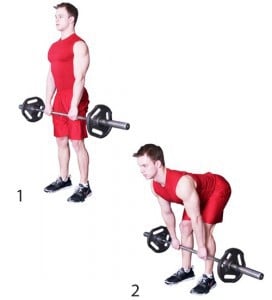
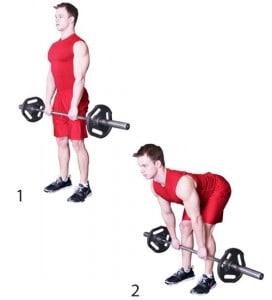
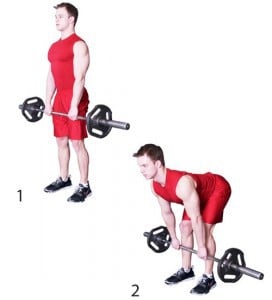
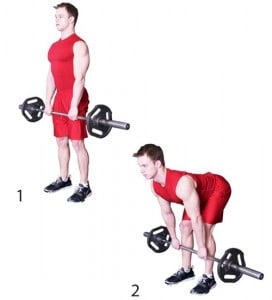
Barbell straight-leg deadlift execution
-
1
Stand with the barbell in your hands, both hands shoulder-width apart. Use the markings to ensure that your hands are evenly positioned on the bar. For a better grip, you can grasp the bar with one hand with the palm facing backward and the other with the palm facing forward.
-
2
Move your glutes backward and your chest forward. At the same time, make your back slightly more arched than its natural curvature. Keep your knees almost straight.
-
3
Continue until you feel as much stretch as possible in the hamstrings.
-
4
Raise yourself again by pushing your pelvis forward and straightening your back (see notes). Continue until your back is upright with its natural curve. Just as when you normally stand upright. Do not extend it too far and therefore do not create an exaggerated curve in your back at the end of the movement (no hyperextension).
-
5
Repeat.
Barbell straight-leg deadlift
Muscles involved:
Legs:
- Hamstrings
- Quadriceps (vastus lateralis, vastus medialis, vastus intermedius, and rectus femoris)
- Sartorius
Glutes:
- Gluteus maximus, medius, and minimus
Pelvis:
- Iliacus (hip flexor)
- Psoas major (hip flexor)
Calves:
- Gastrocnemius
- Soleus
Abdomen:
- Rectus abdominis (straight abdominal muscle)
- Obliquus externus abdominis (external oblique muscle)
- Obliquus internus abdominis (internal oblique muscle)
- Transversus abdominis (transverse abdominal muscle, 'corset muscle')
(Lower) back and spine:
- Erector spinae
- Lumbar multifidus
- Quadratus lumborum
Back and neck:
- Trapezius
- Rhomboid
- Levator scapulae
Barbell straight-leg deadlift technique
The straight-leg deadlift is more comparable to a good morning than to a conventional deadlift. The emphasis is much more on the hamstrings, lower back, and glutes than on the quadriceps.
The farther you tilt forward, the greater the stretch in the hamstrings. The same applies to the extent to which you keep your legs straight. To keep your legs (almost) straight and avoid falling forward, move your glutes backward from the ankles (and not the knees).
Alternatives
- Barbell good morning
- Barbell deadlift
Run your fitness business with more structure
- Planning, member management and coaching in one platform
- Built for coaches, studios and gyms
- Fewer separate tools, more overview