Seated Machine Leg Curl
The leg curl is the only exercise that allows you to train the hamstrings (and the weaker sartorius) in isolation from other muscle groups. The hamstrings perform the function of bending the knee and are assisted by the weaker sartorius muscle.
In this variant, a machine is used on which you can perform the exercise while seated.
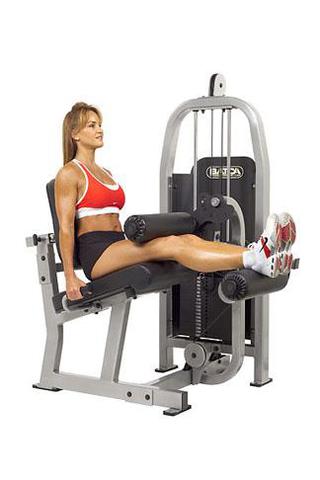
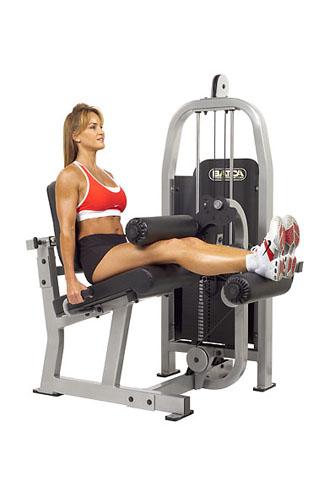
Seated leg curl execution
-
1
Bring your heels toward your glutes until you cannot go any further. Prevent your thighs from moving along with the movement by keeping them pressed against the thigh pad.
-
2
Hold the tension briefly.
-
3
Return your feet downward and forward in a controlled manner, stopping when your legs are almost straight.
Seated leg curl
Muscles involved:
Thighs:
- Hamstrings
- Sartorius
Calves:
- Gastrocnemius
Seated leg curl setup
- Adjust the backrest to the correct distance. Your knees should be level with the machine's pivot point.
- Adjust the foot pad to the correct height. It should be at ankle height or slightly higher.
Seated leg curl technique
Try to perform the exercise through the entire range of motion. Do not use excessive resistance or weight, causing you to complete only the final part of the exercise.
The position of your feet can affect the relative involvement of the calves and which part of the hamstrings is loaded most.
Foot position and hamstrings
Pointing your toes outward can place more emphasis on the outer hamstrings (biceps femoris). Pointing your toes inward places more emphasis on the two inner hamstring muscles (semimembranosus and semitendinosus).
This is due to the different attachment points (tibia and fibula).
Foot position and calves
The calf muscles consist of two different muscles, the gastrocnemius and soleus. The two heads of the gastrocnemius cross the knee joint and can therefore assist with bending the knee.
However, the position of your feet can affect the extent to which the gastrocnemius can assist. Just as an already lengthened muscle cannot deliver maximum effort, an already shortened muscle cannot deliver maximum effort. If, during the leg curl, you point your toes toward your knees or press them downward, the gastrocnemius cannot exert itself fully. Keep your feet in a neutral position (as when standing upright) to engage it maximally.
Seated vs. Lying and Standing
Whether you perform leg curls lying, standing, or seated makes a difference in the involvement of the different muscles that make up the hamstrings. The hamstrings consist of three muscles, one of which has two heads. That makes three muscles with four heads. At the bottom (distally), all three muscles cross the knee joint. At the top (proximally), however, only three of the four heads cross the hip joint. The fourth head is attached to the thigh, while the other three attach to the ischium. This means, among other things, that only this fourth head is not stretched when, for example, you lift your knee or try to touch your toes.
This fourth head is one of the two heads of the biceps femoris, the most laterally located hamstring muscle (and its outer head).
What does this mean?
In the seated variant, the two inner hamstring muscles and the inner head of the biceps femoris are already slightly stretched. As a result, they cannot exert themselves fully ('passive insufficiency'). The outer head of the biceps femoris is the only one that can, because it is not affected by flexion at the hip.
In the lying and standing positions, this is not the case, and the workload is distributed more evenly across all heads.
Alternatives
- Lying leg curl
- Standing leg curl
Run your fitness business with more structure
- Planning, member management and coaching in one platform
- Built for coaches, studios and gyms
- Fewer separate tools, more overview