Barbell Hip Thrust
The hip thrust is the exercise that requires the greatest engagement of the glutes. As with the glute bridge, you work the glutes, erector spinae, and hamstrings by bringing the back and legs into one line.
The hip thrust may be the exercise that has seen the greatest increase in popularity in recent years, due to growing interest among women in strength training in general and well-developed glutes in particular. While the squat was once mainly considered the go-to exercise for this, it is now clear, based on EMG measurements, that the hip thrust requires much greater engagement of the glutes. Other research has also shown that the hip thrust leads to greater glute growth than the squat. This may be because during the squat (and deadlift) tension is lost at the top of the movement, whereas it is maintained during the hip thrust. If more attractive, larger, and stronger glutes are your goal, the hip thrust should not be missing from your training program.
The hip thrust is similar to the glute bridge. The same muscle functions are performed. However, the hip thrust has two major advantages over the glute bridge.
First, the range of motion is greater. Because the back is supported at a higher point, the movement path is larger and places greater demands on the muscles involved.
In addition, the exercise can be performed more easily with heavy weight. In the glute bridge, the weight tends to roll downward toward your head because you finish in an inclined position. In the hip thrust, you bring the barbell to a horizontal position.
The only disadvantage of the hip thrust compared with the glute bridge is that it may take a little longer to get used to the position with your back against the bench. It may also take some practice to get into the starting position.
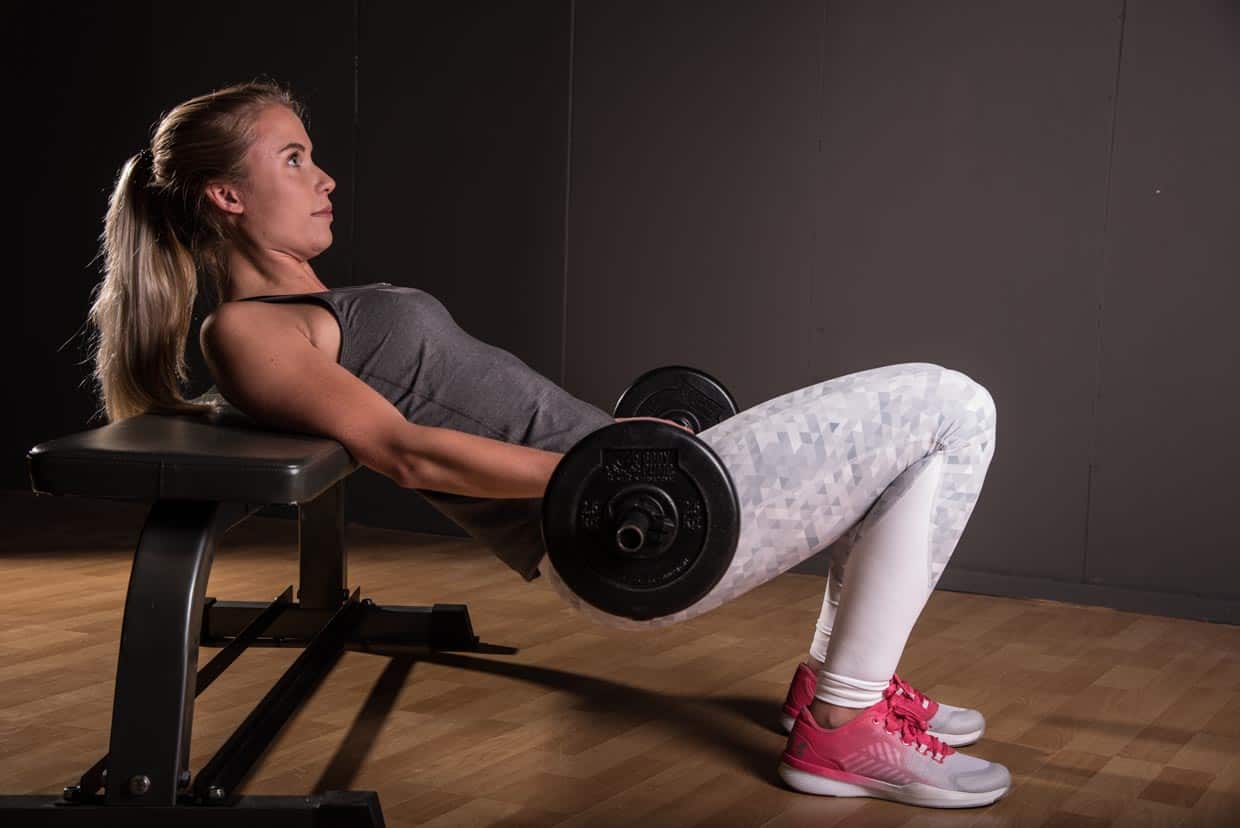
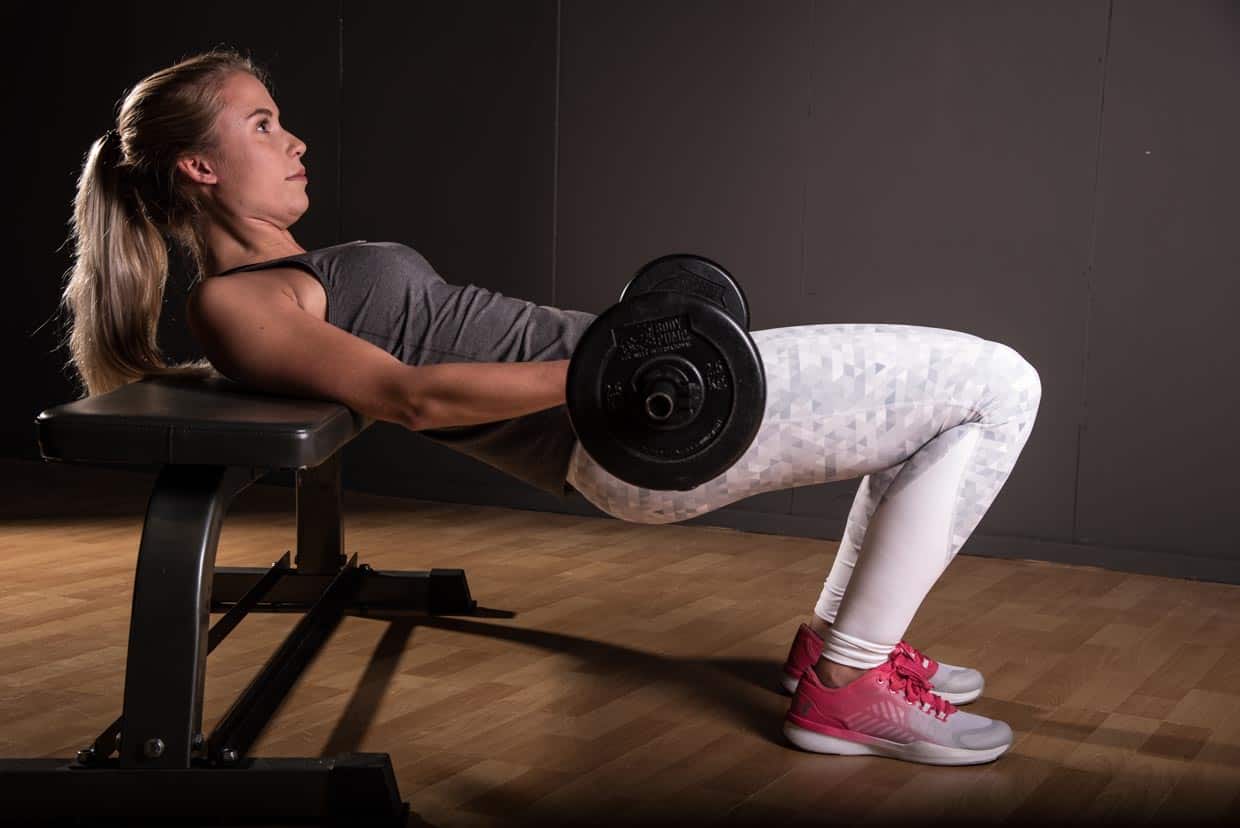
Hip thrust execution
-
1
Drive yourself upward from your pelvis until your back is in line with your thighs. Your hips will then be slightly higher than your knees.
-
2
Lower your glutes back to the starting position in a controlled manner so that tension is maintained.
Hip Thrust
Main muscles:
- Erector spinae ('back extensor muscles')
- Hamstrings (biceps femoris, semitendinosus, semimembranosus)
- Glutes (gluteus maximus, medius, and minimus)
Hip thrust setup with light weight
- Stand approximately half a meter in front of a bench, with your back facing the bench and a barbell in your hands.
- Lower yourself, allowing the barbell to rest in the crease between your upper legs and torso. Make sure the bar is centered.
- Finish in a squat position and make contact with the bench using your back. Position your shoulder blades just above the top of the bench.
- If necessary, adjust the distance between your feet and the bench.
- Place your feet shoulder-width apart for sufficient balance. Point your feet slightly outward at an angle of approximately 15 degrees.
- Place your elbows/forearms on the bench and push yourself slightly upward until your glutes are approximately 5 to 10 centimeters above the floor.
- Grip the barbell again.
Hip thrust setup with heavy weight
- Sit on the floor with your back against a bench, with a barbell positioned just in front of your feet while seated.
- Roll the barbell over your legs until it is positioned above your lower abdomen. Make sure the bar is centered.
- Make sure your back is firmly in contact with the bench and hold the bar with both hands.
- Now place your feet flat on the floor.
- Place your elbows/forearms on the bench and push yourself slightly upward until your glutes are approximately 5 to 10 centimeters above the floor.
- Grip the barbell again.
Hip thrust technique
The height of the bench should be approximately equal to the height of your knees.
If necessary, use a towel or pad around the barbell to prevent painful pressure on the pelvis.
At the top of the movement, squeeze your glutes together as if you had to hold a coin between them. Make sure your hips finish slightly higher than your glutes to ensure a full range of motion. However, avoid arching your back (too much). The exercise is about hip extension, not hyperextension of the back. To prevent this, it may help to look diagonally forward rather than upward.
At the top of the movement, your knees should be directly above your ankles, with your lower and upper legs forming a 90-degree angle. If you feel that your quadriceps are working too hard relative to your glutes, it may help to place your feet slightly farther forward. However, placing them too far forward may cause the hamstrings to do too much work. Therefore, try different distances until you feel that you are working your glutes as much as possible.
You can make the exercise even more challenging by placing a resistance band between your legs at knee height. Because you have to push your legs apart against the band's tension to maintain your position, you also train a second function of the glutes (abduction). The exercise can also be performed on one leg by keeping the other leg extended straight forward in the air.
Alternatives
- Back extensions
- Glute bridge
- Bird dog
Run your fitness business with more structure
- Planning, member management and coaching in one platform
- Built for coaches, studios and gyms
- Fewer separate tools, more overview