Barbell Deadlift
The deadlift is also known as the king of all exercises. Looking at the list of muscles involved above, you can infer why.
- The muscles in the calves bring the forward-projecting lower legs back into alignment above the ankles when you stand up and also work to stabilize throughout the entire movement.
- The quadriceps work hard to extend the knees.
- The hamstrings and glutes work to bring the upper body upright by aligning the thighs and back.
- The erector spinae, which runs along the spine, helps straighten the back.
- The abdominal muscles work mainly to stabilize (the rectus abdominis as an antagonist of the erector spinae and the obliques as a brake on lateral tilting)
- The muscles in the upper back and neck engage to pull the shoulders up and back.
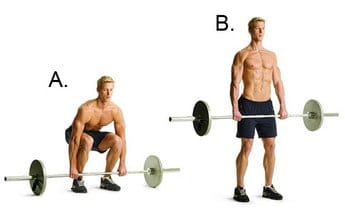
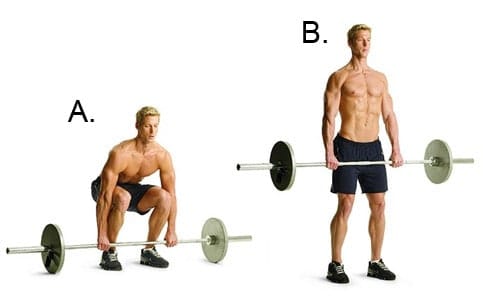
Barbell deadlift execution
-
1
Drive your heels forcefully into the floor to bring yourself upward. Keep the barbell as close to your shins as possible.
-
2
Continue until your legs are almost straight and your back is upright with its natural curve. Just as when you normally stand upright. Do not pull it too far back or create an exaggerated curve in your back at the end of the movement (no hyperextension).
-
3
Push your glutes slightly backward to make room for the bar and bend your knees in a controlled manner. Let your torso naturally move forward to bring the barbell back down to just above the floor. Maintain the natural curve in your back and prevent it from rounding. You do this, among other things, by lowering your glutes far enough.
-
4
Repeat.
Barbell deadlift
Muscles involved:
Legs:
- Quadriceps (vastus lateralis, vastus medialis, vastus intermedius and rectus femoris)
- Hamstrings
- Sartorius
Glutes:
- Gluteus maximus, medius and minimus
Pelvis:
- Iliacus (hip flexor)
- Psoas major (hip flexor)
Calves:
- Gastrocnemius
- Soleus
Abdominals:
- Rectus abdominis (rectus abdominis muscle)
- Obliquus externus abdominis (external oblique muscle)
- Obliquus internus abdominis (internal oblique muscle)
- Transversus abdominis (transverse abdominal muscle, ‘corset muscle’)
(Lower) back and spine:
- Erector spinae
- Lumbar multifidus
- Quadratus lumborum
Back and neck:
- Trapezius
- Rhomboids
- Levator scapulae
Barbell deadlift setup
- Make sure any weight plates on the bar are securely locked in place.
- Stand directly in front of the barbell with your feet between hip- and shoulder-width apart.
- Bend your knees and grasp the barbell with your hands slightly wider than shoulder-width apart. For a good grip, it may be helpful to hold the bar with one hand with the palm facing forward and the other hand with the palm facing backward. With heavier weights, wrist straps may be advisable.
- Make sure your knees point in the same direction as your feet.
- Maintain the natural curve of your back. Do not round it, but do not overarch it either. Help yourself do this by not staring tensely straight ahead (which quickly causes overextension), and by not looking straight down at the barbell (which quickly causes rounding). Choose a point on the floor diagonally in front of you.
- Brace your abdominals and glutes like a natural weightlifting belt to protect your back.
Barbell deadlift technique
There are many variations of the deadlift. The “normal” execution is also widely debated. For example, how far apart the feet should be, whether you push from the heels or the balls of the feet, and how to brace the abdominals. The “optimal” execution may also depend on your personal proportions, mobility and other physical characteristics.
In the execution described above, we assume you push from the heels because this is considered the safest option. Pushing from the heel places more emphasis on the hamstrings and gluteal muscles. Pushing off from the ball of the foot places more emphasis on the quadriceps, but also places greater stress on the knees.
Another discussion may arise about the depth of the deadlift and whether or not to make contact with the floor and barbell.
It is useful to realize that deadlifts can be performed for different reasons. As part of powerlifting competitions, the emphasis will mainly be placed on the upward (concentric) movement. Lowering the weight under control is mandatory in competitions, but is not the greatest challenge in the exercise itself. In powerlifting, weightlifting and, for example, CrossFit, we therefore often see the weight brought to the ground reasonably quickly. The body follows the weight just enough so that the barbell does not simply fall to the ground.
If you are not training for competitions, it is advisable to lower the weight slowly and under control (in about 2 to 3 seconds). This way, you do not skip the eccentric part of the exercise, but you also prevent the tension from being completely lost and having to be rebuilt. Moreover, it is not impressive but annoying if you have to let the entire gym know how much you deadlift by crashing the weight onto the floor as hard as possible.
Alternatives
- Stiff-legged deadlift
- Sumo deadlift
Run your fitness business with more structure
- Planning, member management and coaching in one platform
- Built for coaches, studios and gyms
- Fewer separate tools, more overview