Investigaciones recientes han demostrado que la sentadilla por encima de la cabeza no tiene mayor efecto sobre los músculos del tronco que el sentadilla trasera (sentadilla normal). Los resultados pronto se publicarán en el Revista de acondicionamiento de fuerza y investigación (1).
Sentadilla por encima de la cabeza o sentadilla normal
The purpose of this study was to compare muscle activity and kinetics during the back squat and overhead squat performed at three relative intensities (60, 75 and 90% 3RM). Fourteen subjects (age: 26 +/- 7 yrs, height: 182.5 +/- 13.5 cm, body mass: 90.5 +/- 17.5 kg) performed each exercise using a within-subjects crossover design. In addition, a selection of trunk isolation exercises were included to provide additional comparisons. Squats were performed on a force platform with electromyographic (EMG) activity of the anterior deltoid (AD), rectus abdominis (RA), external oblique (EO), erector spinae (ES), gluteus maximus (GM), vastus lateralis (VL), biceps femoris (BF), and lateral gastrocnemius (GA) recorded throughout. The overhead squat demonstrated significantly greater (p<0.05) activity in the anterior trunk muscles (RA and EO) during the eccentric phase. However, the magnitudes of the differences were relatively small (~ 2 to 7%). In contrast, the back squat displayed significantly greater (p<0.05) activity in the posterior aspect of the trunk (ES) and all lower-body muscles during the concentric phase. Kinetic comparisons revealed that significantly greater peak force (p<0.05) was developed during the back squat. EMG comparisons between the trunk isolation exercises and squat variations demonstrated substantially greater anterior trunk activity during the isolation exercises, whereas the highest activity in the posterior aspect of the trunk was obtained during the squats (p<0.05). The results of the study do not support the hypothesis that the overhead squat provides a substantially greater stimulus for developing the trunk musculature compared with the back squat.
-R. Aspe, Human Performance Laboratory Robert Gordon University, Aberdeen
Sobre la investigación
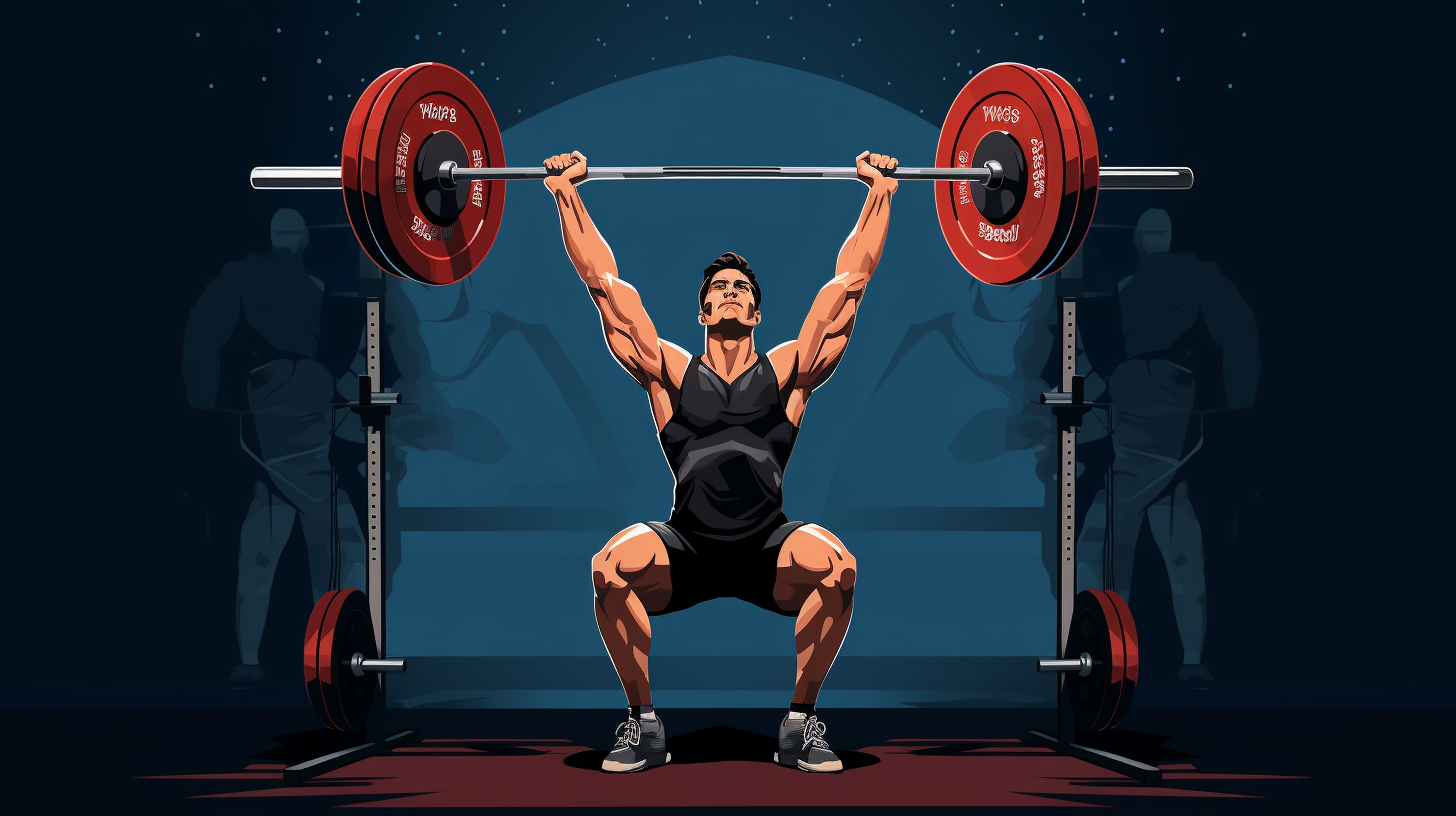
Los investigadores utilizaron EMG (electromiografía) para observar el efecto en varios músculos. Principalmente vieron diferencias en los hombros, pero eso no es sorprendente. Durante la sentadilla por encima de la cabeza (imagen de la derecha), estás continuamente equilibrando la barra por encima de tu cabeza, por lo que no es sorprendente que los hombros estén sometidos a una mayor tensión.
Sin embargo, lo que más preocupaba a los investigadores eran las diferencias en la carga sobre los músculos del tronco. Estos también estarían sujetos a una mayor tensión debido al equilibrio sobre la cabeza, pero esto parece decepcionante según este estudio.
Por lo tanto, los investigadores concluyen que no tiene sentido sustituir la sentadilla trasera por la sentadilla por encima de la cabeza para fortalecer los músculos del tronco. Recomiendan la sentadilla trasera normal complementada con: ejercicios de aislamiento (extensiones de piernas, flexiones de piernas, etc.).
... it does not appear prudent to substitute
the overhead squat for the back squat when the goal is to increase recruitment of the muscles
of the trunk. This research demonstrates that such a substitution would have minimal effect
on the anterior trunk musculature and decrease recruitment of the posterior aspect of the
trunk. Instead, for training the trunk musculature it is recommended that training
programmes include the back squat and supplement with various trunk isolation exercises
Referencia
- Aspe, Rodrigo R MSc; Swinton, Paul A PhD. Electromyographic and Kinetic Comparison of the Back Squat and Overhead Squat Biomechanical Comparison of Squatting Exercises. Journal of Strength & Conditioning Research:POST ACCEPTANCE, 20 March 2014 doi: 10.1519/JSC.0000000000000462