Aktuelle Forschung hat gezeigt, dass der Overhead Squat keinen größeren Effekt auf die Rumpfmuskulatur hat als der Back Squat (normaler Squat). Die Ergebnisse werden demnächst im Journal of Strength and Research Conditioning veröffentlicht (1).
Overhead Squat oder normaler Squat
The purpose of this study was to compare muscle activity and kinetics during the back squat and overhead squat performed at three relative intensities (60, 75 and 90% 3RM). Fourteen subjects (age: 26 +/- 7 yrs, height: 182.5 +/- 13.5 cm, body mass: 90.5 +/- 17.5 kg) performed each exercise using a within-subjects crossover design. In addition, a selection of trunk isolation exercises were included to provide additional comparisons. Squats were performed on a force platform with electromyographic (EMG) activity of the anterior deltoid (AD), rectus abdominis (RA), external oblique (EO), erector spinae (ES), gluteus maximus (GM), vastus lateralis (VL), biceps femoris (BF), and lateral gastrocnemius (GA) recorded throughout. The overhead squat demonstrated significantly greater (p<0.05) activity in the anterior trunk muscles (RA and EO) during the eccentric phase. However, the magnitudes of the differences were relatively small (~ 2 to 7%). In contrast, the back squat displayed significantly greater (p<0.05) activity in the posterior aspect of the trunk (ES) and all lower-body muscles during the concentric phase. Kinetic comparisons revealed that significantly greater peak force (p<0.05) was developed during the back squat. EMG comparisons between the trunk isolation exercises and squat variations demonstrated substantially greater anterior trunk activity during the isolation exercises, whereas the highest activity in the posterior aspect of the trunk was obtained during the squats (p<0.05). The results of the study do not support the hypothesis that the overhead squat provides a substantially greater stimulus for developing the trunk musculature compared with the back squat.
-R. Aspe, Human Performance Laboratory Robert Gordon University, Aberdeen
Über die Studie
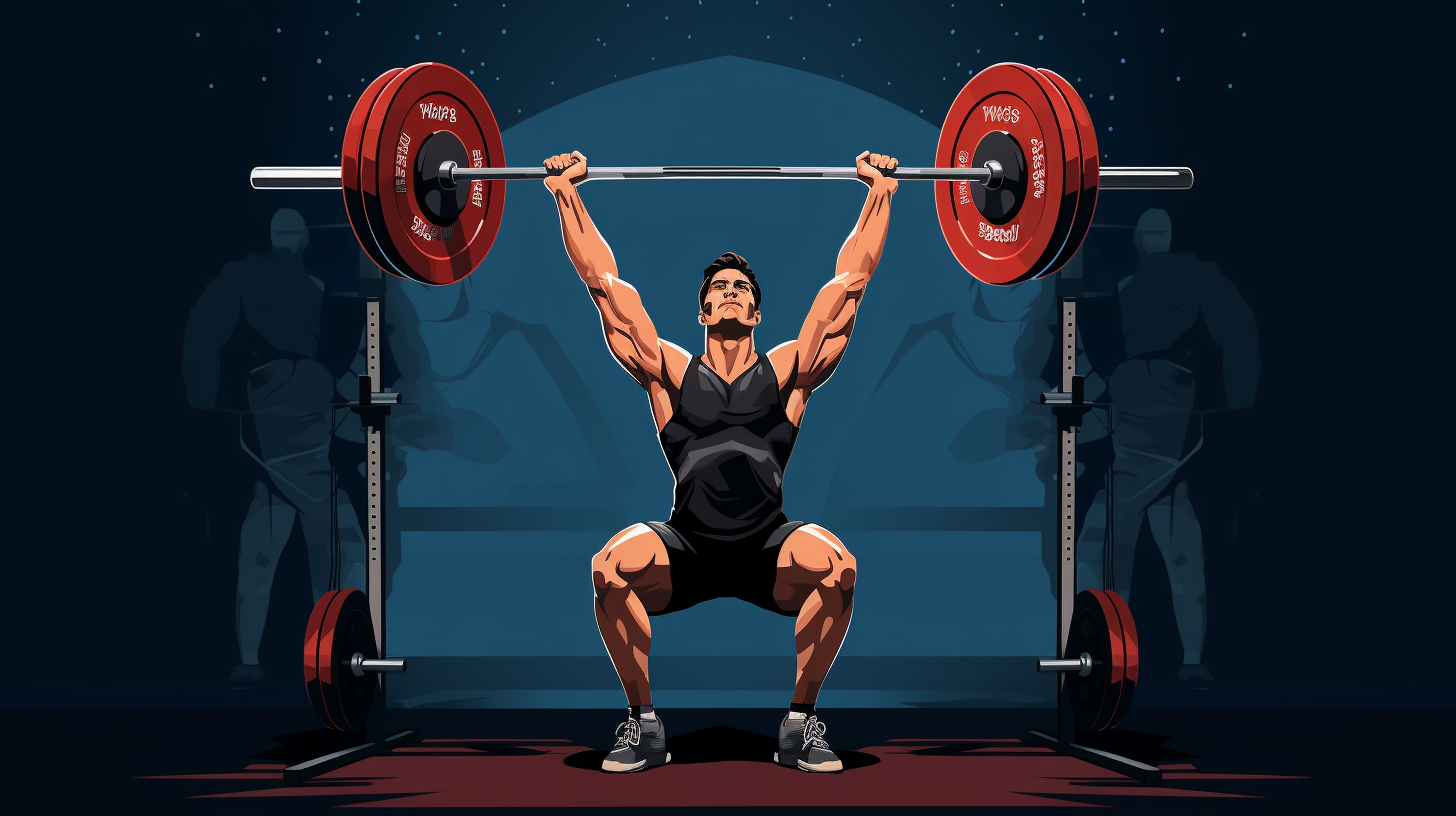
Die Forscher haben mit EMG (Elektromyografie) die Wirkung auf mehrere Muskeln untersucht. Unterschiede sahen sie vor allem in den Schultern, was nicht überraschend ist. Beim Overhead Squat (Abbildung rechts) balancierst du die Langhantel die ganze Zeit über dem Kopf, also ist es nicht verwunderlich, dass die Schultern dabei stärker belastet werden.
Den Forschern ging es jedoch vor allem um Unterschiede in der Belastung der Rumpfmuskulatur. Auch diese sollte durch das Balancieren über dem Kopf stärker belastet werden, doch laut dieser Studie fällt dieser Effekt eher gering aus.
Die Forscher kommen daher zu dem Schluss, dass es keinen Sinn ergibt, den Back Squat durch den Overhead Squat zu ersetzen, um die Rumpfmuskulatur stärker zu machen. Dafür empfehlen sie den normalen Back Squat, ergänzt durch Isolationsübungen (Leg-Extensions, Leg-Curls usw.).
... it does not appear prudent to substitute
the overhead squat for the back squat when the goal is to increase recruitment of the muscles
of the trunk. This research demonstrates that such a substitution would have minimal effect
on the anterior trunk musculature and decrease recruitment of the posterior aspect of the
trunk. Instead, for training the trunk musculature it is recommended that training
programmes include the back squat and supplement with various trunk isolation exercises
Referenz
- Aspe, Rodrigo R MSc; Swinton, Paul A PhD. Electromyographic and Kinetic Comparison of the Back Squat and Overhead Squat Biomechanical Comparison of Squatting Exercises. Journal of Strength & Conditioning Research:POST ACCEPTANCE, 20 March 2014 doi: 10.1519/JSC.0000000000000462