Calf Press
Calf raises target the two main muscles in the calves: the gastrocnemius and the deeper-lying soleus. In this variation, you perform the exercise on a leg press machine.
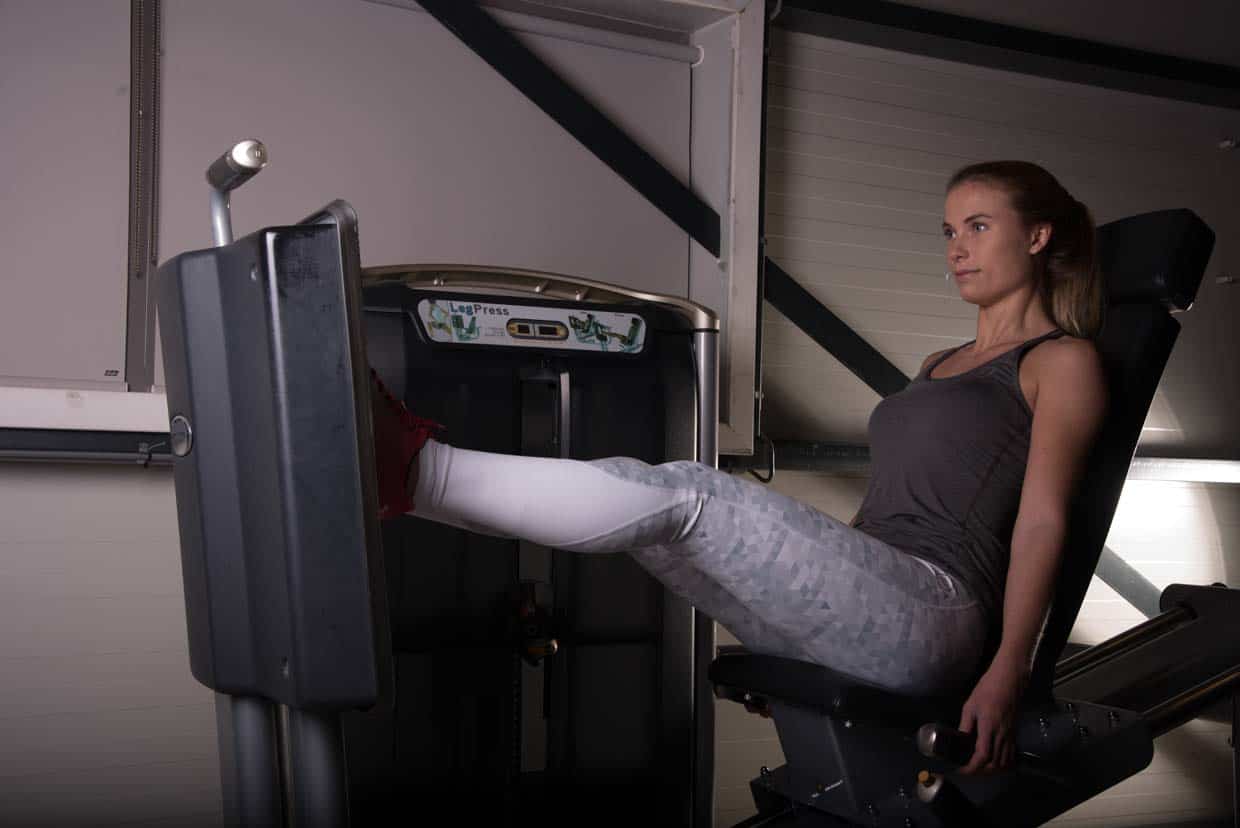
Calf Press execution
-
1
Sit in the leg press, select the desired weight, and place your feet hip- or shoulder-width apart, with your feet fully on the platform.
-
2
Push yourself out until your legs are nearly straight.
-
3
Move your feet down on the platform until only the balls of your feet are in contact.
-
4
Lower yourself slowly until you feel almost a full stretch in the Achilles tendon.
-
5
Push yourself as far upward/backward as possible.
Calf Press
Muscles involved:
Calves:
- Soleus
- Gastrocnemius
- Plantaris (not present in everyone)
Calf Press technique
When training the calves, you can use the following rule of thumb:
Bent legs train the soleus. Straight legs also engage the gastrocnemius.
When performed on the leg press, bending the knee to 45% appears to reduce the engagement of the entire calf by about 10%. At 90% flexion, as in a seated variation, this difference is already 30%. This is mainly due to the lower engagement of the gastrocnemius.
When training the calves, you should mainly consider a few characteristics of the gastrocnemius and soleus. These characteristics determine the effectiveness of the different calf exercises. One of the most important differences is between exercises with (nearly) straight legs and exercises with bent knees.
The soleus crosses only the ankle joint. Therefore, it does not matter to the soleus whether the knee is bent or straight.
The gastrocnemius consists of two heads that end in the same attachment as the soleus: the Achilles tendon, which crosses the ankle joint. However, both heads attach to the thigh bone above. The gastrocnemius therefore crosses two joints: the ankle and the knee. This means that the possible engagement of the gastrocnemius can be influenced by bending or straightening the leg.
With the leg straight and the foot at a normal angle, as when standing, the gastrocnemius can produce maximum force. When the leg is bent, the gastrocnemius is already partly shortened. If you push off with the foot from that position, plantar flexion, the muscle can no longer produce maximum effort. The opposite happens when the leg is straight and you point your toes toward your face. The gastrocnemius is then overstretched to produce maximum effort.
If you want to train the calves as completely as possible with a single exercise, perform it with (nearly) straight legs.
Feet pointing straight forward
EMG measurements show that it is best to keep your feet pointing forward. Do not point your toes inward or outward. Pointing the toes outward appears to reduce the engagement of both the inner and outer parts of the gastrocnemius by nearly 10%. Pointing the toes inward has this effect only on the inner part of the gastrocnemius.
Pointing the feet straight forward produces the highest activation of both heads of the gastrocnemius.
Train heavy or light?
The soleus, which lies deeper than the gastrocnemius, can be considered the workhorse of the calves, responsible for prolonged but low-effort activities such as staying upright and walking. The soleus can therefore consist of as much as 90% slow-twitch muscle fibers.
The gastrocnemius also contains many slow-twitch muscle fibers, accounting for half to three-quarters of all muscle fibers.
You can train the fast-twitch muscle fibers by training explosively and/or heavily. You then also target the muscle fibers with greater growth potential. However, you also target a relatively low number of muscle fibers.
Performing more repetitions and training with a lighter weight targets the largest number of muscle fibers in the calf muscles.
Alternatives
- Dumbbell standing calf raise
- Smith Machine Calf raise
- Standing calf raises
Run your fitness business with more structure
- Planning, member management and coaching in one platform
- Built for coaches, studios and gyms
- Fewer separate tools, more overview