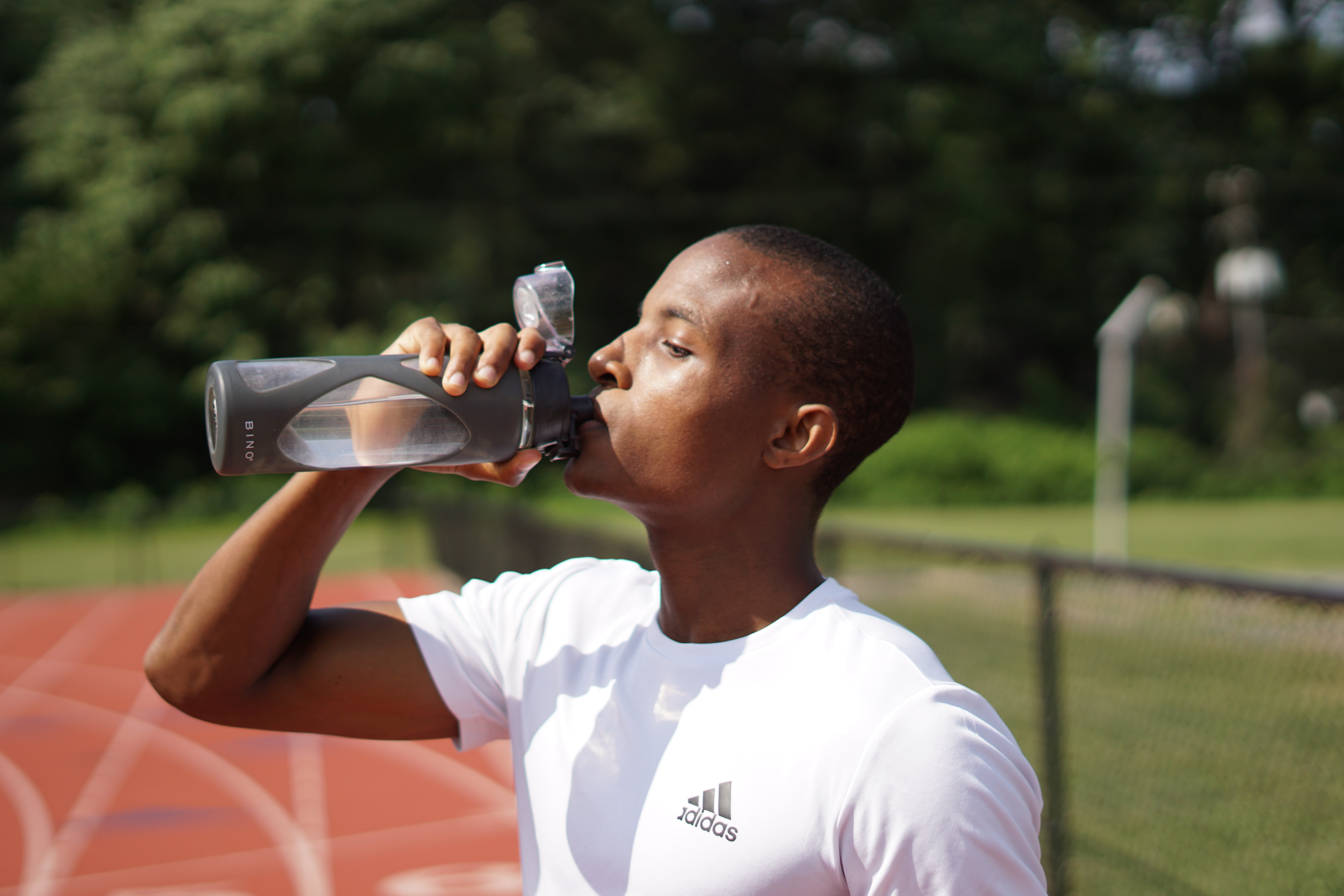
Tennis players who grunt while hitting the ball give the ball 3.8% more speed than when they do not grunt. This is the outcome of a soon to be published study in the Journal of Strength & Conditioning Research (1). A good reason to write about the "power of the grunt", which according to some studies produces 12% more force in strength training and has traditionally been used in martial arts.
Excessive grunting
When I originally published this article, I wrote:
"Fuck Planet Fitness!"
That "gym that is not a gym" where members are not allowed to grunt in order to generate extra force during their exercise. This grunting is said to intimidate other members.
"Gymtimidation" is what they call it. Clever, but it remains a marketing trick to bring in losers.
"There, I fucking said it."
Maybe it was not very smart to put it that way, since in hindsight it turns out I called part of our readers "losers" with that. Yesterday, another article of mine about gym etiquette was posted on our Facebook page.
As an addition to the irritations I mentioned in the gym, grunting during training was mentioned several times as the most annoying. I had written this current article earlier, but given the reactions I thought an update was appropriate.
Am I now one of those antisocial uber-macho-pornstar-wannabe grunters who everyone is right to be annoyed by, or are these readers people who have never trained hard enough to know the added value of grunting?
As is so often the case, the answer lies in the nuances.
Why grunt?
Grunting in order to do that one extra rep or those few extra reps, where you have to pull strength from your toes to get them done (possibly with help), is exactly what the sport is about:
Finding your limits and pushing them so you become stronger every time.
If you walk into the gym every week and simply do "your fixed round" without ever really making it hard for yourself, then you indeed will not understand why grunting is needed.
In my opinion, however, that is because of your limited effort and lower goals.
A bit like those kids who sit down on the grass after running one hundred meters during PE and call you crazy when you do try to run as far as possible in 11 minutes.
Opposite that, however, is the well-known principle of the gorilla who beats his chest extra hard when an attractive woman is training nearby. The gorilla who starts grunting from the very first rep while he can still easily grind out ten more afterwards.
Then something is not right.
If you can do ten reps, it is impossible that the first one already demands so much from you that grunting is necessary. You might as well announce through a megaphone:
"Look at me!!"
"I am desperate for attention, actually very insecure, and I hope to come across as extra masculine now".
So I fully understand that there are situations in which grunting is very annoying. With the information below, however, I will support that it can definitely be functional if used at the right moments!
And yes, after that I will include the complaint about grunting and the other untreated complaints about behavior in the gym in an update about gym etiquette.
Grunting as an age-old aid during physical effort
I regularly teach Kobudo (a Japanese martial art) at secondary schools. When I perform a "kata" for a demo, I always make sure I am standing right in front of them when I make the first "kiai", the shout that goes with launching an attack.
I enjoy it because they always get a real scare when the shout "Eeeeejjj!!" blasts through the room and echoes off the gym walls.
When they are then allowed to get started themselves and also have to make a "kiai", it always begins with a lot of giggling. It still takes some getting used to "acting a little crazy" and standing there shouting together in the hall.
"Eeeeejjj!!!"
Kenneth Nwosu
In tennis it is not always appreciated either. Some women in particular can produce so much noise that opponents complain to the umpire that they are bothered by the vocal violence of what, in their eyes, is a porn-actress-wannabe.
Grunting is natural.
We do not do it instinctively for nothing. Nobody told tennis players, strength athletes or martial artists that it would produce more force before they started trying it.
Nobody whispers in my ear during that heavy final repetition that I will make it if I shout.
It happens by itself.
The only unnatural thing is when we try to convince each other that this is undesirable. That fits the typical Dutch culture of "just act normal, that is crazy enough already".
Do not show off, walk in step, and all that kind of personality-killing nonsense.
I therefore welcome studies showing that verbally adding force to your movements is not merely pure intimidation of the opponent or an attempt to attract the attention of women in the gym, but actually increases force.
Grunting in tennis
American researchers wanted to know what effect grunting in tennis had on, among other things, ball speed (1). They also looked at factors such as maximal oxygen uptake, the ratio of oxygen uptake and consumption, and heart rate.
To do this, they had five men and five women, all competitive at university level, repeatedly hit forehands and backhands.
One time they did this without grunting and another time with grunting (and vice versa).
The researchers saw that grunting significantly increased ball speed, while this did not come at the expense of energy use expressed through factors such as oxygen processing and heart rate.
Grunting increased ball velocity (kph) 3.8% compared to non-grunting condition (p < 0.034) with the M +/- SD being 83.4 +/- .6.1 and 80.3 +/- .8.7, respectively. It may be worthwhile for players and coaches in tennis as well as other sports to experiment with grunting to determine possible improvement in performance.
E.R. Callison, University of Nebraska
Grunting in strength sports
You would think it would be fairly easy to investigate whether grunting makes you stronger during strength training.
It also seemed like a fun subject for a researcher.
However, the number of studies on this turned out to be limited to only two. In addition, the first study I found on it, to my great surprise, states that grunting offers no added value (2).
Grunting did not significantly increase maximum force production in either group, and this was supported by EMG findings. These findings suggest that grunting does not significantly increase force production; however, it should not be discouraged as small increases in force production may influence the outcome of athletic performance.
Z. Morales, Hardin-Simmons Uttiuersity
There are a few comments to make about this, however. I cannot find the full text of the study anywhere. At least, the PDF file I did find was so short that it could just as well have been the abstract.
The exact data therefore cannot be checked. For example, the researcher says there is "no significant difference" and later says that small differences can still have an effect.
From this you can infer that grunting did produce more force, but not enough for statistical significance.
More importantly, the study looked at isometric force during deadlifting.
That is a method that is used relatively rarely in practice. When it comes to force in tennis, strength training and martial arts, the grunt is always used during the concentric part of the movement. The part in which the muscles contract while they shorten.
In tennis, for example, those are the chest muscles that pull the arm from back to front, the oblique abdominal muscles that create rotation in the torso, and the biceps that bend the arm.
In deadlifting during strength training, this is the part where you come up. In tennis, the eccentric part is precisely in the preparation (arm backward, including the stretching of chest muscle fibers).
In deadlifting, the eccentric part is when you lower the weight again.
The isometric part is when tension in the muscles is maintained without movement in the body parts driven by those muscles.
Tension from a standstill is exactly the least interesting thing for these sports when it comes to the added value of a grunt. When have you heard a tennis player grunt while standing still before serving, or a deadlifter while he remains stationary halfway through the movement and is not trying to come further up?
Forearm strength with grunting: more than 12% more force
Fortunately, other researchers approached this a bit more cleverly (3).
They looked at how much force could be generated maximally in the "forearm flexors". These are the muscles that allow your wrist to bend toward the palm of your hand.
They had their subjects bend the wrist as hard as possible every minute for thirty minutes. Sometimes, before such an attempt, they fired a starting pistol to see whether this affected force.
On the final attempt, they had the participants shout while bending the wrist.
As expected, there was a downward line because they became more fatigued after each attempt. The first thing that stands out is that the starting shot caused more force to be generated. This may be comparable to the effect of verbal encouragement.
What mainly interests us here, however, is the fact that the attempt with a shout produced the most force, despite being the final attempt.
The participants did not know this was the final attempt, so this was not due to the mental effect of knowing that the last bit of energy could be squeezed out.
Unlike the previous study, this difference was 12% and therefore definitely significant. The researchers concluded:
The average of single, terminal pulls accompanied by a shout compared with the mean of the averages of all pulls not immediately preceded by a shot or shout discloses a 7.5-lb. or x 2.2 % increase attributable to the shout. This improvement, also, is highly significant.
M. Ikai, George Williams College
Unfortunately, no more studies appear to have been done on this subject.
Grunting in martial arts: the power of the Kiai
Athletes can therefore benefit from "the power of the grunt" in tennis "as well as other sports", as the researchers of the first study stated. And that brings me back to the "kiai" from martial arts.
The word "Kiai" is composed of the words "Ki" (energy) and "Ai" ("harmony" or "connection").
In lessons at secondary schools, I always explain that the kiai is done, among other reasons, to channel your oxygen in order to generate extra force (in addition to developing fighting spirit).
The intention is not to shout for an exaggerated length of time and lose all your oxygen, but precisely to learn to control your breathing.
Following the study among tennis players, I went looking for studies on the kiai, but unfortunately I am not aware of any published studies on that either.
Although I often refer to tennis during lessons as an example of using a shout for force, I did not know that the proof for this hundreds of years old theory would ultimately also be provided by tennis.
Conclusion
Shouting while hitting the ball in tennis appears to increase ball speed by almost 4%.
For strength training, one study states that the added value of shouting is not significant. However, this study was limited in design.
A better designed study did show a significant difference of more than 12%.
Within martial arts, this does not appear ever to have been studied. At least, there are no publications on it in reputable scientific journals. Given the explosiveness of the movements, however, it seems reasonable to extend the findings from tennis to martial arts.
The most important conclusion to me, however, is that this subject is far too easy to investigate compared with the limited number of studies that have been done on it so far.
Further research should provide more insight.
References
- Callison, Emily R. MS; Berg, Kris EdD; Slivka, Dusting PhD. Grunting in Tennis Increases Ball Velocity But Not Oxygen Cost. Journal of Strength & Conditioning Research: POST ACCEPTANCE, 9 February 2014 doi: 10.1519/JSC.0000000000000333
- ZEKE MORALES, SCOTT OWEN, AND DENNIS G. O'CONNELL. VOCAL DISINHIBITION (GRUNTING) DOES NOT INCREASE DEAD LIFT FORCE IN COLLEGE ATHLETES OR NONATHLETES. Perceptual and Motor Skills, 1999,89,233-234. O Perceptual and Motor Slulls 1999
- lmr, M., &STEINHAUS. A. (1961) Some factors modifying the expression of human strength. Journal of Applied Physiology, 16, 157-163.