T-Bar Row
The T-bar row is an exercise targeting the latissimus dorsi. The main muscle responsible for the 'V-shape'. However, many other muscles help bring the elbows and shoulders backward, as well as maintain the bent-over position.
This exercise can be performed in many ways regarding the type of equipment and its placement, as well as the grip used to hold the barbell. The example photo uses a V-bar, which can be found in most gyms. Some locations have special handles that can be slid onto the end of the barbell. Some gyms have a special barbell that is attached on one side to a hinge on the floor.
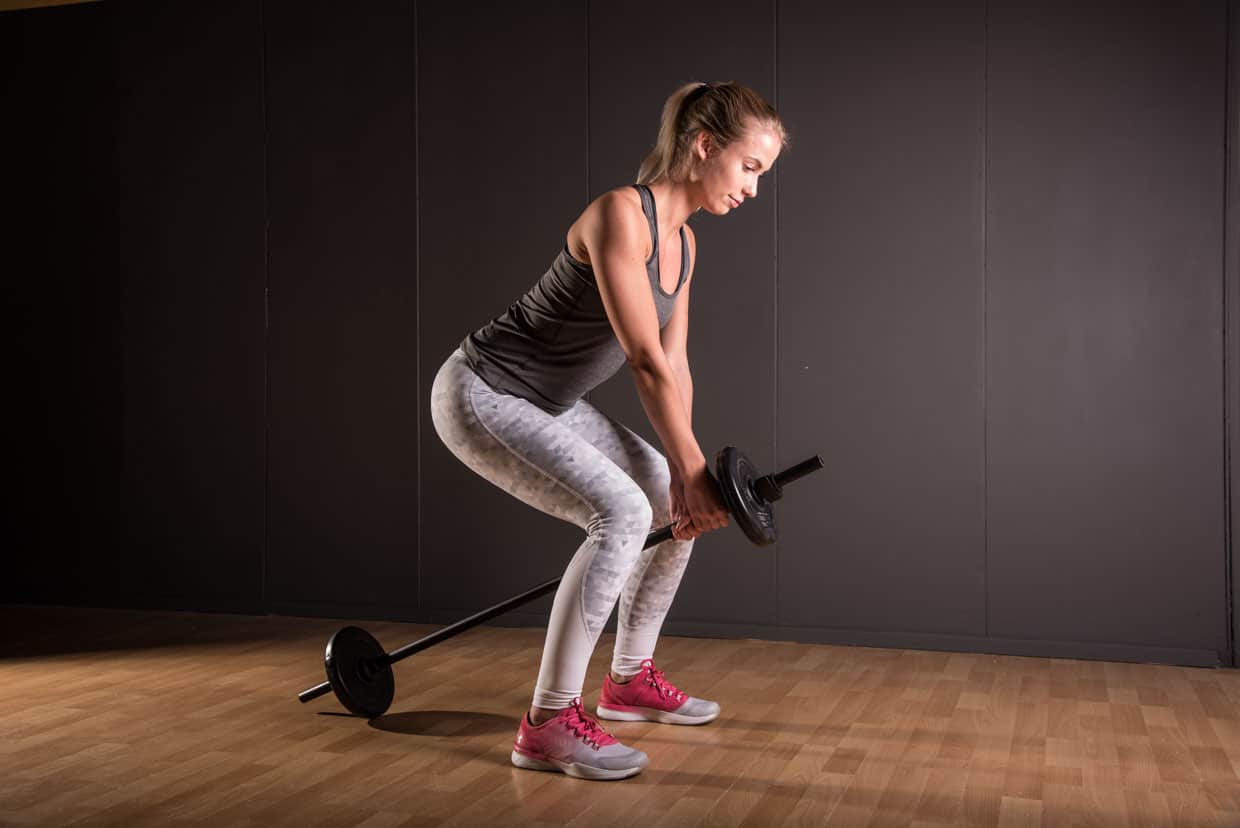
T-bar row execution
-
1
Load one end of a barbell with the appropriate weight.
-
2
Stand over the bar so that it is between your legs, facing the end with the plate or plates.
-
3
Place the handle (V-bar or special T-bar grip) on top of (special grip) or against (V-bar) the bar. With a V-bar, slide it as far as possible from underneath against the plates.
-
4
Grip the handle with both hands and place your feet shoulder-width apart beside and slightly behind the handle in your hands.
-
5
Rise with your arms extended into the starting position, resembling a half-squat position.
-
6
Begin the exercise by pulling your elbows toward and along your sides. Keep the plates passing as close in front of you as possible.
-
7
Lower the barbell back to the starting position in a controlled manner.
T-bar row
- Latissimus dorsi
- Trapezius (especially middle)
- Rhomboids
- Deltoids (especially posterior)
- Rotator cuff (supraspinatus, subscapularis, teres major, teres minor)
- Erector spinae
- Hamstrings (biceps femoris, semitendinosus, semimembranosus)
- Gluteal muscles (gluteus maximus, medius, and minimus)
- Biceps brachii, brachialis, and brachioradialis (elbow flexion)
T-bar row technique
If there is no special T-bar (with one end attached to a hinge), account for the movement of the end of the bar that remains on the floor. It can roll back and forth and, with heavy weights on the other end, lift off the floor. You can prevent it from rolling back and forth by placing this end in a corner of the room or against a piece of equipment. You can prevent it from lifting by asking someone to secure the empty end by placing one foot on it.
The exercise is primarily intended for the latissimus dorsi, which pulls the upper arms backward and upward, and the trapezius, which pulls the shoulders backward. Prevent this from becoming an exercise for the legs, glutes, and lower back by allowing them to assist. Try to ensure that only your arms and shoulders move during this exercise. Do not bend your legs further while lowering the weight, allowing them to assist by extending again during the pull. Also, do not bend farther forward while lowering the weight and then allow the glutes and lower back to assist during the pull.
Keep your back straight, neither rounded nor excessively arched. Keep your head neutral in relation to your back, as when standing upright and looking ahead. Do not look straight ahead or upward; instead, look at a point diagonally in front of you on the floor.
Alternatives
- Barbell bent-over row
- Seated row
- Dumbbell row
Run your fitness business with more structure
- Planning, member management and coaching in one platform
- Built for coaches, studios and gyms
- Fewer separate tools, more overview