Pull-Ups
Pull-ups are a highly effective way to train the back muscles using body weight as resistance. In addition to the back muscles, the chest muscles, biceps, and abdominal muscles are also engaged.
The difference compared with the similar chin-ups is the hand position. Chin-ups use an underhand (supinated) grip, while pull-ups use an overhand grip. This difference in grip results in a different distribution of activation among the various muscles involved in the back.
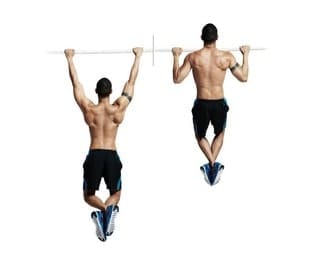
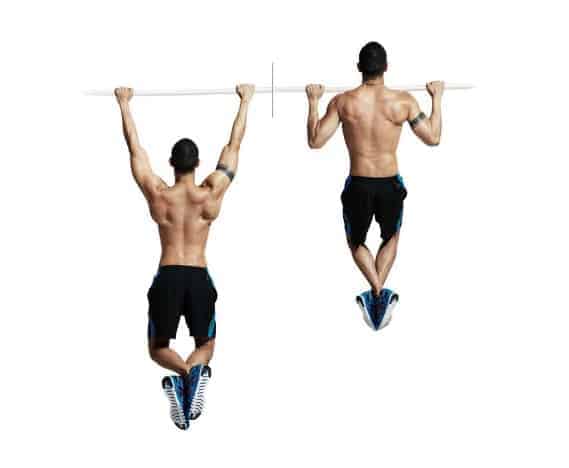
Pull-up execution
-
1
Stand on an elevated platform so that you can grasp the bar without having to jump.
-
2
Grip the bar with your palms facing away from you, with your hands shoulder-width apart or slightly wider.
-
3
Step off the platform and remain in an “active hang” in the starting position. Your arms are not quite fully extended and your shoulders are pulled slightly downward. This keeps the back and shoulder muscles under tension, ready to start the movement.
-
4
Pull yourself upward with your chest toward the bar.
-
5
Lower yourself back to the starting position in a controlled manner. Here too, remain in an “active” hang in the final position. Therefore, avoid allowing all tension to disappear from your back, shoulders, and arms at the end of the lowering phase.
Pull-ups
Main muscles:
- Latissimus dorsi (the large back muscle)
- Trapezius (trapezius muscle, especially the lower part)
- Deltoideus (deltoid shoulder muscle, especially the rear part)
- Rhomboideus (rhomboid muscle beneath the trapezius)
- Biceps brachii, brachialis, and brachioradialis (elbow flexion)
- Rotator cuff (stabilizing shoulder muscles: supraspinatus, subscapularis, teres major, teres minor)
Pull-up technique
Many studies have investigated the effectiveness of different grips during pull-ups. Unfortunately, they do not show a consistent picture. Some researchers found differences between chin-ups and pull-ups in the load on various muscles. During the pull-up, the lower fibers of the trapezius were loaded more, while during chin-ups, the pectoralis major (large chest muscle) and biceps were loaded more. However, another study found no difference in biceps loading.
A disadvantage of using body weight as resistance is that it is too heavy for many people and too light for some. If body weight is too high (or strength is too low), there are still ways to perform this exercise. For example, you can use resistance bands that assist with the movement. Special machines offer the option of reducing the load of your body weight through an adjustable counterweight.
Alternatives
- Lat pulldown
- pull-ups
Run your fitness business with more structure
- Planning, member management and coaching in one platform
- Built for coaches, studios and gyms
- Fewer separate tools, more overview