Dumbbell Lying Row
All so-called rowing exercises primarily focus on pulling the upper arms backward. This is one of the main functions of the latissimus dorsi, the large back muscle. To perform this function with free weights, the upper body must be brought into an (almost) horizontal position so that gravity can provide the appropriate resistance. Lying on a (incline) bench is one way to achieve this. Compared with bent-over variations, the advantage or disadvantage (depending on the goal) is the absence of tension on the lower back.
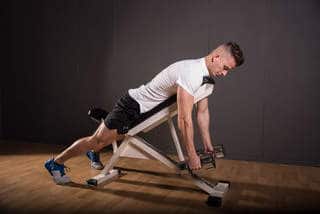
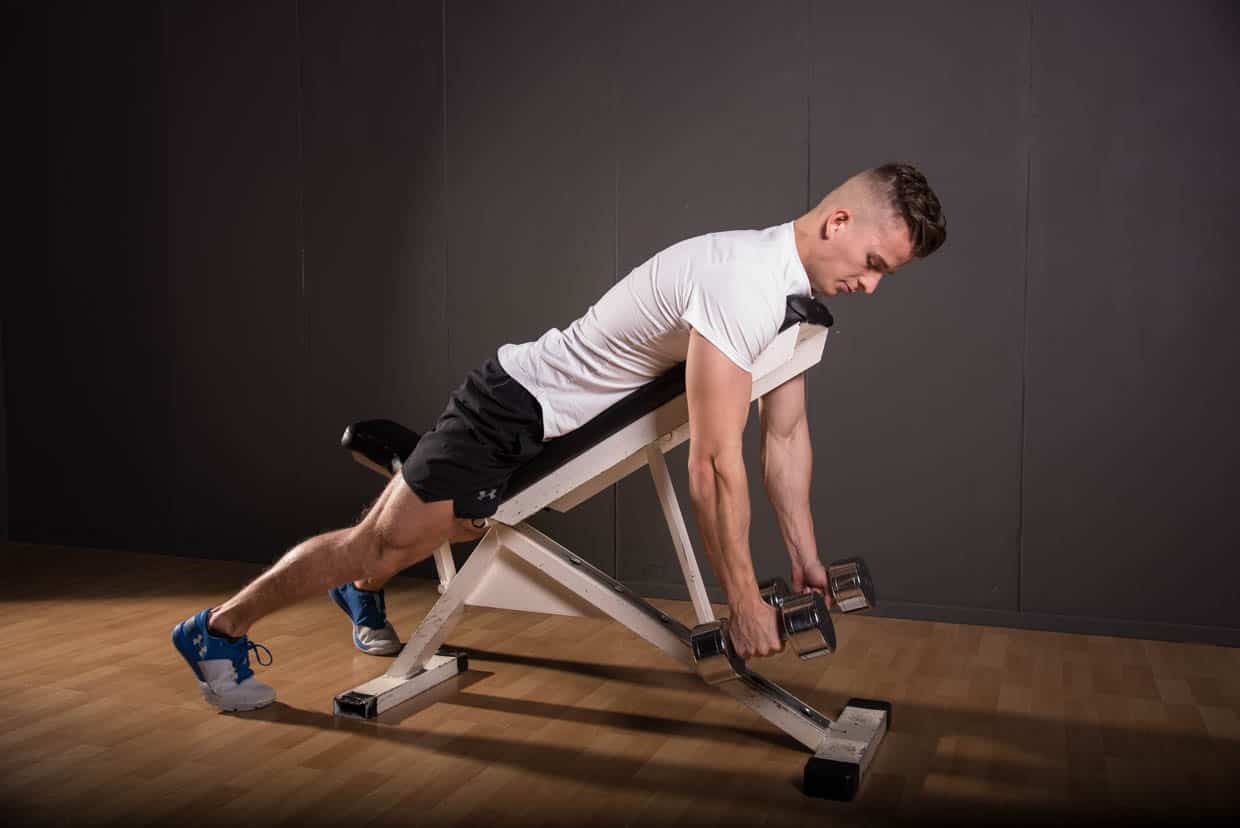
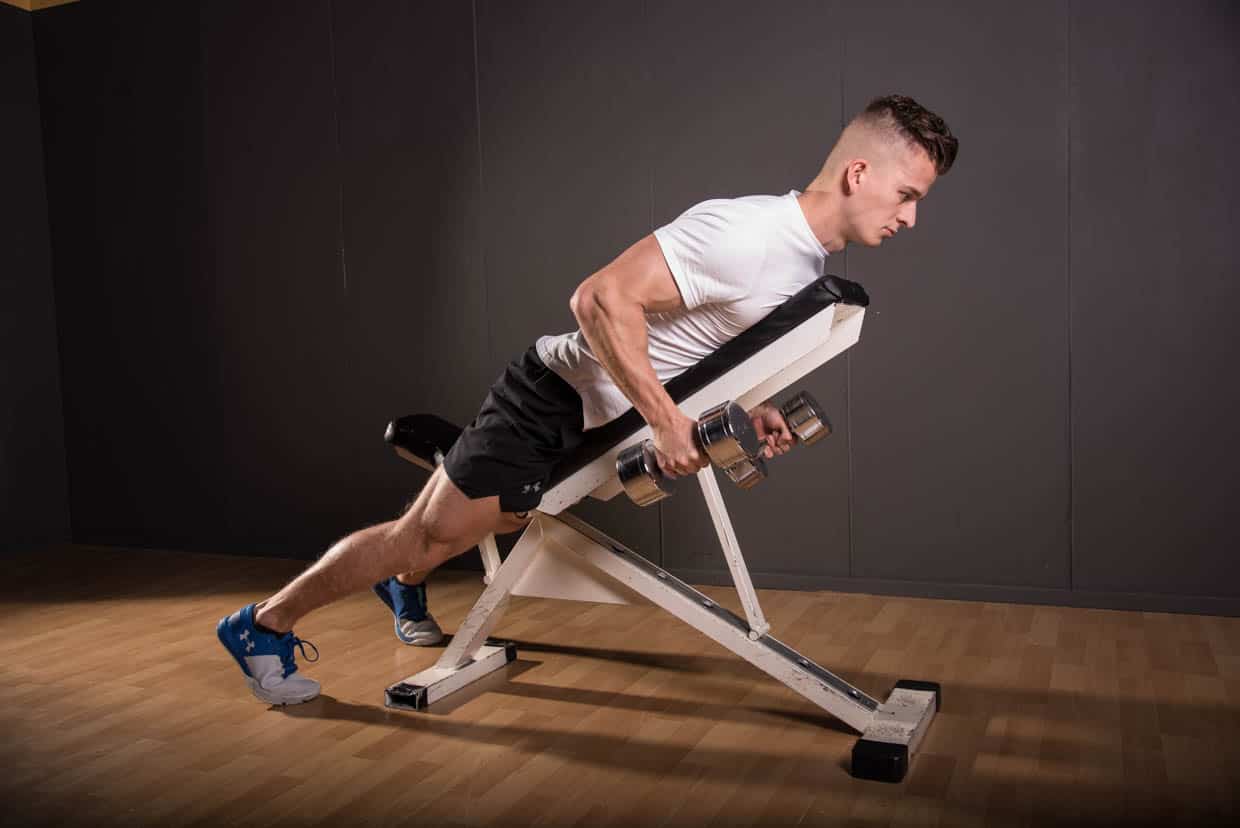
Dumbbell Lying Row execution
-
1
Choose dumbbells of the appropriate weight.
-
2
Place a bench in the incline position.
-
3
Step over the bench and lie down by placing your feet backward one at a time until your chest rests on the bench. Your face should extend beyond the bench.
-
4
Let your arms hang almost straight, with your palms facing each other. This is your starting position.
-
5
Pull your elbows toward and slightly past your sides.
-
6
Controlled, return your arms to the starting position.
Dumbbell Lying Row
- Latissimus dorsi (the large back muscle)
- Deltoideus (the 'deltoid-shaped' shoulder muscle, especially the rear part)
- Trapezius (the trapezius muscle, especially the middle part)
- Rhomboideus (the rhomboid muscle beneath the trapezius)
- Biceps brachii, brachialis and brachioradialis (flexion of the arm)
- Rotator cuff (stabilizing shoulder muscles: supraspinatus, subscapularis, teres major, teres minor)
Dumbbell Lying Row technique
Focus primarily on pulling your elbows backward. Remember that the latissimus dorsi, the large back muscle, pulls on the upper part of the upper arms to bring them backward. It has no role in bending and extending the arms. Therefore, try not to move your hands forward or backward.
The lying variation also makes it possible to isolate the back muscles more. The familiar version in which you support yourself on one arm (dumbbell row) makes it possible to use the abdominal muscles to rotate the torso along with the movement. The shoulder of the active arm can then move downward during extension and upward during the elbow-pulling phase. This makes it easier for the back muscles, which can use the momentum. A method often used to cheat and train with heavier weights. The lying variation prevents this
Alternatives
- T-bar row
- Seated row
- Dumbbell row
- Cable kneeling row
Run your fitness business with more structure
- Planning, member management and coaching in one platform
- Built for coaches, studios and gyms
- Fewer separate tools, more overview