Cable Rear Pulldown
The lat pulldown is named after the muscle primarily targeted by it: the latissimus dorsi, or the large back muscle. The lat pulldown can be performed in several ways. In the standard version, the bar is held in front of the head and pulled toward the chest. In this variation, the bar is pulled behind the head. According to some studies, this behind-the-head variation is less effective for the back muscles and riskier for the shoulders.
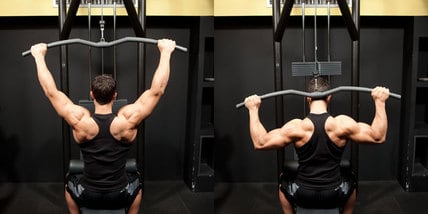
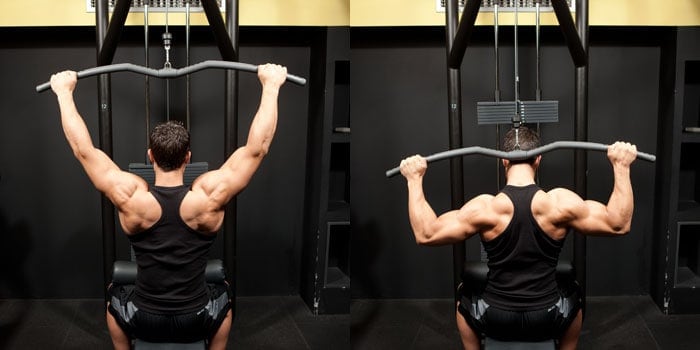
Rear lat pulldown execution
-
1
Attach a wide bar to the top of the cable machine and select the appropriate weight. Make sure the pin is properly inserted.
-
2
Grip the bar with your hands slightly wider than shoulder-width apart, palms facing away from you. Sit down.
-
3
Slide as far forward as possible to get into the starting position.
-
4
Pull the bar down and behind your head until your elbows almost touch your sides.
-
5
Return the bar in a controlled manner by extending your arms (almost) fully.
Rear lat pulldown / Cable rear pulldown
Main muscles:
- Latissimus dorsi (large back muscle)
- Trapezius (trapezius muscle, mainly lower portion)
- Deltoids (deltoid shoulder muscle, mainly rear portion)
- Rhomboids (rhomboid muscles beneath the trapezius)
- Biceps brachii, brachialis, and brachioradialis (elbow flexion)
- Rotator cuff (stabilizing shoulder muscles: supraspinatus, subscapularis, teres major, teres minor)
Rear lat pulldown technique
In addition to the muscles that help pull the upper arms backward and flex the arms, the abdominal muscles, glutes, and lower back help stabilize the upper body.
One difference compared with the standard version is the involvement of the trapezius. Because it mainly pulls the shoulder blades downward (and less backward), it is primarily the lower portion of the trapezius that contributes.
Another difference is the involvement of the biceps and the stabilizing muscles of the rotator cuff in the shoulder. The elevated, externally rotated position of the arms places greater stress on the shoulder joint and makes the rotator cuff work harder. This results in a higher risk of injury.
Some studies show that pulling the bar in front of the body demands more from the latissimus dorsi (the muscle you actually want to train with this exercise) than pulling it behind the head. Other studies do not find this difference, but do show that other muscles, such as the rotator cuff, have to work harder.
There are therefore actually few, if any, reasons to choose the behind-the-head version, while there are several reasons to avoid it.
Neck complaints can also occur with this version. However, this is mainly because people sit too far back and therefore have to bend their head forward so that the bar can pass behind it. Sitting farther forward can prevent this. If this is not possible, you can sit facing the opposite direction. The aim is to pull the bar straight down toward your back instead of along a line that passes through the (natural) position of your head.
Alternatives
- Pull-ups
- Chin-ups
Run your fitness business with more structure
- Planning, member management and coaching in one platform
- Built for coaches, studios and gyms
- Fewer separate tools, more overview