Weighted Hanging Leg-Hip Raise
The Hanging Leg-Hip Raise is an exercise focused on the abdominal muscles, although some muscles in the thighs and pelvis also actively contribute.
As the name indicates, the legs are raised first. This primarily involves two muscles in the thighs and muscles in the pelvis.
The exercise is then intensified by also raising the pelvis itself toward the chest. This is primarily a function of the rectus abdominis (the basis of the “six-pack”). It pulls the pelvis toward the sternum by rounding the back.
The resistance can be increased by placing a weight between the legs.
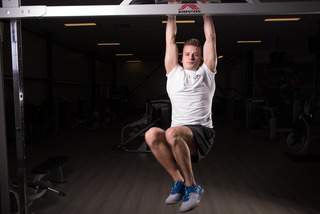
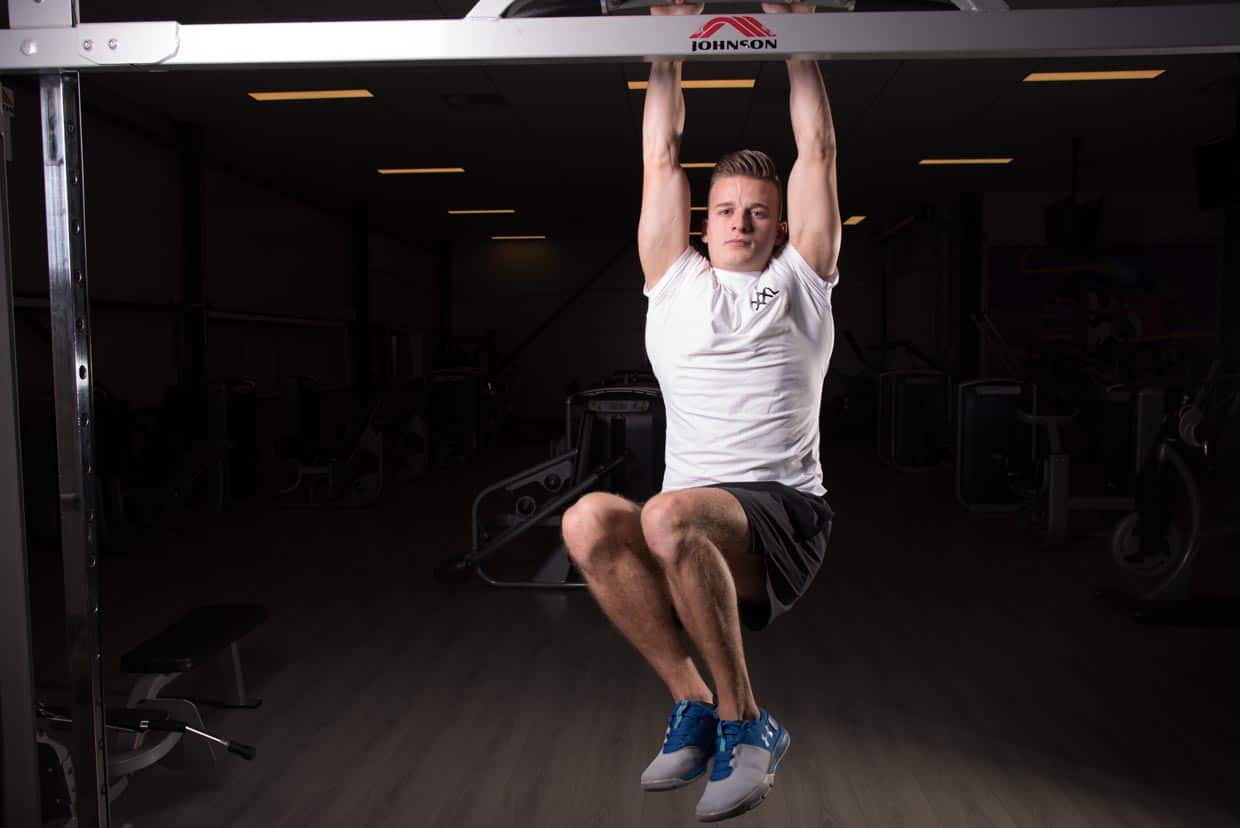
Weighted Hanging Leg-Hip Raise execution
-
1
Hang from a pull-up bar with a dumbbell clamped between the feet/legs or with a dipping belt carrying a weight plate (see notes).
-
2
Raise the knees using the legs.
-
3
In a smooth movement, continue bringing the knees toward the chest or higher by raising the pelvis/hips themselves.
Weighted Hanging Leg-Hip Raise
Active muscles:
Abdominals:
- Rectus abdominis
- Obliquus externus abdominis (external oblique)
- Obliquus internus abdominis (internal oblique)
- Musculus transversus abdominis (transverse abdominal muscle, or “corset muscle”)
Pelvis:
- Psoas major
- Iliacus
Legs:
- Rectus femoris
- Sartorius
Weighted Hanging Leg-Hip Raise technique
You do not perform these and similar leg- or knee raise exercises to train the lower abdominals. That is not possible. You train the entire rectus abdominis, not a specific part of it.
During the first part of the exercise, the muscles in the pelvis and thighs are primarily engaged. The rectus femoris brings the thigh toward the pelvis and the lower part of the spine, and vice versa. The weaker sartorius and muscles in the pelvis (psoas major and iliacus) assist the rectus femoris in this.
The abdominal muscles act more in isolation during the second part of the exercise, when the pelvis itself is raised. Nevertheless, we see that many people who want to train their abdominals consciously or unconsciously do not perform this part of the exercise.
When the extra weight is placed at the feet, it will make the entire exercise more difficult, but especially the part in which the muscles in the legs and pelvis work hard. This happens, for example, when you clamp a dumbbell between the feet. If the weight is placed higher, for example with a dipping belt, it adds relatively little to the load on the legs. You will feel the extra resistance in the second part of the exercise, in which the pelvis is raised upward. This is therefore a better alternative if you want to focus on the abdominal muscles as much as possible.
Alternatives
- Crunches (arms down)
- Sit Ups
- Crunch Machine
- Hanging Leg Hip Raise
Run your fitness business with more structure
- Planning, member management and coaching in one platform
- Built for coaches, studios and gyms
- Fewer separate tools, more overview