RKC Plank
Plank exercises are stabilizing exercises. The plank position requires the muscles in the lower back, abdomen, glutes, and legs—especially the hamstrings—to work to keep the back and legs aligned.
The RKC Plank, or Russian Kettlebell Challenge plank, is a variation of the regular Front Plank. With a regular plank, the goal is to hold yourself in the plank position. With the RKC Plank, you perform a plank as if you are trying to compress yourself. Therefore, you will not see any difference in the photos compared with the regular Front Plank.
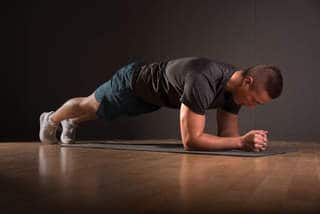

RKC Plank
Muscles involved:
- Rectus abdominis
- Erector spinae
- Hamstrings
- Abdominals
- Glutes
- Pectoralis major
- Anterior deltoid
- Triceps brachii
- Biceps brachii
- Serratus anterior
- Rotator cuff (stabilizing shoulder muscles: supraspinatus, subscapularis, teres major, teres minor)
- Latissimus dorsi
- Trapezius
RKC Plank instructions
- Lie on the floor and place your forearms shoulder-width apart on the floor. Bring your hands together by placing one hand over the fist of the other hand. Now raise your hips until your legs and back are aligned with the natural curvature of your spine. Do not arch or round your back excessively.
- Now pull your shoulders inward by contracting your chest.
- Tighten your glutes as strongly as possible by squeezing them together.
- Try to push yourself forward from your toes while pushing yourself backward against your arms.
Steps 2 through 4 should not visibly change the exercise in any way, other than possibly making your facial expression look more strained because of the tension you are trying to create throughout your body.
RKC Plank technique
In gyms, people usually perform dynamic exercises for the abdominal muscles. However, the abdominal muscles and other core muscles are not engaged in large movements for most of the day. They are almost constantly working to stabilize the trunk. Plank exercises therefore strengthen this practical function. This makes them highly suitable not only for active athletes and injury prevention, but also for preventing back problems in less active people.
Alternatives
- Side plank
- Front plank
- Incline plank
Run your fitness business with more structure
- Planning, member management and coaching in one platform
- Built for coaches, studios and gyms
- Fewer separate tools, more overview