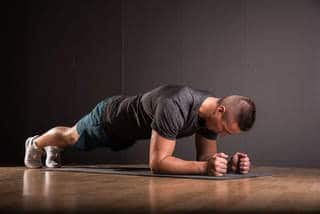
Front Plank
Plank exercises are stabilizing exercises. Maintaining a plank position requires the muscles in the lower back, abdomen, glutes, and legs (especially the hamstrings) to work to keep the back and legs aligned.
The muscles in the chest and shoulders assist in stabilizing the shoulders and torso (upward, downward, and sideways). The biceps and triceps assist in maintaining the alignment of the arms and preventing forward or backward movement.
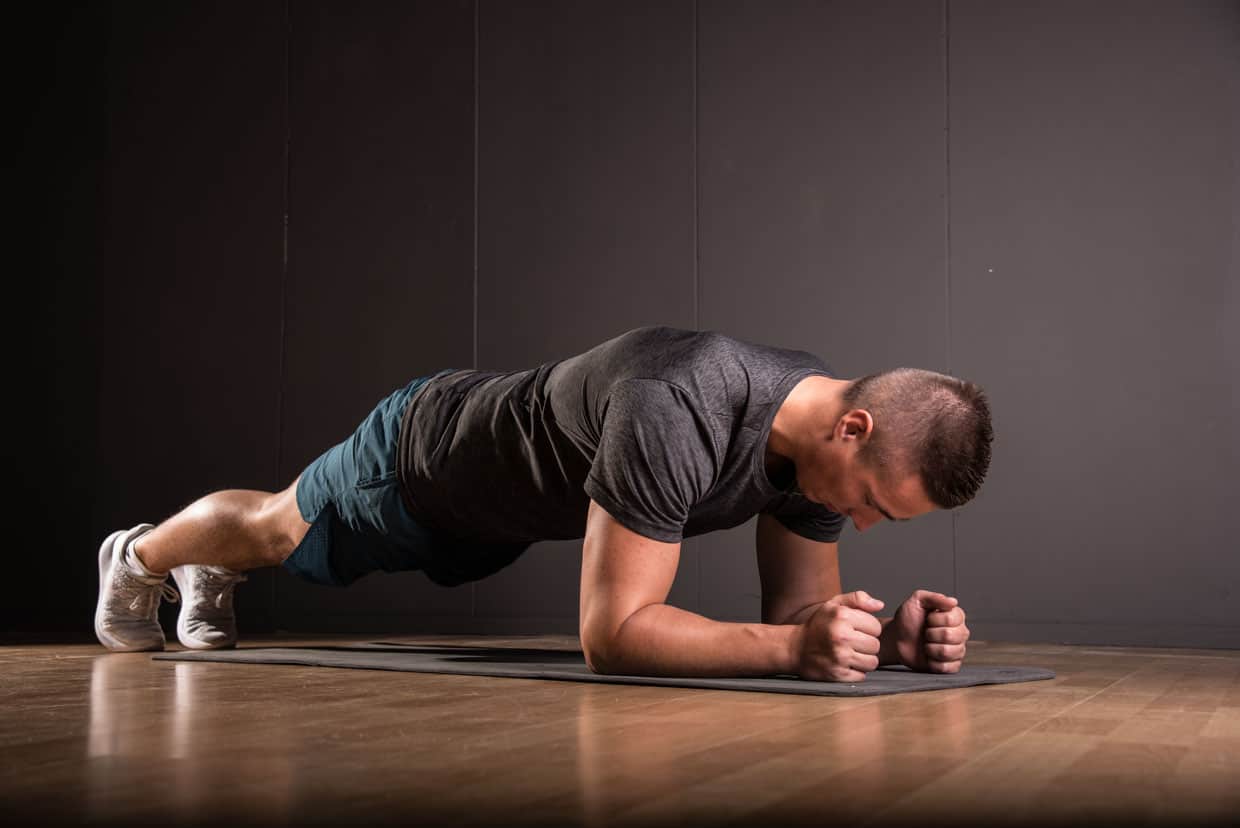
Front Plank
Muscles involved:
- Rectus abdominis
- Erector spinae
- Hamstrings
- Abdominal muscles
- Gluteal muscles
- Pectoralis major
- Anterior deltoid
- Triceps brachii
- Biceps brachii
- Serratus anterior
- Rotator cuff (stabilizing shoulder muscles, supraspinatus, subscapularis, teres major, teres minor)
- Latissimus dorsi
- Trapezius
Front Plank execution
Lie on the floor and place your forearms with clenched fists shoulder-width apart on the floor. Now push your hips upward until your legs and back are aligned, maintaining the natural curvature of your back. Do not excessively arch or round your back.
Front Plank technique
In gyms, people usually perform dynamic exercises for the abdominal muscles. However, the abdominal muscles (and other core muscles) are not engaged in large movements for most of the day. They are almost continuously engaged in stabilizing the torso. Plank exercises therefore strengthen this practical function. This makes them not only highly suitable for active athletes and injury prevention, but also for preventing back problems in less active people.
Alternatives
- Side plank
- Elevated Feet Plank
Run your fitness business with more structure
- Planning, member management and coaching in one platform
- Built for coaches, studios and gyms
- Fewer separate tools, more overview