Cable Woodchopper
The cable woodchopper primarily targets the obliques (internal and external). These muscles on the sides of the abdomen rotate the torso and straighten the torso from a laterally tilted position (lateral flexion of the spine). In this exercise, you train them by performing the function of rotation. Using cables provides an easy way to add resistance to the exercise.
The rectus abdominis, transversus abdominis, and erector spinae primarily have a stabilizing function in this exercise.
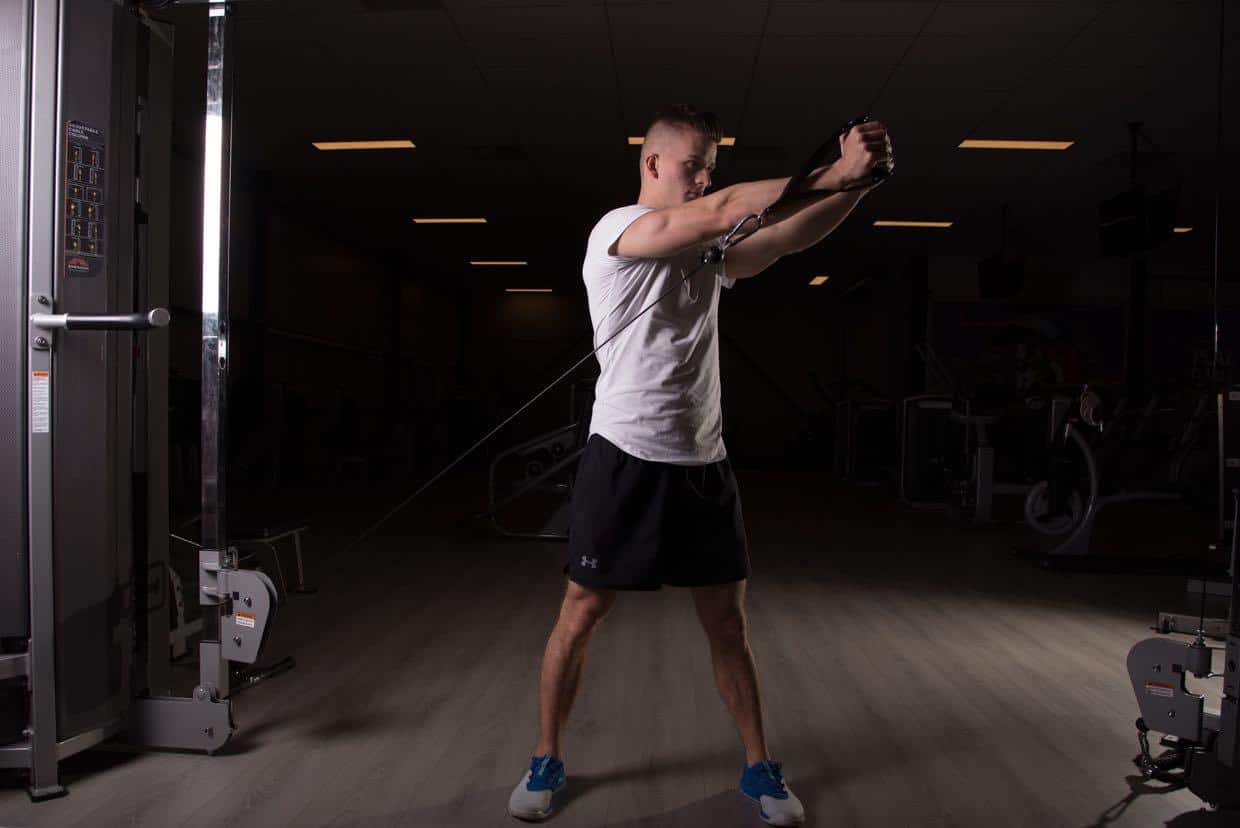
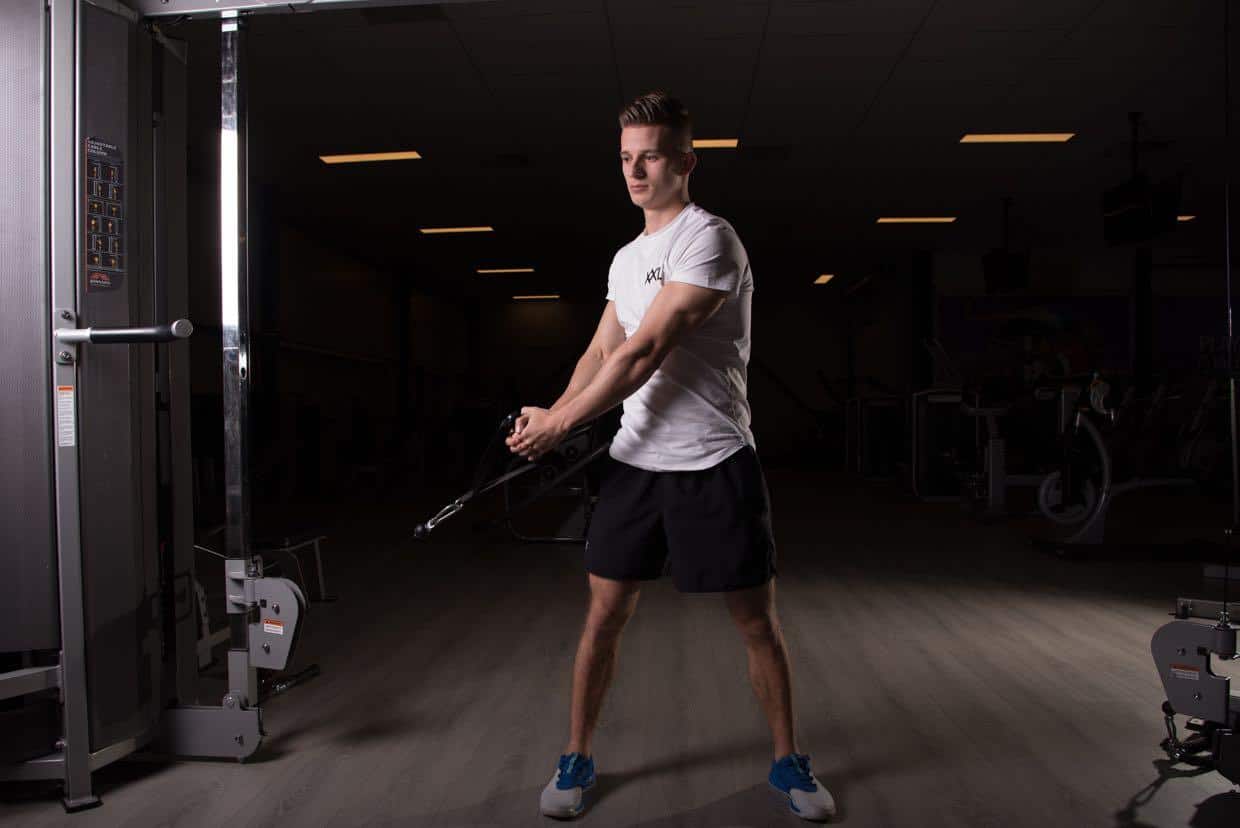
Cable woodchopper
Active muscles:
- External oblique (external abdominal oblique)
- Internal oblique (internal abdominal oblique)
Stabilizing:
- Transversus abdominis (transverse abdominal muscle, or 'corset muscle')
- Rectus abdominis (straight abdominal muscle)
- Erector spinae
Execution:
- Stand in the cable rack, slightly behind the imaginary line between both cables. Keep both legs slightly bent.
- Set the pulley at chest height or slightly lower and attach a single handle.
- Grasp the handle with both hands. Most of your body weight (approximately 70%) rests on the leg closest to the cable.
- Make sure the distance is such that there is still tension on the cable when you are turned toward the cable with both arms extended. This is your starting position.
- Bring the cable across the front of your body to the other side.
- Controlledly return the cable to the starting position
Notes:
The cable woodchopper can be performed in several ways.
The movement path can be horizontal, but also diagonal, and can be performed at different heights. In addition, you can try to perform the exercise as isolated as possible by rotating only from the waist and using the legs as little as possible. Emphasizing or neglecting the eccentric part of the exercise (the way back) can also be a choice.
The chosen execution depends on the goal. Normally, for muscle strength or mass of a specific target group, you could choose an isolated execution. You may question whether increasing muscle mass in the muscles at the sides of the waist is a common goal. This does, after all, increase the circumference of the waist. Developing strength in these important core muscles will more often be the reason. In this respect, 'strength' should primarily be interpreted functionally. Depending on which function needs to be improved, the exercise can be performed with a specific focus.
In most cases, this will mean that it is desirable to initiate the movement with the legs, particularly the leg closest to the cable. The height of the cable, the height at which the exercise is initiated, and the height of the endpoint can also be selected based on a specific goal. The same applies to the speed at which the exercise is performed. It can be performed explosively with as much acceleration as possible or somewhat more slowly with greater emphasis on resistance.
Run your fitness business with more structure
- Planning, member management and coaching in one platform
- Built for coaches, studios and gyms
- Fewer separate tools, more overview