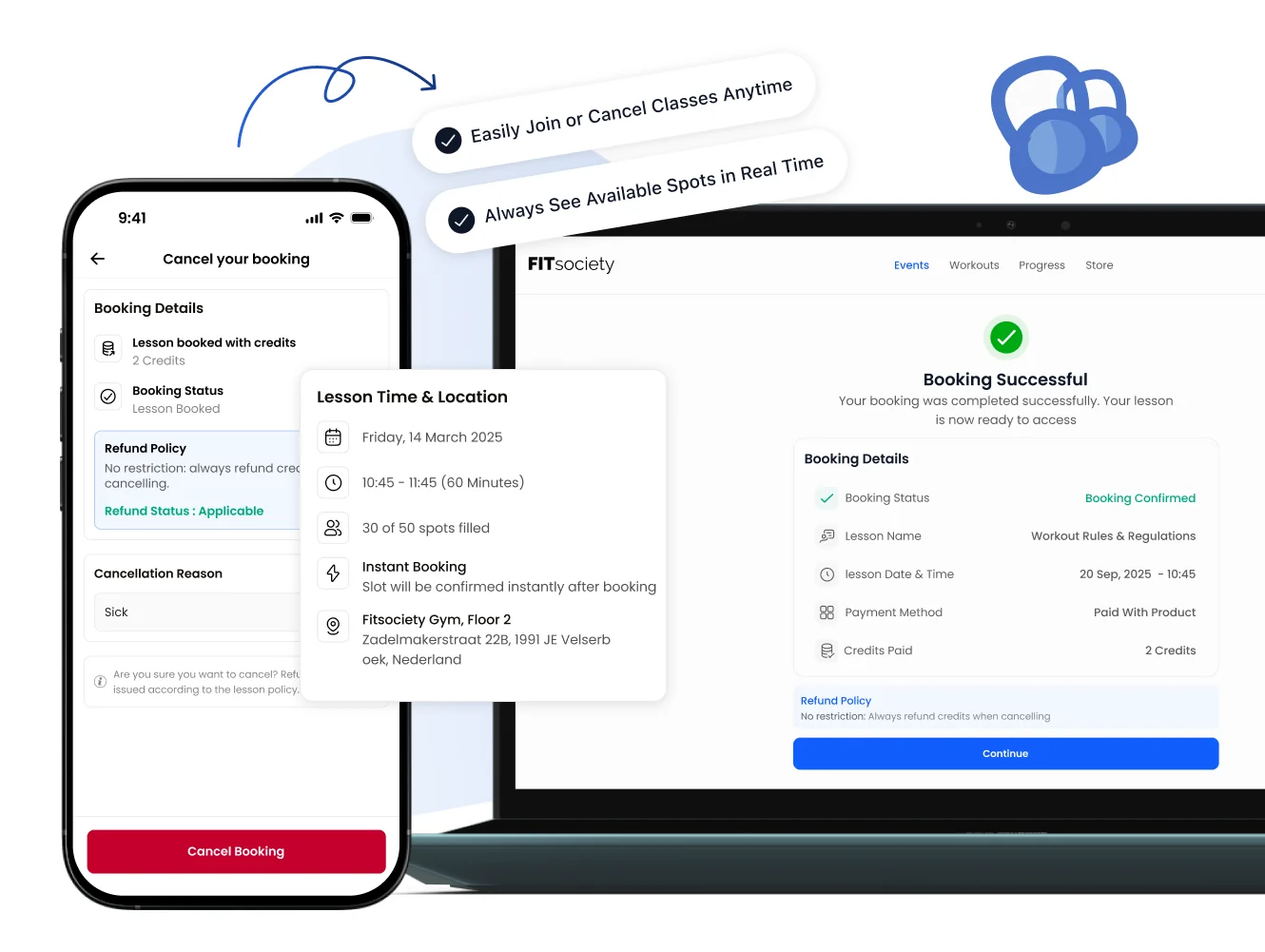
Half an hour before class, a message arrives: “I cannot make it today.” One colleague returns the credit, another points to the booking terms, and the next client asks why they did not get an exception. Meanwhile, a space stays empty.
Start with the booking: what was agreed, what actually happened, and which outcome can you confirm? Reply kindly, offer a clear next step and record the decision so the next colleague can see it. You do not need to redesign your service every time a message arrives.
Separate four situations
| Situation | First action | Do not promise yet |
|---|---|---|
| The client cancels before the agreed deadline | Check and process the cancellation | A replacement place without confirmation |
| The client cancels after that deadline | Check the applicable arrangement and any exception | Both a returned credit and a make-up class |
| The client misses class without cancelling | Check the attendance record and contact them | That every absence was deliberate |
| Your studio or coach cancels | Use the separate arrangement for provider cancellations | The same outcome as a client cancellation |
A late cancellation is still useful information. You know the person is not coming and can check whether another participant can use the space. Explain how clients can notify you even after the deadline.
Choose a deadline that fits the timetable
There is no single deadline that works for every business. Personal training reserves a coach’s time. Yoga and mat Pilates require attention to class size, supervision and whether someone can still attend. Reformer Pilates adds a limit set by the available machines.
Review your last ten cancellations. How much notice did you receive? Was there a waiting list? Did someone actually take the place? A firmer message does not make an unpopular morning slot easier to sell.
In your offer, specify the cancellation deadline, the channel, the booking consequences and who reviews exceptions. This guide does not prescribe a universally valid fee or legally binding terms. Have the conditions checked for your service and jurisdiction before introducing or changing them.
Check first, decide second
- Find the original booking and the time the cancellation was received.
- Check the arrangement attached to that product. A drop-in, class pack and unlimited membership are different.
- Check what has already happened: cancellation, credit returned, payment retained or an alternative promised.
- Let the designated person review a personal exception. Record the decision without collecting an unnecessary private history.
- Confirm the outcome and the next step to the client.
Use a first incident to explain the arrangement calmly. When cancellations recur, discussing the usual time slot or booking format may help more than repeating a warning. An exception may be appropriate, but do not promise it before the responsible person has decided.
Three messages to adapt
Fill in the brackets and verify the booking status before sending. These are communication examples, not contract terms.
A first late cancellation
Hi [name], thanks for letting us know. Your cancellation for [class/date] arrived after [agreed deadline]. For this booking, [verified outcome] applies. Next time, you can cancel through [channel]. Let us know if that does not work and we will help.
A recurring pattern
Hi [name], it has been difficult for you to attend at [time] a few times recently. Does this slot still suit you? Let us look at [specific alternative]. For [date], [verified outcome] still applies; we will confirm any new arrangement separately.
An exceptional or unclear situation
Hi [name], thanks for your message. I will ask [responsible person] to review the arrangement for [booking]. You will hear from us by [time]. I cannot confirm a refund or replacement class yet, so that you receive a clear and accurate answer.
An empty place is not automatically lost revenue
Separate attendance from money. A paid place that stays empty differs from a returned credit. A waiting-list entry is not a new sale. If another member attends using an existing membership, that does not automatically generate additional income.
Track the cancellation, physical attendance, value retained or returned, and any genuinely new payment separately. Use the information to improve the timetable and communication, rather than assigning an imaginary loss to every empty mat.
Use the separate guide to make-up classes when arranging a replacement visit. Check that the same missed booking is not compensated twice through both a returned credit and an additional class.
A checklist for the next four weeks
- Make the arrangement easy to find before booking, with a precise deadline and cancellation channel.
- Assign one exception owner and keep one shared record of the outcome.
- Check that the client confirmation, administration and booking status agree.
- Count late cancellations, places subsequently filled and questions requiring repeated contact each week.
- Review the unclear steps with your team after four weeks. Compare rates as well as counts against total bookings.
Frequently asked questions
Must every client receive the same outcome?
Use the same checks and identify who reviews exceptions. Fair treatment also requires recognising relevant differences in bookings and circumstances.
Can a client still cancel after the deadline?
Provide a clear way to notify you. Any change to credits or payments depends on the applicable arrangement and the verified handling of that booking.
What if someone else takes the place?
Check what your offer says. A replacement attendee, an existing membership booking and an additional paid sale are different outcomes.
Make the arrangement workable
Start with five recent cancellations and check whether a colleague would reach the same decision. Explore FITsociety’s calendar and the options for yoga studios and Pilates studios. Book a demo and bring one real booking scenario to discuss how the workflow fits your offer.