Yes. Integrating selected wearable signals into a permissioned, coach-run workflow supports faster, safer session decisions. Start with three signals: heart rate, a rolling HRV baseline, and sleep duration. The recommended pattern for most coaching businesses is a mobile bridge feeding a unified data model, not a patchwork of native vendor connections.
TL;DR:
- Wearable signals like heart rate, HRV, sleep, steps, and power are most useful when tied to specific coaching decisions, such as session readiness or recovery.
- Automating basic checks, like resting heart rate versus baseline or sleep duration, helps prevent data noise but requires human judgment for action.
- Using a unified data model or platform connector for multiple device brands reduces long-term maintenance and supports scalable coaching workflows.
- Consent and permission processes must clearly explain data use and ensure secure storage, with read restrictions varying by platform, especially for history access.
- HRV research shows trend-based interpretation supports load moderation without compromising fitness improvements, but signals should always be reviewed by a coach.
Where wearable data actually helps coaching
Wearable integrations for coaches work best when tied to a specific decision point, not used as a general dashboard. Five use cases cover most of the value.
- Pre-session readiness: HRV trend and sleep duration flag when to moderate load before a client walks in.
- In-session pacing: Heart rate and power data let a coach adjust intensity objectively instead of relying on perceived effort alone.
- Recovery tracking: Multi-day HRV and resting heart rate trends inform periodization decisions across a training block.
- Remote accountability: Step counts and workout logs give online coaches a signal between check-ins without requiring daily messages.
- Return-to-play monitoring: Combined heart rate and sleep data support gradual reintroduction of load after injury, alongside clinical guidance.
Each use case maps to a different data cadence. Readiness checks need same-day data. Periodization decisions need weeks of trend data. Remote accountability needs consistency more than precision. A coach running one-on-one sessions and a coach managing forty online clients will prioritize these differently, but the underlying signals stay the same: heart rate, HRV, sleep, and activity volume.
The fitness trends for 2026 point to wearables becoming a standard input in coaching, not a novelty add-on. That shift changes what clients expect from a check-in, but it does not change the coaching judgment required to act on the data.
Building a pre-session data check protocol
A repeatable check before each session prevents wearable data from becoming noise. Five minutes, done the same way every time, is enough.
- Check resting heart rate against the client’s 7-day average. A jump of several beats per minute above baseline is worth a conversation before loading the session.
- Check HRV against a rolling baseline, not a single reading. One low morning reading is common and often meaningless; a multi-day downward trend is the signal that matters.
- Check sleep duration from the prior night. Short sleep changes how much load a session should carry, particularly for high-intensity work.
- Check for missed data. A gap in tracking is itself information: it may mean a client stopped wearing the device or skipped a rest day.
- Decide: proceed as planned, adjust volume or intensity, or flag for follow-up. This decision stays with the coach, not the device.
Pro Tip: Set a rolling 7-day baseline for HRV and resting heart rate rather than comparing to a single “normal” number; single-day comparisons produce false alarms.
Automating the first three checks into a digest or dashboard card saves time, but the escalation decision is a coaching judgment, not an automated one. When a signal pattern suggests something beyond training load such as illness or persistent poor sleep, the appropriate response is to refer the client to a medical professional rather than adjust programming. Coaches operate outside clinical scope, and wearable data does not change that boundary.
Which devices and signals are worth tracking
Not every metric a wearable reports is equally useful for coaching decisions. Some are stable and actionable; others are noisy or require specific conditions to trust.
- Heart rate is broadly reliable across most consumer wearables during steady-state activity, less so during rapid movement changes.
- Heart rate variability is more sensitive to motion artifacts and measurement timing; morning, at-rest readings are more trustworthy than readings during activity.
- Sleep duration is generally usable for coaching purposes; sleep staging (light, deep, REM) carries wider error margins and is better treated as a rough indicator.
- Steps and activity minutes are consistent enough for adherence tracking but not precise enough for energy expenditure estimates.
- Power and cadence from dedicated sensors (cycling power meters, running pods) tend to outperform wrist-based estimates for pacing decisions.
The case for smartwatches in athlete monitoring covers practical best practices for interpreting these signals in a training context. Whether a signal comes from an on-device store or a cloud API also affects what a coach can access: on-device data (HealthKit, Health Connect) reflects everything the phone has synced, while cloud API data depends on what the vendor’s servers have processed and how far back the historical window extends.
Choosing an integration architecture that will not become a burden
Three architecture patterns are available for pulling wearable data into a coaching workflow, and the right choice depends on team size more than ambition.
- Phone-as-bridge: A mobile app requests permission from HealthKit or Health Connect and relays data to a server. This is required whenever data lives only on-device, because on-device stores cannot be read directly by a server: a permissioned mobile client has to sit in between.
- Direct vendor API: Connecting to a single vendor’s cloud API, such as the newly consolidated Google Health API, which replaces legacy Fitbit endpoints and adds intraday data and webhook support. This works well for a coach whose clients mostly use one brand of device.
- Aggregator or unified data model: A third-party layer normalizes data across multiple vendors into one schema. This reduces the long-term maintenance burden of supporting many native integrations individually.
For a solo coach or small team, native integration with every device brand is rarely worth the engineering cost. A single aggregator, or a platform connector that already normalizes the common signals, is the more sustainable starting point.
Pro Tip: If most clients use two or three device brands, a platform connector covering those brands will handle the majority of cases; add native support only when a large share of clients request an unsupported device.
Real-time needs also shape the choice. Webhooks push data as it becomes available, useful for same-day readiness alerts. Batched sync, pulling data once or twice daily, is sufficient for weekly trend review and periodization decisions. Most coaching workflows do not need true real-time data: a morning batch pull covers pre-session checks for same-day sessions.

What permissions and consent you need to collect
Wearable data is sensitive, and both Apple and Google enforce structured permission models rather than open access.
- HealthKit requires purpose strings and per-type permissions. Apple’s guidance requires apps to request access to each data type individually and explain, in plain language, why that access is needed.
- Health Connect limits historical access. Android’s Health Connect restricts reading data older than 30 days prior to when permission was granted, unless a persistent read permission is separately requested and approved.
- No advertising use. Both platforms restrict wearable health data from being used for advertising purposes; coaching platforms should store this data securely and separately from marketing systems.
- Vendor terms change. Data-use terms, including restrictions on feeding wearable data into AI or LLM contexts, have shifted across vendors; check each device maker’s current policy before routing data into an AI feature.
A short onboarding consent checklist should cover: which data types are requested, why each is needed, how long historical data will be visible, and where the data is stored. Clients should see this before linking a device, not after.
What the research says about HRV and noisy signals
HRV-guided training produced fitness gains comparable to fixed programming while recording fewer high-intensity days according to trials, according to a review of HRV-based exercise prescription, which also reported high participant compliance with daily HRV recording across the trials reviewed. For coaches, the practical takeaway is that HRV trends can support load moderation without sacrificing training outcomes, provided the signal is read as a trend rather than a single data point.
Common data-quality failures include motion artifacts during HRV capture, inconsistent sensor placement, and irregular wear time. Mitigations are straightforward:
- Treat any HRV reading taken during activity or immediately after waking with more skepticism than a still, seated morning reading.
- Filter out days with partial device wear rather than averaging them into a baseline.
- Recalibrate expectations after a device firmware update or a switch to a new device model.
A narrative review of wearable biosensing and machine learning in coaching contexts concludes that these systems function as decision-support when paired with signal quality control and human oversight, not as autonomous coaching tools. That framing should guide how any AI feature is used inside a coaching workflow: it flags patterns, the coach decides.
A small validation pilot, four to six weeks with five to ten clients who already track consistently, is enough to confirm whether the signals and thresholds chosen actually match what the coach observes in sessions.
Setting up the workflow step by step
Turning the checklist above into a working system takes a handful of concrete steps.
- Pick two or three core signals. Heart rate, HRV, and sleep duration cover most pre-session decisions; resist adding more before these are working reliably.
- Write the consent and permission flow first. Draft the purpose strings and the client-facing explanation before any technical integration work begins.
- Map data fields to coaching metrics. Decide what a “readiness flag” means in terms of specific thresholds, and build a simple digest card showing those flags per client.
- Set automated alerts for the checks that can be automated. A daily digest or dashboard flag for out-of-range heart rate, HRV, or missed data covers the mechanical part of the pre-session check.
- Run a pilot with a small group before rolling out to every client. Four to six weeks is enough to catch threshold problems and false alarms.
- Adjust thresholds based on what the pilot shows, then expand.
Pro Tip: Build the digest card around three fields only at first: today’s resting heart rate versus baseline, today’s HRV versus rolling average, and last night’s sleep duration. Add fields only once the basic version is used consistently.
How FITsociety supports these workflows
This community-driven fitness software is designed for personal trainers, online coaches, studios, and gyms, incorporating input from fitness professionals on practical needs. Several parts of the checklist above align with capabilities offered by this type of platform.
- Intake and onboarding: Client intake forms and check-ins provide a structured starting point for collecting consent language and baseline information.
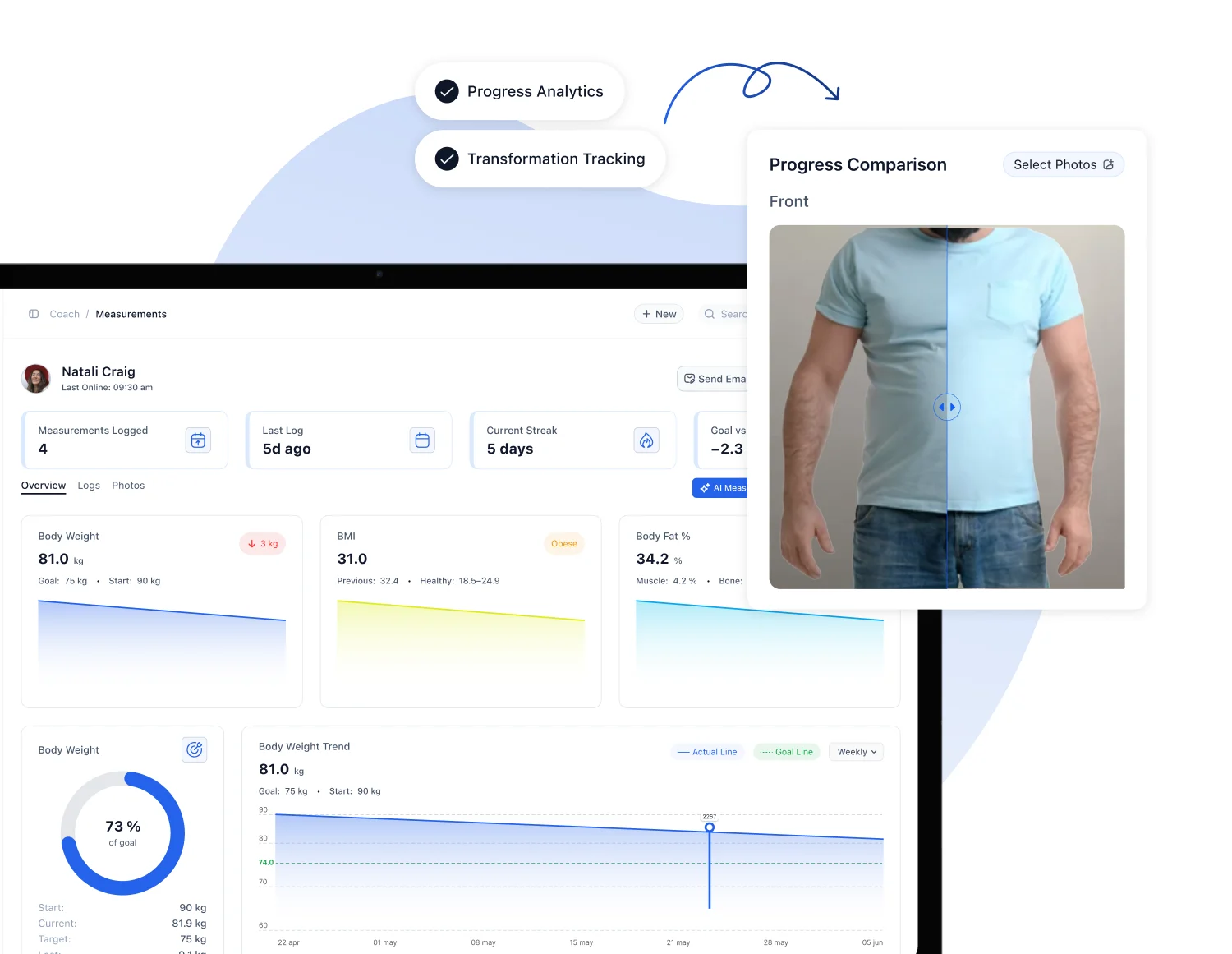
- Progress tracking: Built-in tracking tools provide a place to log the metrics chosen for the digest, alongside training and nutrition plans.
- API and MCP: A public API and MCP support are available for teams building connected workflows; specific endpoints, supported actions, and permissions should be verified against official documentation before implementation.
- CoachAI: CoachAI assists with drafting training plans, forms, and recipes, supporting coaches while leaving programming decisions with them.
- Calendar sync: Integrations with Google Calendar and Microsoft Outlook/Microsoft 365 support scheduling around session readiness, covered further below.
Coaches building an alert digest or a rescheduling flow around wearable signals should confirm current sync behavior and API scope on FITsociety’s calendar feature page before operationalizing it, since exact behavior can change between releases.
Onboarding clients and syncing the calendar
A clean onboarding script and calendar setup determine whether the workflow above actually gets used week to week.
- Explain the purpose before requesting access. Tell the client which data types are needed (heart rate, HRV, sleep) and what decision each one supports.
- Link the device through a mobile app bridge when the data lives on-device. This step is unavoidable for HealthKit and Health Connect data, since a server cannot read those stores directly.
- Sync the coaching calendar. Google Calendar and Microsoft Outlook/Microsoft 365 integrations let session times reflect availability changes; verify current sync frequency and conflict handling before relying on it for same-day rescheduling.
- Surface readiness flags ahead of the booked session, not after, so the coach has time to adjust the plan.
- Track pilot metrics for six weeks: how often flags appear, how often they change a session plan, and how often clients keep the device linked without lapsing.
Group bookings and online PT sessions both benefit from the same readiness flag showing up before the calendar slot, whether the session is in-person or remote.
Putting wearable data to work with FITsociety
Coaches who want to run the workflow described above without building custom integrations from scratch have an existing option in FITsociety. The platform brings intake forms, progress tracking, training and nutrition plans, group bookings, online PT, and calendar sync into one dashboard, so the pieces needed for a wearable-informed workflow already sit next to each other instead of across separate tools.
CoachAI can help draft the forms and check-in templates used during onboarding, leaving the coach to set thresholds and make the judgment calls. The public API and MCP support give technically minded teams a path to connect wearable data sources into the same dashboard clients already use, though specific endpoints and permissions should be confirmed against current documentation before building on them.
FITsociety’s development is shaped by feedback from working coaches, and new capabilities are prioritized based on that input rather than promised on request. Coaches curious whether their specific setup fits should review the coaching product page or check current plans and pricing directly, since plan limits and features are confirmed there rather than assumed.
Sources
- Impact of heart rate variability-based exercise prescription
- Configuring HealthKit access | Apple Developer Documentation
- Android Help: Health Connect permissions and access
- About the Google Health API | Google for Developers
FAQ
Do I need a mobile app to access client wearable data?
Yes, when the data lives in an on-device store like HealthKit or Health Connect, a mobile app has to request permission and relay it to a server, since servers cannot read those stores directly. A direct vendor cloud API connection can sometimes avoid this requirement, depending on the device brand.
How far back can I access a client’s historical wearable data?
It depends on the platform: Health Connect on Android limits historical access to 30 days before permission was granted, unless a persistent read permission is separately requested. Apple’s HealthKit access is granted per data type, and availability of older data depends on what the client’s device has already synced.
Is HRV-guided training actually supported by evidence?
Small trials suggest HRV-guided training produces fitness improvements comparable to fixed programming, while reducing the number of high-intensity training days needed to get there. The evidence supports using HRV trends as one input for load decisions, not as a replacement for coaching judgment.
Should AI make training decisions based on wearable data?
No. Research on wearable biosensing and machine learning in coaching contexts describes these systems as decision-support tools that depend on signal quality control and human oversight, not autonomous coaching. A coach should treat AI-generated flags as prompts to review, not instructions to follow automatically.
Does FITsociety integrate directly with wearable devices?
FITsociety offers a public API and MCP support for connected coaching workflows, alongside built-in progress tracking, intake forms, and calendar sync with Google Calendar and Microsoft Outlook/Microsoft 365. Specific wearable integration endpoints and supported actions should be verified on FITsociety’s official pages before building a workflow around them.