An automated, retention-first dunning workflow, meaning smart retries paired with one-tap self-service card updates, recovers the majority of rescuable failed membership charges and stops most involuntary churn before it starts. The fix isn’t one tool; it’s a sequence: expiry reminders before the card dies, three retries spaced over 7 to 14 days, tokenized update links in every message, and a human phone call for high-value members who don’t respond by day seven.
TL;DR:
- Sending expiry reminders and enabling account-updater services can prevent many card expiration failures without member intervention.
- Retry schedules on Day 1, Day 3, and Day 7 backed by smart network signals significantly improve recovery rates over fixed or manual follow-up.
- Personalized messaging referencing member benefits and easy one-tap update links boost payment recovery by around 18 percent compared to generic or invoice-focused messages.
- Access restrictions at 72 hours give automated workflows time to recover accounts before canceling high-value members or involving staff callbacks.
- Transitioning from manual to automated, staged dunning processes can raise recovery rates from 58 percent to over 82 percent, saving revenue and improving member retention.
Why Reduce Failed Payments in Fitness Matters for Your Bottom Line
A failed charge isn’t a billing hiccup. It’s the first domino in a churn event that you can usually stop, if you move fast enough.
Industry benchmarking from ClubIntel and IHRSA puts involuntary churn at roughly 30 to 40 percent of total membership churn, driven almost entirely by unresolved failed payments rather than members who actually wanted to quit. Run the math on a mid-size studio with 400 members paying $120 a month: even a conservative 8 percent monthly failure rate puts roughly $3,800 at risk every billing cycle. Multiply that across a year and you’re looking at tens of thousands of dollars that never should have left the books.
The recovery window is short and front-loaded. Data from Recurly’s payment analysis shows that 90 percent of successfully recovered transactions happen within the first 10 days after the initial failure. Wait two weeks to follow up and you’ve likely missed the window entirely; the member has mentally moved on, found a competitor, or simply stopped noticing your gym’s absence from their bank statement.
Speed determines outcome here. A failed payment addressed on day one behaves nothing like the same failure ignored until day twenty, even though the underlying issue (an expired card, say) is identical.
What Causes Membership Payments to Fail?
Not every decline is the same problem, and treating them identically wastes retry attempts and annoys members who never needed a nudge. Failed transactions generally fall into a handful of recognizable buckets:
- Expired or reissued cards. The most common and most recoverable failure; the member’s bank issued a new card number and nobody updated the file.
- Insufficient funds. Often timing related to payday cycles; retrying a day or two later frequently succeeds without any message at all.
- Issuer hard declines. The bank has flagged the transaction as fraud-suspect or account-closed; retrying immediately almost never works and can trigger issuer penalties.
- 3DS or authentication friction. The card requires a verification step the original transaction didn’t complete, common with European cards and increasingly with U.S. issuers.
- ACH returns. Bank account transfers fail for reasons ranging from closed accounts to insufficient funds, and they carry longer resolution timelines than card transactions.
- Technical or processing errors. Gateway timeouts, expired tokens, or mismatched billing details that have nothing to do with the member’s actual ability to pay.
Reading the decline code matters more than most operators realize. Stripe’s documentation on hard declines is explicit: hard-decline codes cannot be auto-retried and require a new payment method entirely. Soft declines like insufficient funds are worth retrying on a schedule; hard declines need a human message and a new card, full stop.
High-Impact Prevention and Recovery Strategies: The Operational Playbook
This is where most fitness businesses either close the revenue gap or keep bleeding it quietly every month. The sequence below is ordered by priority, not chronology, so start at the top if you’re building from scratch.
- Pre-dunning before the failure happens. Send expiry reminders 30 and 7 days before a card lapses. Enable account-updater services if your payment processor supports them, since these can silently refresh expired card data without member action. Encourage a backup payment method on file for members who’ve had prior issues.
- Smart retries on a defined schedule. The practitioner standard is retries on Day 1, Day 3, and Day 7, giving payday cycles time to refresh a thin account balance. Optimized, network-informed retry logic can lift recovery rates by 10 to 20 percentage points over rigid single-merchant retry rules, largely because it uses issuer-level timing signals instead of a flat calendar. Never retry immediately on a hard decline or a flagged fraud code; you’ll waste the attempt and risk an issuer cap on future retries.
- Retention-first dunning messaging. Same-day tokenized SMS on the first failure, a Day 3 escalation email, and a Day 6 or 7 “last chance” message that references what the member stands to lose, not just what they owe. Personalized messaging that mentions specific benefits or classes recovers payments at roughly 18 percent higher rates than generic, accusatory billing language.
- Self-service updates with zero friction. A one-tap tokenized link that lets a member update their card without logging into a portal is often the single highest-return feature you can add to a dunning flow. Put that link in every message, not just the first one.
- Access restriction with a human safety net. Freeze account access at 72 hours rather than canceling immediately; that gives the automated sequence room to work. For high-lifetime-value members who haven’t responded by Day 7, route them to a staff callback instead of letting the system cancel automatically.
- Measure and tune constantly. Track recovery rate, time to recovery, and revenue at risk on a rolling basis, and revisit your retry timing quarterly as issuer behavior shifts.
Pro Tip: Write your Day 7 message as if you’re talking to someone you’d genuinely miss training, not someone who owes you money. Practitioner data backs this up: benefit-referenced copy outperforms invoice language by a wide margin.
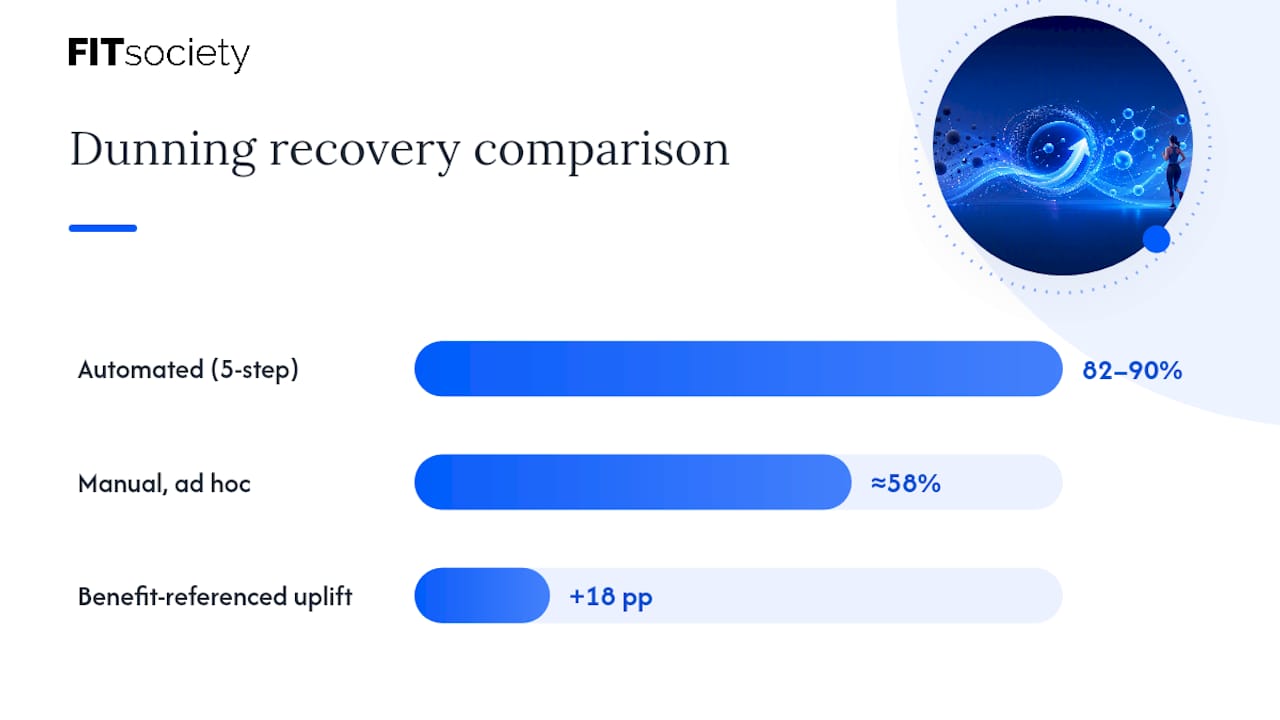
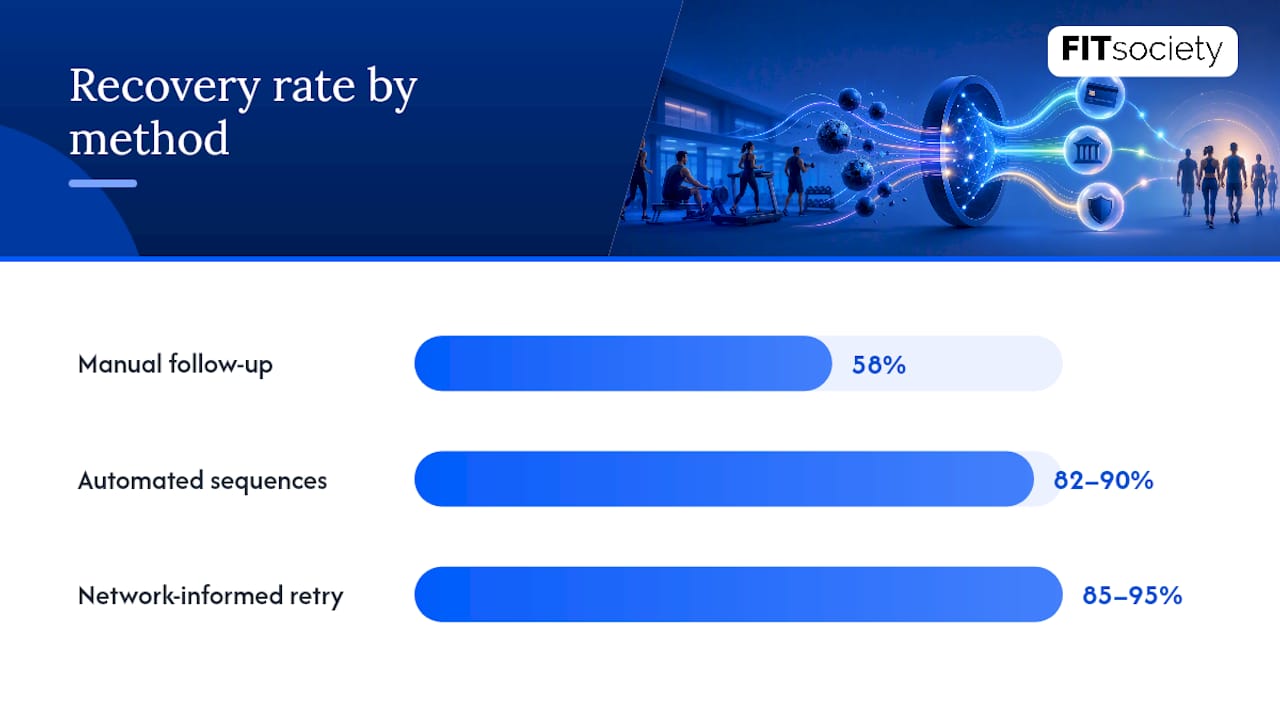
Automated, multi-step sequences aren’t a marginal improvement over manual follow-up. A structured 5-step dunning workflow, meaning notification, retries, escalation, access restriction, and staff fallback, recovers materially more revenue than single-notice approaches, with practitioner reporting showing automated implementations reaching 82 to 90 percent recovery compared to roughly 58 percent for manual, ad hoc follow-up.
How Do You Audit and Fix Your Current Payment Recovery Process?
Most operators discover their real failure rate the first time they actually pull the numbers, and it’s usually higher than gut instinct suggests.
Audit (this week):
- Pull the last 90 days of failed payment events from your billing system.
- Calculate your failure rate (failed transactions ÷ total transactions).
- Calculate your current recovery rate (recovered ÷ failed) and average time to recovery.
- Total the revenue currently at risk from unresolved failures.
Configure (week one):
- Turn on account-updater if your processor offers it.
- Set a 3-step retry schedule (Day 1, Day 3, Day 7) or enable smart retry logic if your platform supports it.
- Add SMS as a channel alongside email, and embed a tokenized update link in every touchpoint.
- Set your access-restriction window (72 hours is a reasonable starting point).
Process (week two):
- Draft three message templates: first notice, escalation, and last chance.
- Assign a named staff member to handle Day 7 callbacks for high-value accounts.
- Build a simple dashboard tracking recovery rate, time to recovery, and revenue at risk.
On targets: manual follow-up typically recovers around 58 percent of failed payments, automated sequences land in the 82 to 90 percent range, and advanced network-informed retry logic can push recovery rates as high as 85 to 95 percent as your process matures. A simple way to estimate recovered revenue: multiply your monthly failed-payment total by the gap between your current recovery rate and your target.
How FITsociety Supports This Workflow
FITsociety connects membership billing, communication, and scheduling in one dashboard, which matters because payment recovery works best when it’s tied to what a member is actually doing, not treated as a standalone billing task. The platform’s membership and payment tools let coaches and studios manage recurring billing alongside client records, so a failed charge and a member’s booking history live in the same place.
Automated reminders and the member self-service portal reduce the manual chasing that eats staff time, while Google Calendar and Microsoft Outlook/365 integrations keep booking and attendance data visible alongside billing status. This context helps staff prioritize: a member who trains four times a week and just had a card decline is a different conversation than one who hasn’t shown up in two months.
FITsociety also offers a public API and MCP support for teams that want to connect payment-failure events to their own automation. Exact retry logic, notification channels, and setup steps vary by plan, so confirm current capabilities on FITsociety’s feature and pricing pages before building a configuration around them. Community feedback from fitness professionals continues to shape how these workflows evolve.
Real-World Improvements From Structured Dunning Programs
Gyms and studios that move from ad hoc follow-up to a structured, automated dunning sequence tend to see the gap close fast, largely because the fix targets the exact window where most recoveries happen. Practitioner reporting on automated gym billing recovery documents recovery rates climbing from roughly 55 to 65 percent under manual processes to 82 to 90 percent after implementing a staged sequence with tokenized links and access restrictions.
The pattern holds across different business sizes: the lever isn’t more staff time, it’s better timing and lower friction. A member who gets a same-day text with a one-tap update link resolves the issue in the time it takes to wait in a checkout line. The same member, left to discover the problem when their app access freezes a week later, has already started shopping around.
Recovered members also tend to stick around longer than newly acquired ones, since they’ve already built a training habit. Pairing your payment recovery process with a broader member retention strategy compounds the effect: every dollar you recover from a lapsed card is a member you don’t have to replace through paid acquisition.
Getting Your Team Up to Speed on Payment Recovery
A dunning workflow only works if your front-desk and coaching staff understand what it’s doing and when to step in. Start training with the escalation points, not the technical setup: staff need to know that a Day 7 callback list exists, who’s on it, and what to say.
Keep the script simple and retention-focused. Staff shouldn’t open with “your payment failed”; they should open with something closer to “we noticed an issue with your card and wanted to make sure you don’t lose your spot in Tuesday’s class.” That framing mirrors the personalized messaging approach that drives higher recovery rates, and it keeps the conversation about the member’s experience rather than the invoice.
Run a short weekly review of the recovery dashboard with whoever owns billing operations. Two metrics matter most in these check-ins: how many high-value members hit the Day 7 escalation list, and how long recovery is taking on average. If either number drifts, that’s a signal to revisit retry timing or message templates before it becomes a larger churn problem.
Document the process once, then revisit it quarterly. Payment behavior shifts with issuer policy changes and seasonal cash flow patterns, so a workflow that worked in January may need retry-timing adjustments by summer.
A Practical Next Step for Your Billing Workflow
Running this playbook manually, meaning tracking retries in a spreadsheet and calling members one by one, works for a handful of accounts but breaks down fast once you’re managing hundreds of memberships. The platform brings billing, automated reminders, member self-service, and scheduling into one system, so a failed payment doesn’t sit disconnected from the rest of a member’s account.
Coaches and studio owners can manage recurring memberships alongside training and nutrition delivery, which means the person handling billing follow-up already has visibility into whether that member is actively training or already disengaged. The calendar integrations with Google Calendar and Outlook/Microsoft 365 keep booking activity in view alongside payment status, useful context when deciding who gets an automated nudge versus a personal call.
If you’re evaluating a platform switch, FITsociety’s guide on switching gym software without disruption walks through migrating member and payment data safely. To see current plans and what’s included at each tier, visit FITsociety’s software for coaches, studios and gyms and review the feature pages before configuring a recovery workflow around them.
Sources
The benchmarks and workflow recommendations in this guide draw on payment-processor documentation and practitioner analysis from the fitness billing space:
- Gym Billing Automation: Recover 95% of Failed Payments
- Failed payment recovery: data-based strategy (Recurly blog)
- Smart Retries — Stripe documentation
- The Failed Payment Leak: Recovering Members Who Never Meant to Quit — Gideon Wafula
For businesses focused on the retention side of recovered revenue, a partner resource on gym SEO and membership growth covers how acquisition strategy connects to the members you keep from churning.
FAQ
What happens if a gym membership payment fails?
Most billing systems flag the account and trigger a retry or a notification rather than canceling the membership immediately. A well-run recovery sequence gives the member 7 to 14 days and multiple retry attempts before restricting access, with full cancellation typically reserved for accounts that remain unresolved well past the initial failure.
Can I be charged again if my gym payment doesn’t go through?
Yes. Automated retry systems are designed to attempt the charge again on a schedule, commonly on Day 1, Day 3, and Day 7, rather than charging repeatedly without pause. Retries stop automatically once a hard decline code appears, since those transactions require a new payment method instead of another attempt.
Will an unpaid gym membership hurt my credit?
An unpaid membership itself doesn’t typically appear on a credit report unless the gym sends the unresolved balance to a collections agency. Policies vary significantly by business, so members should check their specific gym’s terms rather than assume a universal rule.
What happens if I put a stop payment on my gym membership?
A stop payment blocks the specific transaction from processing, but it doesn’t cancel the underlying membership agreement or contract. Most gyms will still attempt to collect the owed balance and may restrict account access under their standard failed-payment process until the member formally cancels or resolves the balance.
Does FITsociety help reduce failed payments for fitness businesses?
FITsociety connects membership billing with automated reminders and a member self-service portal, giving coaches and studios a single place to manage recurring payments alongside client activity. Specific retry configurations and plan availability should be confirmed on FITsociety’s pricing page before setup.