AI recipe generators can produce personalized recipes and macro-aware meal plans in seconds, matched to fat loss, muscle gain, or tracking goals. They excel at speed, variety, and pantry-to-meal ideas. They fall short on portion accuracy and micronutrient completeness. Treat outputs as drafts, not final numbers.
TL;DR:
- AI recipe generators can produce macro-aware meal plans quickly but often misestimate portion sizes and micronutrient content, especially in complex dishes.
- Accurate targeting relies on calculating BMR with Mifflin-St Jeor and adjusting for activity and goals, with protein targets around 1.2 to 2.0 grams per kilogram of body weight.
- Specific prompts with detailed profile data, ingredient weights in grams, and macro requests improve recipe usability and verification before consumption.
- Image-based estimates are accurate for identifying foods but less so for portion sizes and nutrients, making paired ingredient descriptions essential.
- Human review by coaches or dietitians remains vital to ensure micronutrient completeness, especially for clinical or strict tracking needs.
How AI recipe generators build a personalized meal plan
The process runs in three stages: profile, calculation, recipe generation.
Profile inputs typically include weight, height, age, activity level, goal, allergies, meal timing, and cuisine preference. The system converts these into a calorie target using a metabolic formula, most commonly Mifflin-St Jeor, then applies an activity multiplier to estimate total daily energy expenditure. Goal adjustments follow: a deficit for fat loss, a surplus for muscle gain, or a maintenance range for tracking. Many AI nutrition-agent projects follow this exact Mifflin-St Jeor and TDEE pipeline before adjusting for the user’s goal.
Recipe matching happens last. The model pulls ingredients from nutrition databases and applies portion heuristics to hit the target macros. Photo or pantry-based prompts enter here too.
- Profile data sets the calorie and macro baseline.
- Activity multipliers and goal adjustments shift that baseline up or down.
- Recipe generation matches ingredients and portions to the adjusted target.
- Image or pantry inputs add convenience but introduce more estimation error.
What these tools do well and where they fall short
AI recipe generators save time on variety, ingredient swaps, dietary filters, and turning leftover pantry items into a usable meal. They handle allergy exclusions and cuisine preferences without friction.
The accuracy gaps show up in portion size and nutrient completeness. Multimodal models generally identify foods in photos well but often misestimate portion sizes and nutrient content in medium and large meals, with notable errors across multiple nutrients, according to an evaluation of ChatGPT for nutrient content estimation. A separate comparison of AI-generated meal plans against dietitian guidelines found one model showed moderate alignment with energy requirements for simulated profiles, demonstrating promise with room for improvement, but alignment varied by model and task.
- Errors grow with complex, mixed dishes rather than single ingredients.
- Vague prompts and image-only inputs push error rates higher.
- Strict tracking or clinical needs require verifying AI totals against weighed ingredients.
Use AI for drafting and ideation. Verify totals before relying on them for precise tracking or medical nutrition needs.
Setting calorie and macro targets AI can actually follow
Reliable outputs start with a baseline the AI can work from, not guess at.
- Calculate BMR with Mifflin-St Jeor, then multiply by an activity factor to get TDEE.
- For fat loss, apply a deficit of roughly 300 to 500 calories below TDEE.
- For muscle gain, apply a surplus of roughly 200 to 400 calories above TDEE.
- For protein, sports-nutrition guidance points to a range of about 1.2 to 2.0 grams per kilogram of body weight per day for active adults, well above the general adult RDA.
- Split daily protein across three to five meals to hit per-meal thresholds that support hypertrophy.
Pro Tip: Ask the AI to show calories and macros per meal, not just per day, so you can check that each meal carries enough protein on its own.
These figures are starting points. ACSM guidance on resistance training and nutrition emphasizes individualized, consistent plans over constant micro-adjustment. Monitor weight trend, training performance, and adherence, then adjust the target every few weeks.
What to tell the AI for a usable recipe
Vague prompts produce vague recipes. Specific fields produce usable ones.
- State weight and height with units, activity level, and the specific goal (fat loss, muscle gain, or maintenance).
- List allergies, dislikes, and any equipment limits (no oven, slow cooker only, and so on).
- Specify the number of meals per day and prep time available per meal.
- Ask for ingredient weights in grams rather than vague terms like “a serving” or “healthy.”
- Request a per-serving macro table alongside the recipe, not just a calorie total.
Contradictory constraints (high protein plus very low calorie plus no animal products, for example) push the model toward unrealistic substitutions. Treat any image-only calorie estimate for a large or mixed meal as provisional. Accuracy improves when the AI receives structured, nonvisual descriptors and precise ingredient amounts alongside the image, so pair photos with a written ingredient list whenever possible.
Two workflows you can copy today
Single-recipe prompt: “Create a high-protein dinner for muscle gain, 700 calories, 50 grams protein, no dairy, 20-minute prep, using chicken thighs and rice. Return ingredient weights in grams and a per-serving macro table.”
Verification checklist before eating or logging it:
- Do the stated calories and macros match a quick manual check of the ingredient list?
- Are portion sizes realistic for the stated serving count?
- Do substitutions respect every allergy or dislike listed?
3-day mini meal-plan workflow: collect profile data, compute calorie and protein targets, generate the plan, then audit for meal variety and obvious micronutrient gaps such as missing vegetables or fiber sources. Export a shopping list and add prep sessions to a calendar.
Pro Tip: Run every AI-generated plan through the same short checklist each time, calories, protein per meal, allergy compliance, and micronutrient variety, so review stays fast instead of becoming its own project.
Combining AI drafts with coach oversight
AI drafts speed up meal planning but do not replace review. Comparative analyses of AI-generated diets against dietitian plans find AI output can underperform on micronutrient-rich composition, according to a review of AI-generated diets in dietetics, which is one reason human review still matters for completeness and for clinical caution.
A practical handoff looks like this:
- AI generates a recipe or short meal plan draft based on the client’s profile and goal.
- The coach reviews macros, portions, and allergy compliance before publishing it.
- The plan goes to the client through the coaching platform, with a check-in scheduled seven to ten days later to review adherence and adjust.
This is the same pattern FITsociety’s nutrition software for online coaches is built to support: AI-assisted drafts paired with coach review, plan delivery, and scheduled check-ins in one workflow.
How FITsociety fits into AI-assisted nutrition planning
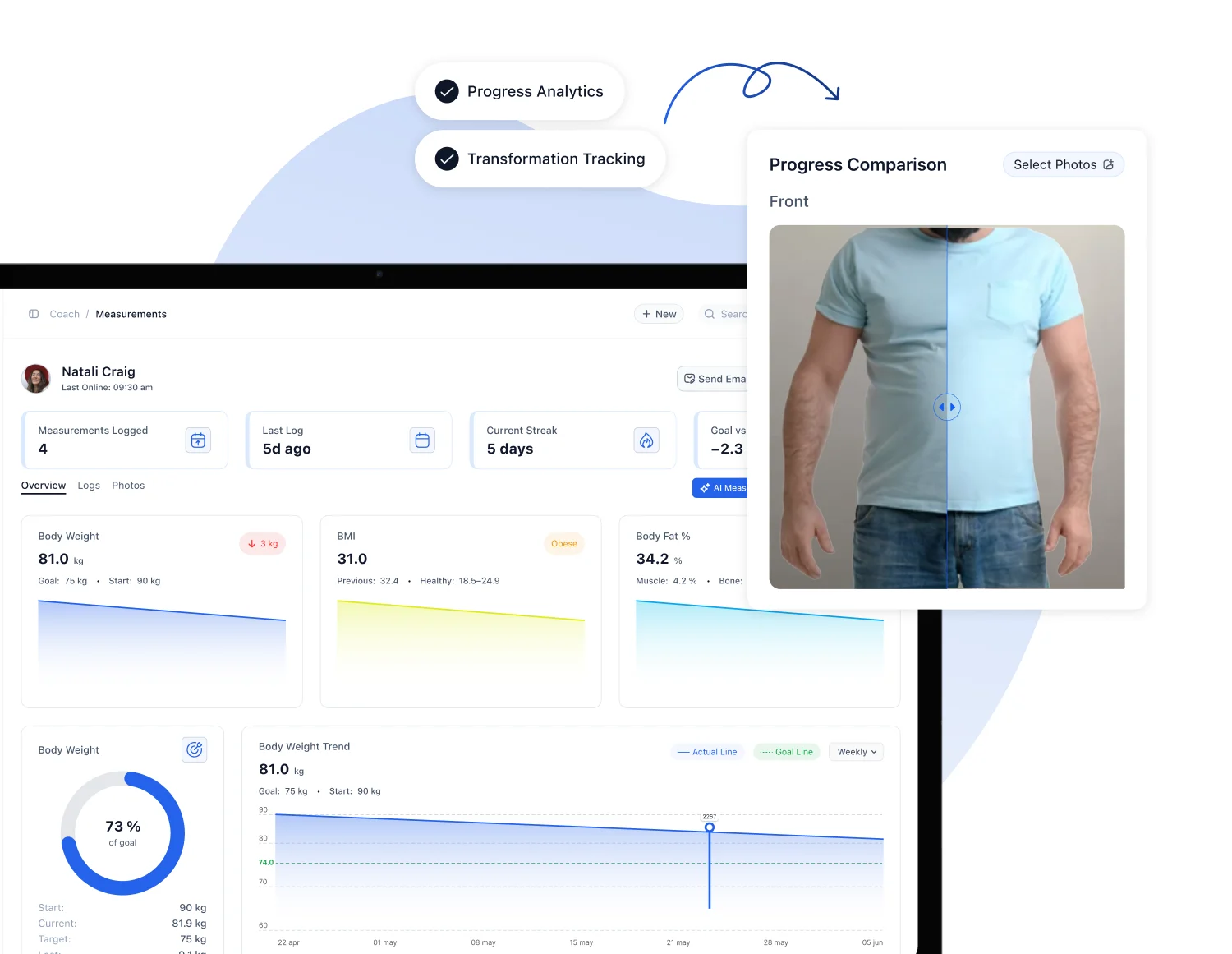
FITsociety is community-driven fitness software, developed with feedback from the coaches and studios who use it. For nutrition workflows, that means CoachAI can draft recipes and meal plans inside the same dashboard where coaches build training plans, run intake forms, and manage client check-ins.
The coach stays in control. Every AI draft is reviewed before it reaches a client, and the coach remains responsible for the final decision, the same way a manual plan would work. Plans and check-ins live alongside scheduling for group classes, small-group sessions, and one-to-one appointments, with calendar syncing options available for keeping sessions and prep time organized.
Coaches and studios can explore the nutrition software page or check plan details on the main FITsociety site to see how AI-assisted drafts fit into a broader coaching workflow.

This article is general information, not a substitute for advice from a qualified doctor. Consult a qualified healthcare professional about your own circumstances before acting on anything here.
Sources
- An Evaluation of ChatGPT for Nutrient Content Estimation from Meal Photographs
- Image-Based Dietary Energy and Macronutrients Estimation with ChatGPT-5: Cross-Source Evaluation Across Escalating Context Scenarios
- Evaluating AI-Generated Meal Plans for Simulated Diabetes Profiles: A Guideline-Based Comparison of Three Language Models
- Resistance training prescription for muscle function, hypertrophy, and physical performance: an overview of reviews
FAQ
Can an AI recipe generator replace a dietitian or coach?
No. AI recipe generators draft recipes and macro estimates quickly, but research on AI-generated meal plans shows accuracy varies by model and task, so human review remains necessary for clinical or complex cases.
How accurate are AI calorie and macro estimates from photos?
Photo-based estimates are usually accurate at identifying the food itself but less reliable on portion size and nutrient totals, especially for medium and large mixed meals. Providing ingredient weights alongside the photo improves the estimate.
What inputs make AI-generated recipes more reliable?
Specific weight, activity level, goal, allergies, and ingredient amounts in grams produce far more usable results than vague prompts like “healthy dinner.” Asking for a per-serving macro table alongside the recipe also makes the output easier to verify.
How much protein should I target for muscle gain?
Sports-nutrition guidance points to roughly 1.2 to 2.0 grams of protein per kilogram of body weight per day for active adults, spread across three to five meals to support recovery and hypertrophy.
Does FITsociety generate nutrition recipes for clients?
FITsociety’s CoachAI can draft recipes and meal plans inside the coaching dashboard, which coaches then review before publishing to a client’s plan. Details are available on the nutrition software page.