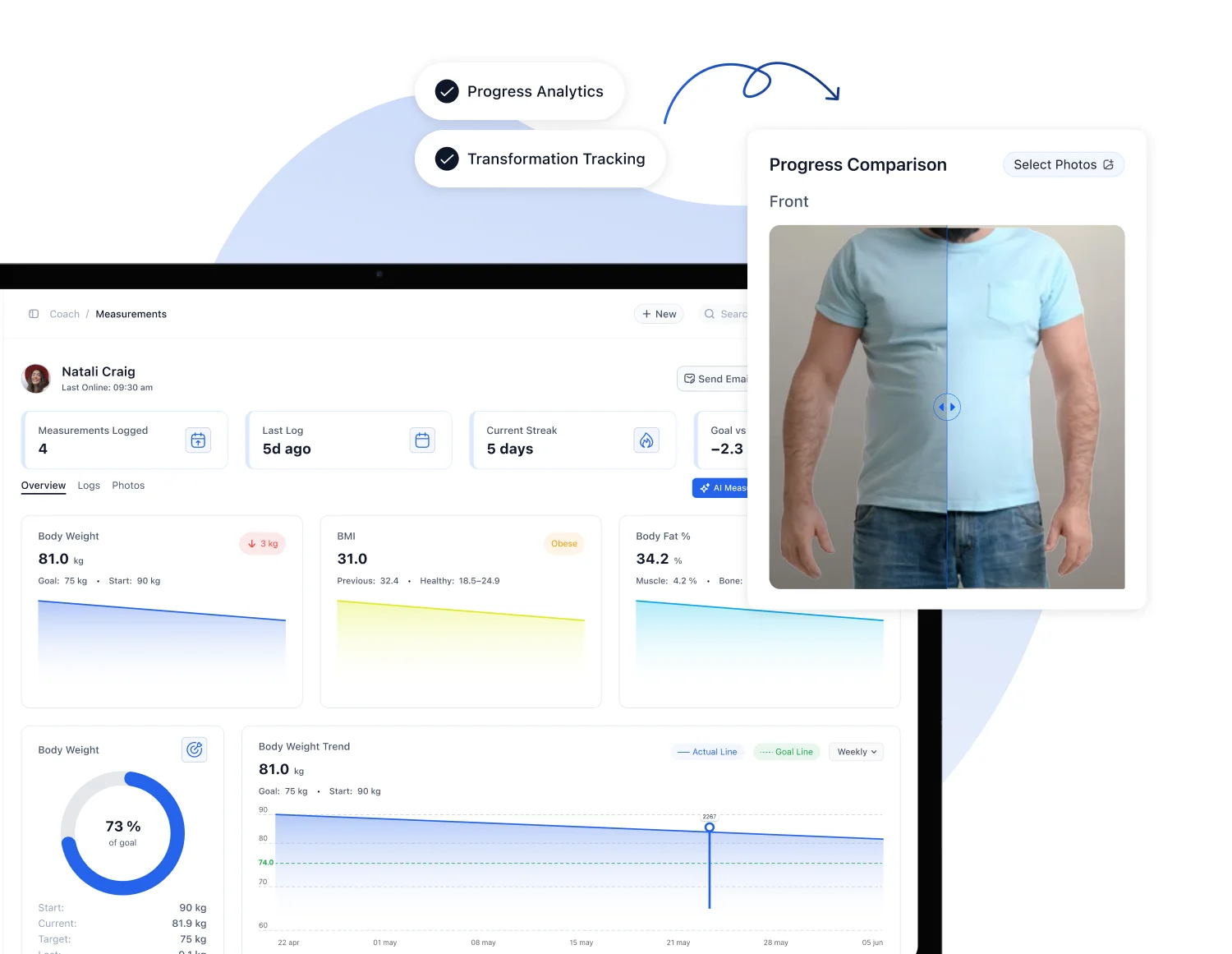
A sound training plan structure has four parts: a goal, a time frame split into blocks, defined training variables, and set review points. Build those once, then adjust per client. For coaches running one-to-one, small-group and online clients, the plan, the booked sessions and the progress data need to sit in one workflow. FITsociety is community-driven fitness software that connects training plans, progress tracking, bookings and payments for coaches and teams.
This guide covers the structure itself, a step-by-step build, a reusable template and the review routine.
TL;DR
- Structure = goal, time frame (macro, meso, micro), variables (FITT-VP), review points.
- Build order: goal, sub-goals, testing, interventions, key variables, weekly detail.
- Progress systematically. NSCA’s guideline: revisit the program every 3 to 5 weeks.
- Schedule recovery inside the plan. Plan reviews at fixed points.
- Small groups and remote clients need the same structure, with progressions and regressions per person.
What a training plan structure is
NASM defines program design as a purposeful system or plan put together to help an individual achieve a specific goal. Its OPT model applies training variables in a planned, progressive manner. Each phase builds the foundation for the next.
Three things follow for a coach:
- A plan is a system, not a list of workouts.
- Order matters. Early phases prepare the client for later phases.
- Every element ties back to the client’s goal.
A list of exercises with sets and reps is a workout. A plan adds time, progression and review.
The layers: macrocycle, mesocycle, microcycle
Cleveland Clinic describes periodization in nested layers. A microcycle is typically one week of specific workouts aimed at short-term goals. A mesocycle lasts a few weeks to a few months and targets one focus area. A macrocycle covers the big picture.
| Layer | Typical span | What it holds | Coach question |
|---|---|---|---|
| Macrocycle | Months to a year | Overall goal, sub-goals | What is the client working toward? |
| Mesocycle | Few weeks to few months | One focus area (for example, base strength) | What does this block develop? |
| Microcycle | One week | Specific workouts, session days | What happens on each training day? |
| Session | One workout or class | Warm-up, main work, cool-down | What is the order of work today? |
Cleveland Clinic also states that periodization helps improve performance, reduce overtraining and injury, and support specific short- and long-term goals. Planned rest is part of the strategy, not a gap in it.
How long should each layer be?
No single span fits every client. Use the client’s goal and schedule. A client preparing for an event on a fixed date needs the macrocycle to end at that date. A general-fitness client can run repeating blocks with a review at the end of each.
The variables inside every plan: FITT-VP
The US Army’s Human Performance Resource Center (HPRC) lists the elements as frequency, intensity, time, type, volume and progression. Use them as the checklist for every plan.
| Variable | What it sets | Example guidance from HPRC |
|---|---|---|
| Frequency | Sessions per week | Resistance training 2 to 3 days per week for all major muscle groups; aerobic endurance 3 to 4 sessions per week |
| Intensity | How hard | Resistance as a percentage of one-rep max; endurance as a percentage of max heart rate |
| Time | Session length, work:rest | Session duration and work-to-rest ratios |
| Type | Exercise selection | Exercises across movement categories |
| Volume | Total work | Repetitions multiplied by sets |
| Progression | Change over time | Increasing any other variable gradually |
HPRC also notes anaerobic endurance work at 1 to 2 sessions per week with at least 48 hours of recovery. Treat these as starting ranges. The client’s ability, history and goal set the actual numbers.
How to build the plan, step by step
Wackerhage and Schoenfeld describe a six-step process for evidence-informed training plans in Sports Medicine (2021). The steps below follow it and add the practical work around each one.
Step 1: Define the overall goal
Write one goal the client can state in a sentence. Include a time frame. “Lose body fat” is a direction. “Complete a 10K in 12 weeks” is a goal.
Where it goes wrong: goals set at intake and never revisited. Collect them on an intake form so they sit in the client record. FITsociety includes intake forms and check-ups in its client administration, and CoachAI can draft forms.
Step 2: Break it into measurable sub-goals
The authors give examples such as VO2max, lactate threshold pace and BMI. For most personal training clients, use measures you can repeat: a squat or press load for a set number of repetitions, a timed distance, a girth or body-weight measurement.

Where it goes wrong: sub-goals you cannot measure the same way twice. FITsociety supports progress and measurement tracking, so repeat measurements stay in one place.
Step 3: Plan testing and monitoring
Choose valid, reliable tests and decide when they happen. Baseline at the start, then at set points. Keep the test list short. Every test should answer a sub-goal.
Step 4: Choose evidence-based training and nutrition interventions
Select the training method and, where it is part of your service, the nutrition approach. Match them to the goal and to what the client can actually do. The NSCA frames this as asking which required exercise methods the client can perform given ability and training environment. A client with a home setup and two dumbbells needs a different selection than a client with gym access.
Coaches remain responsible for these decisions. Software holds and delivers the plan. It does not replace professional judgment.
Step 5: Plan key variables across the whole period
Map the FITT-VP variables across the macrocycle with the client. Decide where volume rises, where it drops, and where a block ends. This is the skeleton. Detail comes next.
Step 6: Design the weekly plans and individual sessions
Now write the microcycles and sessions. Keep each one consistent with the block it sits in. FITsociety’s help center covers creating training plans step by step, and CoachAI supports drafting training plans that you then review and edit.
For existing clients, the help center also explains ways to customize a training plan for a member. Customizing from a base plan keeps your structure consistent across clients.
Four principles that order the decisions
The NSCA’s Personal Training Quarterly treats program design as a decision process. It applies four principles in order: specificity, individuality, progressive overload, then variation. Each answers one question.
- Specificity. What does the goal require?
- Individuality. What can this client do, given ability and environment?
- Progressive overload. How will the demand increase?
- Variation. How will exercises change to avoid accommodation?
A Cal State open textbook chapter adds recovery and reversibility to the list of five basic principles. Recovery follows the hard/easy principle: inadequate recovery risks overtraining syndrome. Reversibility means fitness gained is lost when training stops.
In practice, that means the plan needs easy days, rest days and a plan for missed weeks. Build those into the structure at the start.
Progression, variation and recovery
The NSCA defines progressive overload as systematically modifying a program over time. Exercises progress individually, according to the client’s ability and speed of adaptation. Variation may change exercises or their order. The general guideline is to change the program every 3 to 5 weeks. The reasoning: neuromuscular coordination and hypertrophy improve in the first 3 to 5 weeks of a new program, before accommodation sets in.
ACE makes a related point in its workout-plan guidance. A structured program provides a framework for progression. Do not change the entire program each week. Change one variable at a time to raise difficulty.
A working rule set:
- Change one or two variables per block, not all of them.
- Progress per client, not per calendar.
- Put a lighter week in the block plan before the client needs one.
- Record what changed, so the next review has data.
Structuring plans for one-to-one, small-group and remote clients
The structure stays the same. Delivery changes.
One-to-one
The plan is individual. The session carries the detail. The Bloomsbury Complete Guide to Personal Training describes a session flow: collect information on the response to previous activity, discuss objectives, assess readiness, record changes, warm up, teach and correct technique, progress or regress exercises, cool down, give feedback, and link progress to short-, medium- and long-term goals.
Small groups
ACE’s small group training course covers screening clients for group fit, using progression and regression models to individualize within a group, and applying periodization for participants at different fitness levels.
Practical structure for a group block:
- One shared session design for the block.
- Two or three versions of each main exercise (regression, standard, progression).
- A record of which version each participant uses.
- Review points per participant, not only per group.
Remote and online
The EU-funded TeleExe4All manual for coaches advises that in tele-exercise, coaches tailor workouts to each client’s fitness level, goals and limitations. In live online groups, name participants so they feel present even when they cannot see the rest of the group.
For asynchronous clients, the plan has to stand on its own. Include exercise instructions, session targets, a way to log results and a scheduled check-in.
Scheduling: where the plan meets the calendar
A plan fails when sessions do not happen. Training frequency is a plan variable, so the booking calendar is part of plan design.
For teams, add three questions:
- Which coach owns the plan, and which coach delivers each session?
- Where do group classes, small-group sessions, one-to-one appointments and online PT sit in the same week?
- Does the schedule match the frequency the plan specifies?
FITsociety’s booking calendar covers group classes, small-group sessions, one-to-one appointments and online PT. Google Calendar and Microsoft Outlook/Microsoft 365 integrations are available. Confirm sync behavior and plan availability on the calendar feature page before you set up a team workflow.
Reviewing and adjusting the plan
The Bloomsbury guide says to monitor progress with appropriate methods, review it with clients at agreed points using agreed evaluation guidelines, invite the client’s own views and give positive, timely feedback.
Wackerhage and Schoenfeld note that training adaptations vary greatly. Monitor key variables. If a client does not respond, consider a plan B, such as increasing the exercise dose.
A review checklist
- Did the client complete the planned sessions?
- Did the sub-goal measures move?
- Did the client report pain, fatigue or poor sleep?
- Is the next block’s focus still right?
- Which variable changes, and by how much?
- When is the next review?
Put the review dates in the plan on day one, then book them as appointments. Check-ins and reminders can be automated in FITsociety, which keeps review points from slipping.
Any client who reports pain, dizziness or a medical condition should be referred to a physician before the plan continues.
Template: a 4-week block
Use this as a skeleton. Replace the content with the client’s own numbers.
| Section | Week 1 | Week 2 | Week 3 | Week 4 |
|---|---|---|---|---|
| Block focus | One focus area | Same | Same | Same |
| Frequency | Set sessions per week | Same | Same | Same or reduced |
| Main lifts | Baseline loads | Add load or reps | Add load or reps | Reduced volume |
| Intensity | Moderate | Moderate to high | High | Lower |
| Recovery | Rest days set | Rest days set | Rest days set | Extra recovery |
| Check-in | Short | Short | Short | Full review and re-test |
Fill-in fields for every client plan:
- Client goal and date
- Sub-goals and baseline measures
- Block focus and length
- Weekly frequency
- Session list with exercise, sets, reps, intensity, rest
- Progression rule for each main exercise
- Regression option for each main exercise
- Review date
- Notes for the next block
Running this structure in FITsociety
FITsociety is community-driven fitness software developed with feedback from fitness professionals. It connects client and member administration, intake forms, training and nutrition plans, progress tracking, bookings, communication, memberships and payments. Coaches work in a dashboard. Clients use a portal and mobile apps.
Published plans, billed monthly:
- Coach: €179 per month
- Team: €289 per month
- Club: €489 per month
A public API and MCP support are available for connected coaching workflows. See FITsociety for current plan details.
FAQ
What is a structured training program?
It is a plan with a defined goal, a time frame divided into blocks, set training variables and planned reviews. NASM calls program design a purposeful system that moves a client toward a specific goal in a progressive manner.
What are the key components of a training plan?
Frequency, intensity, time, type, volume and progression, known as FITT-VP. Add a goal, measurable sub-goals, recovery and review dates.
How often should I change a client’s program?
The NSCA gives a general guideline of every 3 to 5 weeks. Progress each exercise according to the client’s ability and rate of adaptation, and adjust sooner if monitoring shows the client is not responding.
Does the structure differ for group and online clients?
The structure is the same. Groups need progression and regression options for each exercise so participants at different levels can follow one session. Online clients need a plan that stands on its own, with clear logging and scheduled check-ins.
Sources
- NASM, Program Design (sample chapter)
- HPRC, Use the FITT-VP principle to plan your workouts
- Wackerhage and Schoenfeld, Personalized, Evidence-Informed Training Plans (Sports Medicine, 2021)
- NSCA Personal Training Quarterly 3.2, Principle-Based Program Design
- Cleveland Clinic, Periodization Training: Benefits and Examples
- Cal State open textbook, Designing a Structured Exercise Program
- ACE, How to Create a Workout Plan from Scratch
- ACE, Small Group Training: Program Design for Healthier Communities
- TeleExe4All, Manual for tele-exercise for coaches and trainers (2024)
- Bloomsbury, The Complete Guide to Personal Training, 3rd edition guides