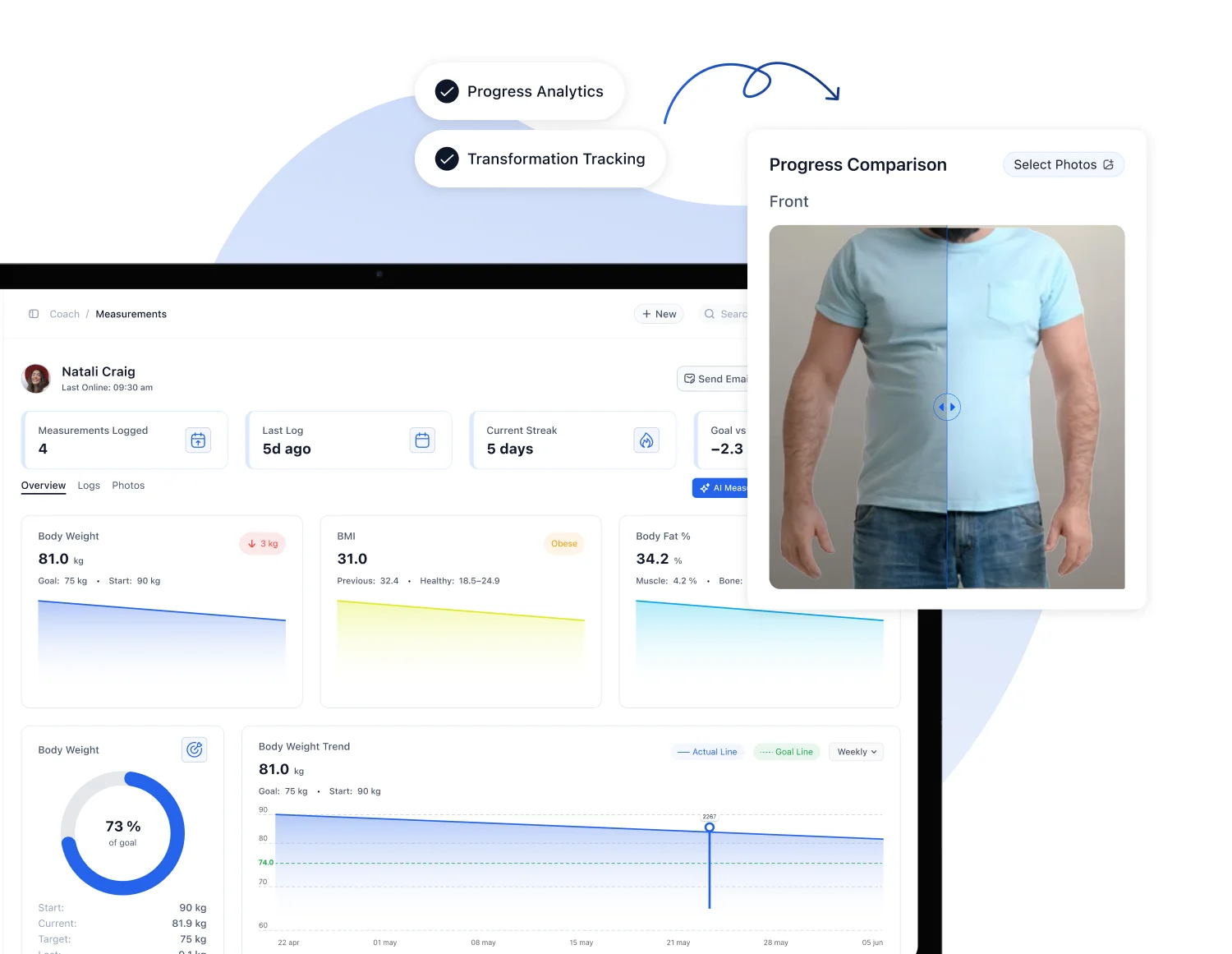
A fitness service catalog works when a stranger can read one entry and know the format, the total time, the total price, the location and the next step. Build each entry on those five facts, name it in client language, and keep it identical to what the booking calendar shows. FITsociety connects the booking calendar, memberships and payments, so the catalog and the schedule can live in one system instead of drifting apart across a PDF, a website and a spreadsheet.
TL;DR
- Group services by format first: one-to-one, small group, classes, online coaching, assessments.
- Name each service in the words clients use. Add one sentence on who it is for and what it includes.
- Price with scope: sessions, duration, validity, payment terms and exclusions stated.
- Reconcile the catalog with the booking calendar every time a service changes.
- Test every entry on a cold reader before publishing.
What a fitness service catalog is
A service catalog is the structured list of everything a coaching business sells. Each entry is a defined service with a name, a description, a duration, a price and a way to book it.
It differs from a price list. A price list shows numbers. A catalog explains what each number buys, who it suits and how to get it.
For fitness businesses the catalog serves three readers:
- Prospects deciding whether to book a first session.
- Current clients choosing the next step: a block, a membership, an upgrade.
- Staff who need one source of truth for what can be sold and scheduled.
What every entry needs
Templates for personal trainer price lists agree on a core set. One published template lists business name and logo, service categories, service descriptions, pricing per session, package or month, package inclusions, expiration dates for session packs, payment options and contact information. Another overview for training studios adds session duration and frequency, group class size and type, fitness assessments for baseline metrics, and refund policies.
Turn those into a fixed entry format:
| Field | What to write | Example |
|---|---|---|
| Name | Client-language title | One-to-One Strength Coaching |
| Format | In person, online, class, small group | In person, one coach, one client |
| Who it is for | One sentence | Beginners and people returning to training |
| What is included | Short list | Session, written plan, progress notes |
| Duration | Total time, stated plainly | 60 minutes including warm-up |
| Price | Complete statement | Per session, per block or per month |
| Validity | When credits expire | Block valid for a stated number of months |
| Terms | Cancellation, rollover, late arrival | Notice period and what is charged |
| Next step | Book or enquire | Book now, or request intro call |
Keep the field order the same in every entry. Consistency lets a reader compare two services in seconds.
Group services by format
Clients do not think in internal categories. They think in what they will do and with whom. Start with five format groups:
- One-to-one coaching. Individual sessions in person or by video.
- Duo and small group. Two to six people sharing a coach.
- Classes. Scheduled sessions with a capacity cap.
- Online coaching. Remote programming, check-ins and reviews.
- Assessments and reviews. Baseline testing and progress reviews.
One published studio guide shows how to separate formats in client-facing copy: one-to-one as undivided coaching suited to beginners and injury returns, small group at four to six people for clients who already move well, and online coaching as a written monthly program with video form review and a monthly check-in call. The pattern: each format states the group size, the audience and the delivery.
Add specialist rows only when you deliver them
Pre- and post-natal work, sport-specific training and post-rehab support belong in the catalog as their own entries when a coach is qualified and scheduled for them. A separate entry makes the offer findable. It also makes the coach assignment explicit for the team.
Write exclusions as carefully as inclusions
Proposal guidance for fitness services says a prospect should be able to answer four questions in minutes: the goal, the sessions and support, the cost and what must be approved. It also advises listing exclusions such as gym access, travel, nutrition counseling, equipment and missed sessions. A clear exclusion removes a support message later.
Naming conventions that hold up
Names are the part of the catalog read first. They also appear in booking drop-downs, confirmation emails, invoices and reports. A weak name gets copied everywhere.
Rules that work:
- Use client words. “Personal Training, 60 Minutes” beats an internal code.
- Skip abbreviations. “PT” and “SGT” are staff shorthand. Spell out the service or add it in the description.
- Name the difference, not the mood. Guidance on building a clear service menu recommends replacing vague tier names with the practical difference between choices. If two entries differ only in length, say so in the name.
- State numbers. “30 minutes” and “60 minutes” distinguish two services. “Short” and “long” do not.
- Pick one pattern. For example: Format, Duration, Audience. Apply it to every entry.
- Do not promise outcomes in a name. A name should describe the service, not a health result.
Naming pattern examples
| Weak | Clearer |
|---|---|
| Gold Package | 10 One-to-One Sessions, 60 Minutes Each |
| Online | Online Coaching: Monthly Program and Check-In |
| Group | Small Group Training, Up to 6 People |
| Assessment | Starting Assessment, 90 Minutes |
| Premium Plan | Monthly Membership, 2 Classes per Week |
A good test: remove the price and the logo. Can a stranger still tell the services apart?
Price with scope
A number alone invites questions. Pair each price with its basis and its validity. The same studio guide pairs formats with pricing basis and credit validity: single sessions paid per session, blocks of five, ten and twenty with progressively better rates, a small group membership billed monthly, and online coaching billed monthly with a notice period. Block pricing makes the loyalty ladder visible without a sales conversation.
Use this checklist before publishing a price:
- [ ] Unit stated: per session, per block, per month.
- [ ] Total shown, not only a per-session rate.
- [ ] Validity period stated for blocks and packs.
- [ ] Payment options stated: up front, installments, recurring.
- [ ] Cancellation and late-arrival rules stated.
- [ ] Rollover rules stated for memberships.
- [ ] Exclusions stated.
The guide on clear service menus also advises explaining whether a stated duration includes conversation and preparation, and showing a complete price statement rather than an unexplained number.
Price is also what many clients look at first. A peer-reviewed study of 1,000 gym-goers in the Philippines found price was the most considered attribute at 21.59%, ahead of ventilation, service and trainer. The study covers fitness centers in one country, so read it as a reminder that price clarity matters, not as a US benchmark.

Connect the catalog to the calendar
The most common catalog failure is a mismatch. The website says 45 minutes, the calendar blocks 60. The page says a class holds 12, the schedule allows 15. Clients notice. Staff then explain the difference by message.
Each catalog entry should map to a bookable service with matching settings:
| Catalog field | Calendar setting |
|---|---|
| Name | Service title shown at booking |
| Format | In person, online or hybrid |
| Duration | Appointment length |
| Group size | Capacity per session |
| Coach | Which coaches can deliver it |
| Price and validity | Payment and credit rules |
| Terms | Cancellation window |
Guidance on service menus treats this as a rule: reconcile the menu against the booking calendar whenever a service changes, and keep a review date on an internal fact sheet.
Where FITsociety fits
The booking calendar in FITsociety covers group classes, small-group sessions, one-to-one appointments and online PT. Individual coaches and teams coordinate bookings next to client coaching, so the same system holds the client’s plan, progress and schedule. Google Calendar and Microsoft Outlook/Microsoft 365 integrations are available for coaches who run their day from those calendars.
Memberships and payments connect to the same environment, along with a webshop for selling memberships and sessions. A catalog entry for a monthly membership, a ten-session block or a class pass can therefore sit alongside the booking and payment records it depends on. Details of the calendar are on the FITsociety calendar feature page.
Policies that belong in the entry
Booking rules cause the most disputes, so put them in the catalog. A studio guide example states a standing weekly slot held while used consistently, 24 hours’ notice for full credit return, a charge inside 24 hours, and a priority reschedule when the coach cancels. Adopt your own terms. Write them once, in the same words, in the catalog and at booking.
Team and multi-location catalogs
A solo coach can hold the catalog in one head. A team cannot. Studio owners and gym operators need three extra layers:
- Coach assignment. Which coaches deliver which services. A specialist service should not be bookable with a coach who does not offer it.
- Location. Services at each site, with the same names and the same structure.
- Roles. Who may edit names, prices and terms. One owner of the catalog avoids silent edits.
For clubs, keep a shared naming pattern across locations. A member who moves between sites should see the same service names. Where prices differ by site, state that in the entry, not in a footnote.
Connect services to the client journey
A catalog sells services. It also starts a journey. Map each entry to what happens after the purchase:
- Onboarding. Intake forms and a health screen before the first session.
- Delivery. A training plan, and a nutrition plan if the service includes one.
- Review. Progress tracking and scheduled check-ins.
- Renewal. A next block or recurring membership.
One studio guide describes a 12-week cadence: a full assessment at week 0, a short check-in at week 4, a re-test at week 8 and a full re-assessment with a written review at week 12. Use a cadence like this to define what a block includes and to give clients a reason to renew.
FITsociety covers these steps in one environment: intake forms and check-ups, training and nutrition plans, progress tracking, bookings, communication, memberships and payments. Coaches work in a dashboard, and clients use a portal and mobile apps. For plan work, see the help article on customizing a training plan for a member. For review work, see viewing and interpreting a member’s progress. Coaches remain responsible for their coaching decisions.
CoachAI supports tasks such as drafting training plans, forms, recipes and news. It can help produce first drafts of catalog copy and intake forms. The coach reviews and approves the final text.
Test the catalog on a cold reader
A catalog is an artifact that can be tested. The method in the service menu guidance: ask a reader to identify the format, total appointment time, total charge, location and whether the next click books or enquires, then record every answer they had to guess.
Run it in four steps:
- Pick someone who has never trained with you.
- Show one entry without explaining it.
- Ask the five questions.
- Rewrite the entry wherever they guessed.
Repeat for the entries clients ask about most.
Starter template
Copy this block for each service. Fill every line.
Service name:
Format: (one-to-one / duo / small group / class / online / assessment)
Who it is for: (one sentence)
What is included: (3 to 5 items)
What is not included: (travel, gym access, nutrition counseling, equipment)
Duration: (total minutes, preparation included or not)
Group size: (maximum)
Location: (site, or online)
Price: (amount, unit, total)
Validity: (months or weeks)
Payment options: (up front / installments / monthly)
Cancellation and late arrival:
Next step: (book / enquire)
Coach(es):
Last reviewed:
Maintenance routine
Catalogs go stale. Set a rhythm:
- Monthly: compare the catalog with the calendar. Fix mismatches.
- Quarterly: review which services sell and which do not. Merge near-duplicates.
- After any change: update the entry, the booking service and the price in the same sitting.
- Yearly: review prices and terms, and note the date.
Plans and pricing
FITsociety publishes three plans. Coach is €179 per month. Team is €289 per month. Club is €489 per month. Coach suits independent trainers and online coaches. Team suits studios and coaching teams. Club suits gyms and clubs coordinating members, coaches and multiple locations. Check fitsociety.io for current plan details and what each includes.
FAQ
What should be in a service catalog for a personal training business?
Include a name, format, description, duration, price, validity, payment options, terms and contact or booking link for each service. Add group size for classes and small groups. Add a one-line audience statement so clients can self-select.
How many services should a catalog list?
List as many as you can deliver and schedule, and no more. Many coaches start with the five format groups and two to four services in each. Merge entries that differ only in small details.
How should I name services?
Use the words clients use, avoid abbreviations, state durations and group sizes, and keep one pattern across the list. Describe the real difference between similar services instead of using tier names.
How do I keep the catalog consistent with bookings?
Treat each entry as a bookable service with matching duration, capacity, coach and terms. Review both whenever a service changes. A system that holds catalog, calendar and payments together makes this easier.
Can AI draft catalog copy?
AI can produce a first draft of descriptions and forms. The coach checks the numbers, terms and claims before publishing. CoachAI in FITsociety supports drafting tasks like these.
Sources
- Personal Trainer Price List Template
- What Should a Personal Trainer Service Overview Include?
- Building a clear service menu
- Training Services & Studio Guide Template
- Gym-Goers Preference Analysis of Fitness Centers (Sustainability, 2021)