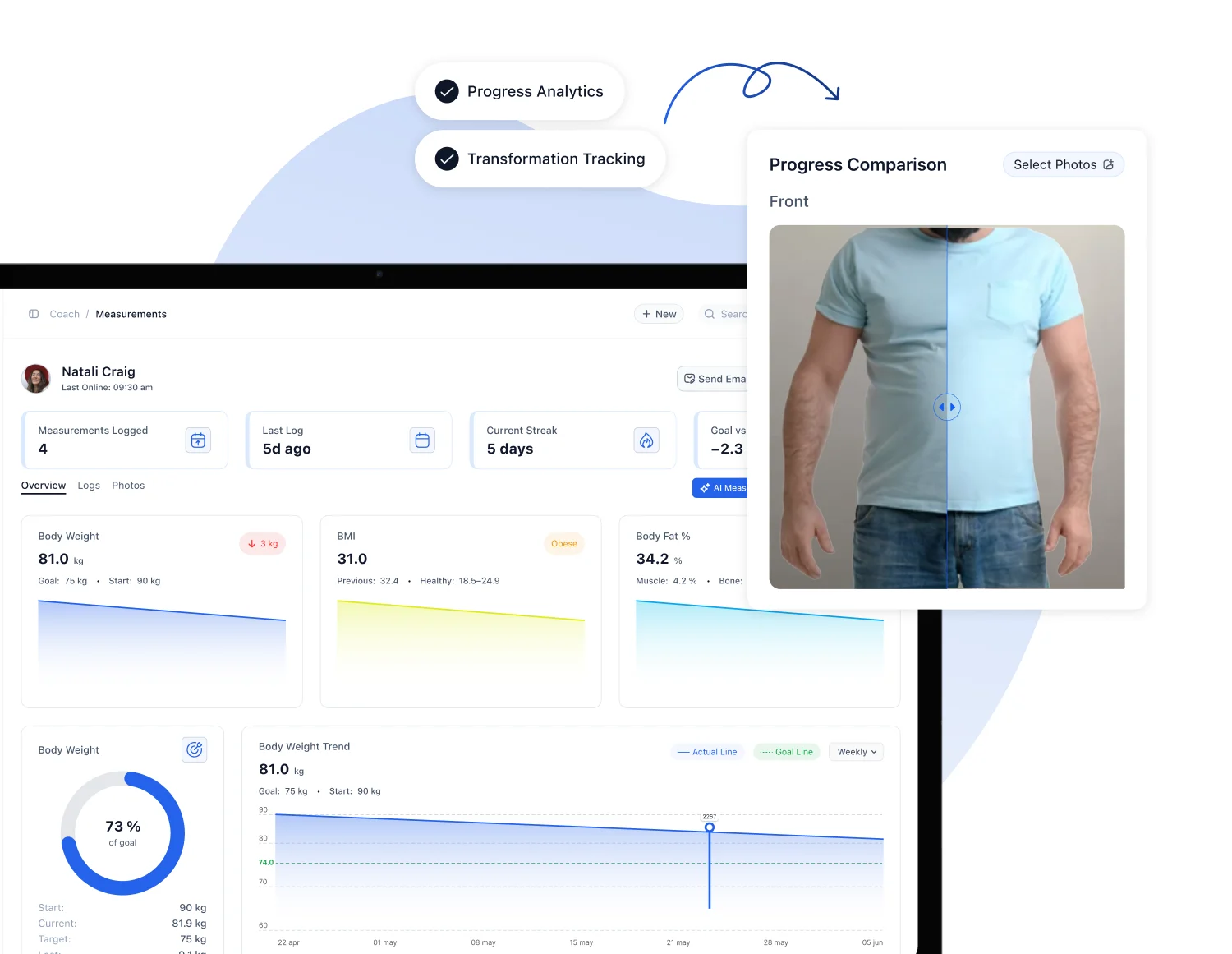
Entry prices for personal trainer software typically run free to about $35 per month, with a market median near $19.45. That headline number rarely reflects your real bill. Payment processing fees, per-client overages, and add-on modules like nutrition tracking or branded apps push most coaches well past the advertised rate within a few months.
TL;DR:
- Most personal trainer software costs between $9 and $35 per month, but add-on fees for payment processing, client overages, and extra modules often increase the total bill early on.
- Entry tiers typically cap client numbers at 1 to 5, do not include payment processing, and reserve branded apps for higher-priced plans, complicating cost comparisons.
- Different pricing models—per-client, per-coach, flat tiered, or quote-based—suit various business sizes, making it essential to calculate real costs based on your current and projected roster.
- Hidden costs such as setup fees, migration charges, and extra module purchases often push monthly expenses significantly higher than advertised rates.
- Consolidated platforms like FITsociety may reduce overall expenses and simplify billing, especially when replacing multiple separate tools with one integrated subscription.
What Does Personal Trainer Software Pricing Look Like Right Now?
Entry-tier pricing clusters in a tighter band than most trainers expect. Across sampled vendors, published entry prices range roughly $9 to $35 per month, and the median starting price sits at $19.45. Two vendors reviewed in that same dataset offered free starter tiers, including at least one $0-per-month Basic plan aimed at trainers who want to test the platform before committing to a paid tier.
Here’s the pricing snapshot broken down by what you’ll typically encounter shopping for coaching software this year:
- Free tiers: Usually capped at 1 to 3 clients, limited templates, and no payment processing or branded app access.
- Entry paid tiers ($9 to $20/month): Cover a small client roster (often 1 to 5 clients), basic messaging, and simple workout or nutrition templates.
- Mid tier ($20 to $35/month): Adds automation, larger client caps, and sometimes payment collection built in.
- Studio or enterprise tiers: Almost always quote-based, priced around client volume, staff seats, and integrations rather than a flat monthly number.
Statistic Callout: The market median entry price for personal training software is $19.45 per month, but that figure describes the cheapest advertised tier, not what a working coach with a real client roster typically pays once add-ons and per-client fees are included.
What an entry plan usually excludes matters more than what it includes. Most entry tiers cap your client count at a handful of people, don’t include payment processing without an extra fee, and reserve branded mobile apps for higher tiers. If you’re comparing platforms strictly on the entry-tier number, you’re comparing apples that will turn into very different fruit once you outgrow that starter client cap, a pattern confirmed across multiple personal training software programs reviewed in 2026.
How Do Personal Training Software Pricing Models Actually Work?
Vendors price coaching software four main ways, and each one rewards a different business stage. Knowing which model you’re looking at before you sign up saves you from a nasty bill surprise six months in.
Per-client pricing charges you a flat rate for every active client on your roster, sometimes with volume discounts as you scale. This model punishes growth early (each new client is a direct cost) but becomes predictable once your roster stabilizes. It suits coaches with high-touch, lower-volume programs where each client generates solid revenue.
Per-coach pricing charges per staff seat rather than per client, which favors solo operators and studios with a small number of trainers managing large client books. A single coach handling 60 clients pays the same as a coach handling 15, so this model rewards volume.
Flat tiered pricing bundles a client cap, feature set, and support level into fixed monthly buckets ($19, $39, $79, and so on). It’s the easiest to budget against because you know your ceiling, but you’ll eventually hit that ceiling and jump a tier, sometimes for features you don’t need yet.
Quote-based pricing applies mostly to studio and gym-scale software, where the vendor prices based on member volume, integrations, and support needs. You lose price transparency but gain negotiating room, particularly on annual contracts.
- Per-client: Best for coaches under 20 clients where each relationship is high-value.
- Per-coach: Best for solo trainers or small teams with growing rosters.
- Flat tiered: Best for coaches who want predictable, comparison-friendly pricing.
- Quote-based: Best for studios and multi-location gyms with complex needs.
Pro Tip: Before you sign up for a per-client plan, calculate your cost at double your current roster size. If the math makes you wince, a per-coach or flat-tier model will likely serve your growth better.
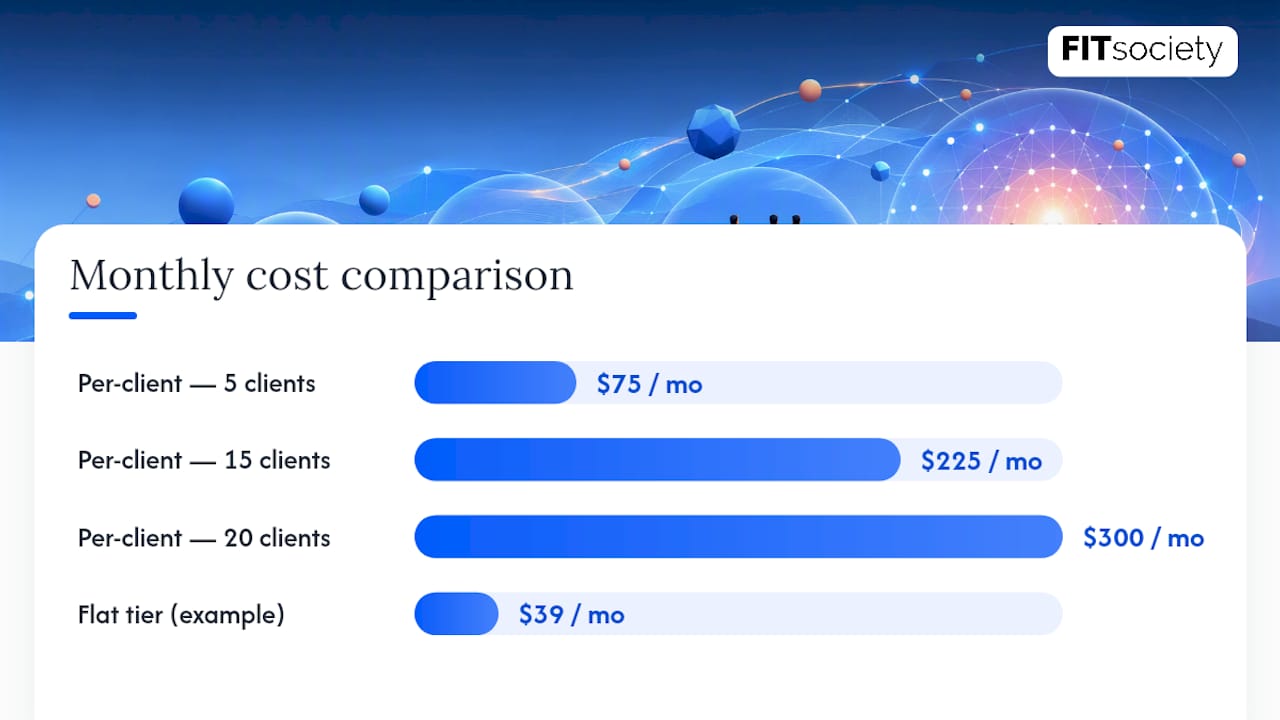
The pricing model matters more than the sticker price. A $15-per-month per-client plan can cost more than a $39 flat-tier plan once you cross 15 or 20 clients, which is exactly the trap that makes headline comparisons misleading without checking the client cap tied to each figure.
What Hidden Costs Show Up After You Sign Up?
The advertised monthly rate is the floor, not the ceiling. Reviewers consistently describe a foot-in-the-door pattern: a low headline price draws you in, then layered add-ons and per-client charges raise your effective bill as your business grows. Here’s where that extra spending actually comes from:
- Payment processing fees. Most platforms route card payments through a processor and take a cut, typically a percentage plus a small fixed fee per transaction. On a $2,000-per-month collection volume, that can add $50 to $80 monthly on top of your subscription.
- Branded app costs. A white-label mobile app with your logo and colors is rarely included in entry or mid tiers. Expect it gated behind a premium tier or a separate quoted fee, since branded app builds usually appear as higher-tier add-ons rather than standard features.
- Setup and migration fees. Moving client data, workout libraries, and payment history from another platform sometimes carries a one-time migration charge, especially on studio-tier plans.
- Add-on modules. Nutrition coaching tools, habit tracking, and automated check-ins are frequently sold as separate modules rather than bundled into your base price.
- Client-seat overages. Cross your plan’s client cap and you’ll either pay per additional client or get forced into the next tier, even if you only need five more slots.
A comparison of personal training software pricing found this pattern holds across most vendors that advertise attractive entry prices.
How Much Will Personal Trainer Software Cost as You Scale?
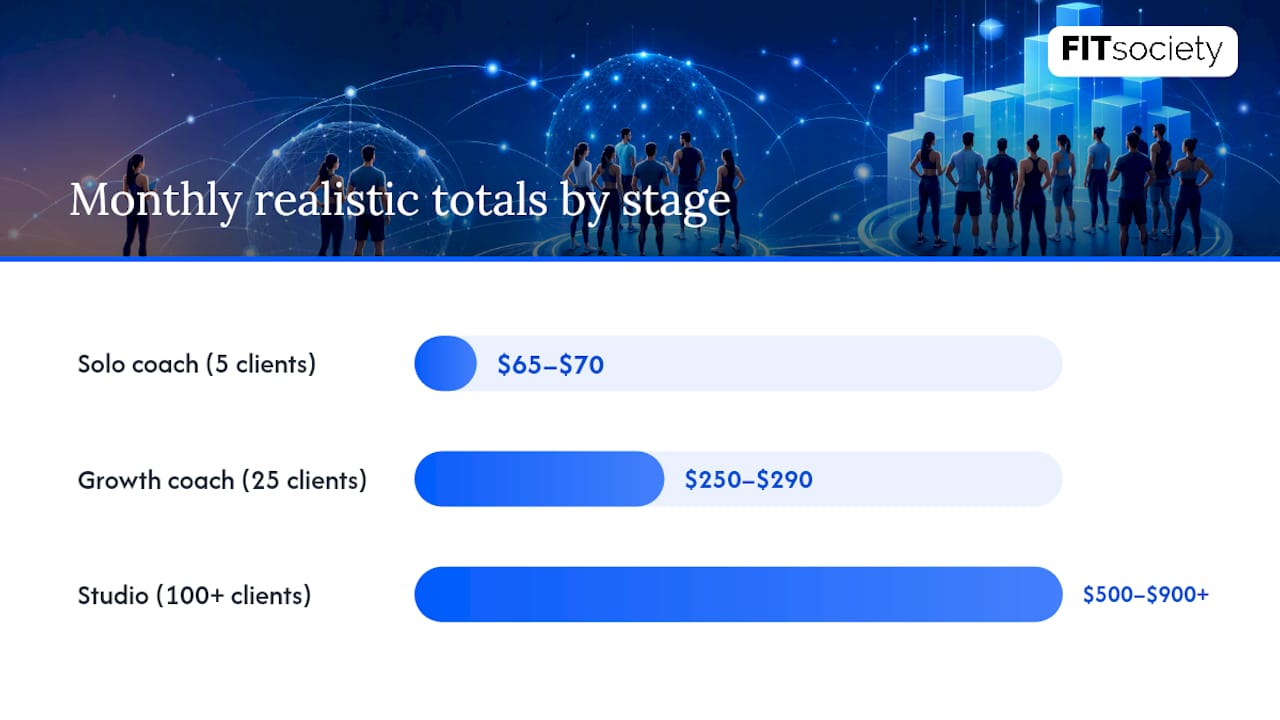
Numbers are more convincing than warnings. Here’s what a realistic monthly bill looks like at three common business stages, using the pricing patterns described above.
- Solo coach, 5 clients. Base plan around $19/month, plus payment processing on roughly $1,000/month in collected client fees (around $35 to $40 at a typical 3% to 4% blended rate), plus a small nutrition add-on at $10/month. Realistic monthly total: $65 to $70.
- Growth coach, 25 clients. You’ve likely outgrown the entry tier’s client cap, so you jump to a mid tier around $39/month. Add per-client overage charges if your plan caps out at 15 to 20 (commonly $1 to $2 per client over the limit), payment processing on $5,000/month in collections (roughly $175 to $200), and a branded app amortized at $20/month if you’ve added one. Realistic monthly total: $250 to $290.
- Studio, 100+ clients. Most coaches at this scale move to quote-based studio pricing, often starting around $150 to $300/month base depending on staff seats and locations, plus payment processing on much larger collection volume, plus setup and onboarding fees amortized over the first year. Realistic monthly total: $500 to $900+, heavily dependent on your negotiated contract.
Statistic Callout: Because entry tiers typically include only 1 to 5 clients, the jump from Scenario A to Scenario B often isn’t a smooth per-client scale. It’s a forced tier upgrade the moment you sign your sixth or tenth client.
Use this simple template to run your own numbers: Base plan price + (payment processing rate × your monthly collected revenue) + (per-client overage × clients above your cap) + amortized one-time fees ÷ 12 = your realistic monthly total. Plug in your actual roster and collection volume, not the vendor’s marketing example client.
One more wrinkle worth flagging: several vendors advertise annual discounts as “months free” rather than a percentage off. Always convert the annual price to a monthly-equivalent rate before comparing it against a competitor’s monthly plan, or you’ll be comparing two different units and drawing the wrong conclusion.
What Should You Ask Before Choosing a Pricing Plan?
Picking the right pricing structure comes down to matching the plan to where your business actually is today, not where you hope it’ll be in two years. A lightweight app suits a solo coach fine, while a multi-revenue studio needs a fuller suite, and paying for studio-grade features as a solo trainer is money spent on capacity you won’t use.
Before you sign anything, ask the vendor these six questions directly:
- What’s the exact client cap on this tier, and what happens the day I exceed it?
- Is payment processing included, or is that a separate percentage-based fee?
- Does a branded mobile app cost extra, and if so, how much?
- Are there setup, migration, or data export fees if I leave later?
- What does support actually include at this tier: chat, email, or a dedicated rep?
- Is there a long-term contract, and what’s the cancellation and refund policy if I cancel mid-term?
Pro Tip: Ask specifically what happens to your client data and training history if you cancel. Some platforms hold your content hostage behind a “contact sales to export” wall, turning a simple cancellation into a weeks-long negotiation.
Solo coaches should weigh higher prices only against features they’ll use immediately, like automated check-ins or practical strategies to track fitness progress such as a simple nutrition module. Studio operators can justify paying more for staff permissions, multi-location reporting, and integrated payment tools, since those features directly reduce administrative labor across a bigger team.
Watch for a few red flags that predict rising long-term costs: vendors that won’t state client caps clearly upfront, pricing pages that hide per-transaction fees until checkout, and contracts that auto-renew annually without a clear cancellation window. Any of these usually means your bill grows faster than your roster does.
How Long Does Setup and Onboarding Take?
Setup time varies enormously depending on the platform’s scope. Lightweight coaching apps can be live the same day, with you importing client contacts and building your first workout template within an hour or two. Full gym or business management suites are a different project entirely, often requiring 2 to 6 weeks for data migration, staff training, and payment system integration.
One-time costs to budget for separately from your monthly subscription:
- Migration fees: Moving historical client data and payment records from a previous platform, when charged, tends to run from a small flat fee up to a few hundred dollars depending on data volume.
- Branded app builds: Custom app development or white-labeling is typically quoted individually rather than bundled into a subscription tier.
- Consultancy or onboarding calls: Studio-tier vendors sometimes charge for dedicated onboarding sessions beyond a standard walkthrough.
To avoid disruption during a switch, export your existing client data before you cancel your old platform, confirm your new provider’s import format ahead of time, and run both systems in parallel for at least one billing cycle. A structured software switch checklist reduces the odds of losing client history or double-billing clients during the transition.
FITsociety: One Subscription Instead of a Stack of Fees
Every hidden cost described above (nutrition add-ons, branded app fees, disconnected payment tools) usually exists because you’re paying separately for each function across different vendors. Some platforms consolidate client management, training and nutrition plans, payment processing, and a branded app option into one subscription, which can reduce the stacking effect that turns a $19 headline price into a $250 monthly bill by accident.

The platform includes automated check-ins, progress tracking, scheduling, and a webshop for selling memberships and sessions directly, so you’re not paying a separate vendor for each of those functions. Its nutrition tools handle macros, meal plans, and check-ins inside the same workflow you already use for training programs, instead of routing you to a third-party nutrition app with its own subscription. Coaches managing larger rosters can review business-level features covering analytics and membership tools built for studio operations.
If you’re tired of adding up subscription costs across four or five separate tools every month, start a trial on FITsociety’s platform and run your own numbers against what you’re currently paying. Most coaches find the consolidated bill is easier to predict, and often cheaper, than the stack it replaces.
The Real Budgeting Mistake Trainers Make
Most trainers price-shop the wrong number. They compare the $9 tier against the $19 tier and pick the cheaper one, without checking whether that $9 tier caps them at three clients or excludes payment processing entirely. The sticker price is the least useful number on the pricing page.
Run the worked-example math from this article with your own client count and collection volume before you sign anything. If a “cheap” plan turns into $80 a month once you add payment fees and a nutrition module, it was never actually the cheap option. Test any shortlisted platform with real paying clients during a trial period, not a demo account, because that’s the only way to see how per-client overages and add-on charges behave against your actual roster.
Buy for your business today, not the studio you hope to run in three years. A solo coach paying for enterprise features they won’t touch for 18 months is subsidizing capacity, not investing in it. If annual billing is available and you’re confident in the platform after a trial, locking in that rate protects you from mid-year price increases that catch monthly subscribers off guard.
— Matthijs
Sources
The pricing figures and comparisons in this article draw from a small set of dedicated reviews and industry posts published in 2026:
- Best Personal Training Software (2026): top picks + real pricing
- Best personal training software
- The Best Personal Training Software Programs in 2026
Pricing data reflects figures captured and reported by these sources in mid-2026 and may shift as vendors update their plans.
FAQ
What Is the Best Software for Personal Trainers?
The best choice depends on your business stage: solo coaches usually do better with lightweight, per-coach priced apps, while studios need fuller suites with staff seats and payment tools. An all-in-one platform like FITsociety fits coaches who want training, nutrition, payments, and a branded app under one bill instead of several separate tools.
How Much Do Personal Training Software Programs Cost?
Entry prices range roughly from free to $35 per month, with a market median around $19.45. Realistic monthly totals, once you add payment processing and per-client overages, typically land between $65 and $290 depending on your roster size.
How Much Is a One-Hour Personal Training Session?
Session pricing varies widely by region, experience, and specialty, and isn’t something software vendors set. Your software subscription cost is a fixed monthly expense, so it’s worth calculating what percentage of your session revenue it consumes as your client count grows.
How Much Does Trainerize Cost Per Month?
Trainerize is a third-party platform with its own published pricing tiers separate from the market figures in this article; check its current pricing page directly for exact rates, since third-party pricing changes independently of the broader market median discussed here.
Are There Free Personal Trainer Software Options?
Yes, some vendors offer free starter tiers, usually capped at 1 to 3 clients with limited features. They work well for testing a platform before committing, but most coaches outgrow the free tier within their first few paying clients.