Personal trainer KPIs are the numbers that show whether a coaching business is healthy: revenue, client retention, schedule use and client progress. Twelve metrics are covered below, each with a formula, a review cadence and the decision it informs. A one-page monthly review template closes the guide.
TL;DR
- Track four groups: revenue, retention, operations, client progress.
- Start with five: monthly recurring revenue, retention rate, average revenue per client, session utilization, no-show rate.
- Review weekly for attendance and bookings. Review monthly for revenue and churn.
- Early attendance patterns predict retention better than session counts alone.
- A KPI without a decision attached is a vanity metric. Drop it.
What a KPI is for a personal trainer
A KPI is a number with a definition, a period and an owner. “Clients are doing well” is an impression. “Retention was 85% over the last 90 days” is a KPI.
Two types apply to coaching:
- Business KPIs: revenue, churn, utilization, acquisition. They show whether the business is sustainable.
- Client KPIs: attendance, adherence, measurements, habit logging. They show whether the coaching works.
Both types matter. Strong client results with weak retention usually point to a pricing, communication or scheduling problem. Strong revenue with weak client results usually predicts churn later.
Coaches stay responsible for the targets they set and the decisions they make. The numbers inform judgment. They do not replace it.

Revenue KPIs
1. Monthly recurring revenue (MRR)
- Formula: sum of all recurring monthly payments (memberships, subscriptions, packages billed monthly).
- Cadence: monthly.
- Decision: whether income is predictable enough to hire, raise rates or add a location.
Separate recurring revenue from one-off sales such as single sessions, workshops and product sales. A month with high one-off sales can hide a shrinking recurring base.
2. Revenue growth rate
- Formula: (this month’s MRR − last month’s MRR) ÷ last month’s MRR × 100.
- Cadence: monthly, read as a three-month trend.
One month proves little. A three-month direction shows whether acquisition outpaces churn.
3. Average revenue per client (ARPC)
- Formula: total monthly revenue ÷ number of active paying clients.
- Cadence: monthly.
- Decision: pricing and package structure.
A falling ARPC with a stable client count often means discounting or a drift toward lower-priced tiers. Segment by service: one-to-one, small group, online coaching, group classes.
4. Client lifetime value (LTV)
- Formula: ARPC × average months a client stays.
- Cadence: quarterly.
- Decision: how much can be spent to acquire a client.
LTV needs at least a year of history to be reliable. Until then, use the average tenure of clients who have already left, and label it an estimate.
Retention KPIs
5. Client retention rate
- Formula: (clients at end of period − new clients added in period) ÷ clients at start of period × 100.
- Cadence: monthly and quarterly.
For context, Health & Fitness Association data on independent facilities put average retention at roughly 72–73%. That figure comes from facilities, not solo coaching, and from 2019 data. Use it as a rough reference, then compare against your own history first.
6. Churn rate
- Formula: clients lost in period ÷ clients at start of period × 100.
- Cadence: monthly.
Churn is the inverse view of retention. Track it by cohort: clients who joined in the same month. Cohorts show whether the problem sits in onboarding (early exits) or in long-term engagement (exits after month six).
7. Early attendance and consistency
- Formula: sessions attended in the first 90 days ÷ sessions booked in the first 90 days, plus the spread of days and times.
- Cadence: weekly for new clients.
This is the strongest lead indicator in the research. A study of new members found that frequent and stable attendance behavior early in membership is associated with continued attendance later. Consistency of when and where members show up matters, not only the number of visits.
Health & Fitness Association profiles also show the decay: average monthly attendance fell from 7.48 visits in month one to 0.92 visits by month twelve.
Practical use:
- Flag any client who misses two consecutive booked sessions in the first 90 days.
- Encourage a fixed weekly slot rather than ad hoc booking.
- Contact clients whose attendance days keep shifting.
8. Billing model mix
- Formula: share of clients on month-to-month billing vs. fixed-term or prepaid packages.
- Cadence: quarterly.
Industry research reported by FitTech Global found that members on month-to-month billing were four times more likely to cancel than members on a 12-month minimum term. The source dates from 2015 and covers club members, so treat the multiple as directional. The principle holds for coaching: commitment length affects churn. Automated recurring payments also cut administrative work.
Operations KPIs
9. Session utilization rate
- Formula: paid session hours delivered ÷ available bookable hours × 100.
- Cadence: weekly.
- Decision: whether to open, close or move slots.
Utilization shows where the schedule leaks. Break it down by day and hour. A trainer at 95% on Tuesday evenings and 40% on Friday afternoons has a pricing or timing question, not a demand problem.
10. No-show and late-cancellation rate
- Formula: (no-shows + late cancellations) ÷ booked sessions × 100.
- Cadence: weekly.
Every missed slot is lost capacity. Track the rate per client as well as overall. A few repeat clients usually account for most of it. Reminders and a clear cancellation policy are the standard controls.
11. Group class fill rate
- Formula: attendees ÷ class capacity × 100.
- Cadence: weekly.
For studios and teams running group classes and small-group sessions, fill rate shows which formats and time slots earn their place. Track the waitlist length for full classes. A consistent waitlist is a case for adding a session.
Client progress KPIs
12. Progress and adherence
- Metrics: measurements, performance benchmarks, habit logging rate, check-in completion rate.
- Cadence: weekly check-ins, monthly review.
Pick two or three outcomes per client, agreed at intake: for example strength benchmarks, body measurements or daily habit completion. Check-in completion rate is also a business KPI. Clients who stop checking in often stop attending next.
Keep scope in mind. Fitness metrics describe training progress. Clients with medical conditions need guidance from their physician, and nutrition targets for medical needs belong with a registered dietitian.
Metrics to ignore or demote
- Total followers or website visits: only relevant when tied to leads. Track leads and consultations booked instead.
- Raw session counts: these hide who attends and when. Pair them with consistency.
- Averages without segments: blended numbers cover up differences between one-to-one, group and online clients.
- Benchmarks from other business models: large-club averages do not describe a solo online coach.
Facility perception can also move renewals. IHRSA research on cleanliness found that members who rated a club extremely clean were about 90% likely to renew, against about 50% for those who did not. Studios and gyms can add a short satisfaction pulse to their KPI set for this reason.
A minimum viable KPI set by business type
| Business type | Core KPIs | Review rhythm |
|---|---|---|
| Independent personal trainer | MRR, retention, no-show rate, utilization | Weekly bookings, monthly money |
| Online coach | MRR, churn by cohort, check-in completion, ARPC | Weekly check-ins, monthly money |
| Small studio | Class fill rate, retention, billing mix, utilization | Weekly operations, monthly money |
| Gym or multi-location club | Churn by location, MRR by location, attendance by cohort, staff utilization | Weekly by location, monthly roll-up |
Start with the row that fits. Add metrics only when a decision requires them.
Where the data comes from
Most KPI problems are data problems. Numbers sit in a spreadsheet, a calendar, a payment processor and a chat app, and no month-end review matches them up.
Three sources cover nearly every KPI above:
- Payments and subscriptions: MRR, ARPC, churn, billing mix.
- Booking calendar: utilization, no-shows, fill rate, attendance consistency.
- Client records: check-ins, measurements, habit logs, plan adherence.
When these live in one system, a KPI becomes a filter rather than a manual calculation.
Tracking KPIs with FITsociety

FITsociety is community-driven fitness software for personal trainers, online coaches, studios and gyms. It is developed with feedback from fitness professionals. Features are shaped by practical needs, though not every request is built.
Relevant to the KPIs above:
- Bookings: a calendar for group classes, small-group sessions, one-to-one appointments and online PT. Individual coaches and teams coordinate bookings alongside client coaching.
- Calendar integrations: Google Calendar and Microsoft Outlook/Microsoft 365 are available.
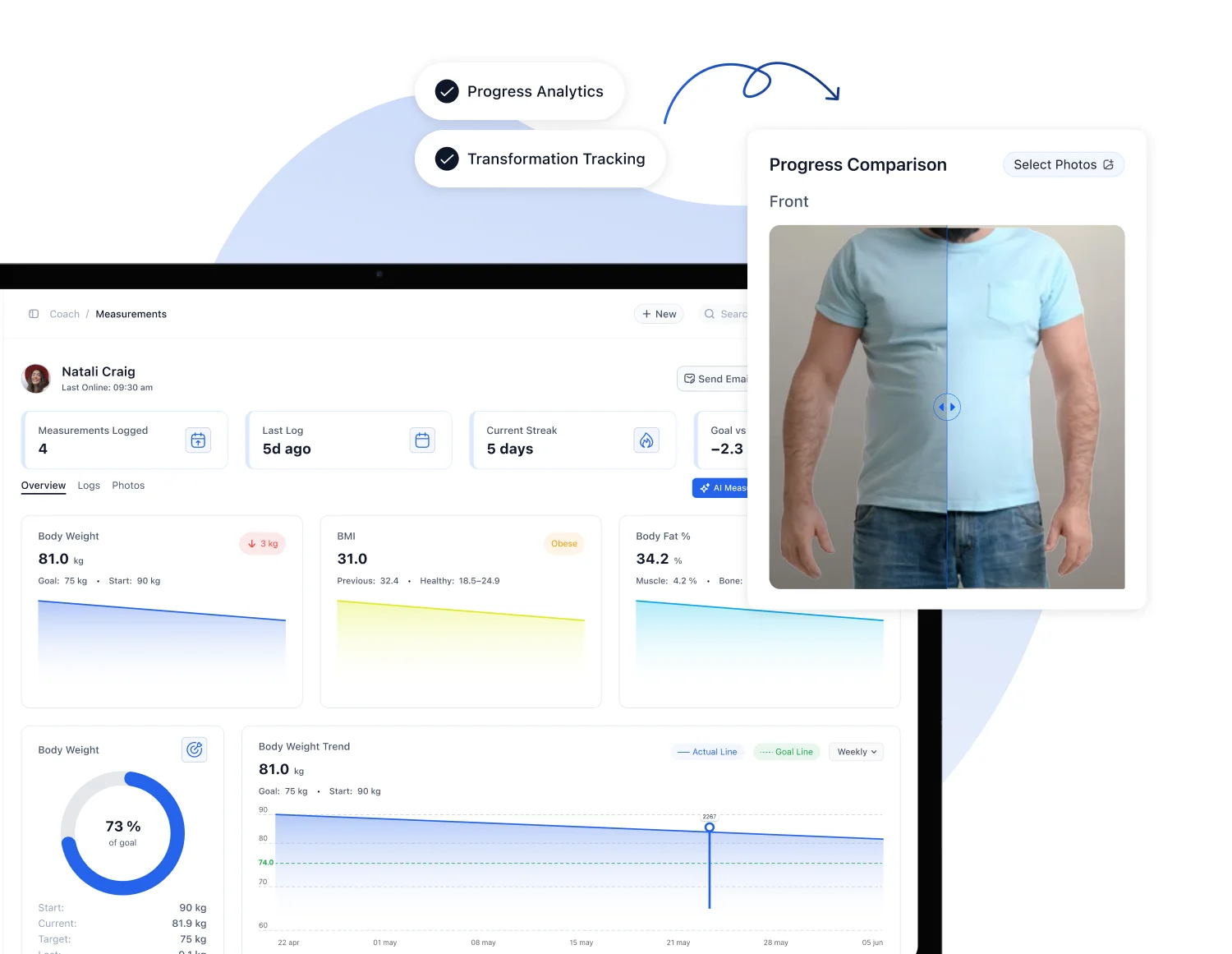
- Client management: intake forms, check-ups, progress tracking, training and nutrition plans, communication.
- Memberships and payments: recurring memberships, payment processing and webshop tools.
- Connected workflows: a public API and MCP support are available.
Published plans:
| Plan | Price |
|---|---|
| Coach | €179 per month |
| Team | €289 per month |
| Club | €489 per month |
Plan details, trial terms and feature access by plan are listed on the FITsociety site. Check the current plan page before choosing, since features by plan can change.
Monthly KPI review template
Use one page. Fill it in on the same day each month.
Section 1: Revenue
- MRR this month / last month / change
- ARPC by service type
- Recurring vs. one-off share
Section 2: Retention
- Clients at start / joined / left / at end
- Retention and churn rates
- Cohort check: month-one and month-three exits
- Share of clients on month-to-month billing
Section 3: Operations
- Utilization by day and time
- No-show and late-cancellation rate
- Group class fill rate and waitlists
Section 4: Clients
- New clients flagged for inconsistent attendance
- Check-in completion rate
- Clients reaching their agreed benchmark
Section 5: Decisions
- One number to improve next month
- One action to take
- Who owns it, and the date to re-check
Limit decisions to one or two per month. More than that dilutes follow-through.
Setting targets
- Baseline first. Record three months of current numbers before setting any goal.
- Compare to yourself. Use external benchmarks as context only. Sources differ in model, region and year.
- Set ranges. “Retention between 80% and 85%” is more useful than a single figure.
- Tie each target to an action. If utilization on Friday is low, the action might be a new class format or a price change on that slot.
- Revisit quarterly. Targets change with capacity and client mix.
FAQ
What are the most important KPIs for a personal trainer?
Start with monthly recurring revenue, client retention rate, average revenue per client, session utilization and no-show rate. These five cover income, loyalty and schedule efficiency. Add client-progress metrics such as check-in completion once the business metrics are tracked reliably.
How often should a trainer review KPIs?
Review attendance, bookings and no-shows weekly. Review revenue, churn and average revenue per client monthly. Review lifetime value and billing mix quarterly. Weekly reviews catch problems while a client can still be contacted.
What is a good client retention rate?
It depends on the model. Health & Fitness Association data on independent facilities showed roughly 72–73% average retention, but that reflects facilities and 2019 data, not every coaching format. Measure your own baseline, then aim to improve on it by cohort.
Do online coaches need different KPIs?
The revenue and retention KPIs are the same. Replace session utilization and no-shows with check-in completion rate, plan adherence and response time. For online PT sessions held live, utilization and no-show rate still apply.
Can KPIs be tracked without software?
Yes, with a spreadsheet, at a small client count. The work grows as bookings, payments and check-ins multiply, and manual entry introduces errors. Moving to software makes sense when the monthly review takes longer than the decisions it informs.
Sources
- IHRSA 2019 Profiles of Success, Health & Fitness Association
- Why do new members stop attending health and fitness venues?
- IHRSA update: One million strong, FitTech Global
- Guide to Health Club Cleanliness, IHRSA