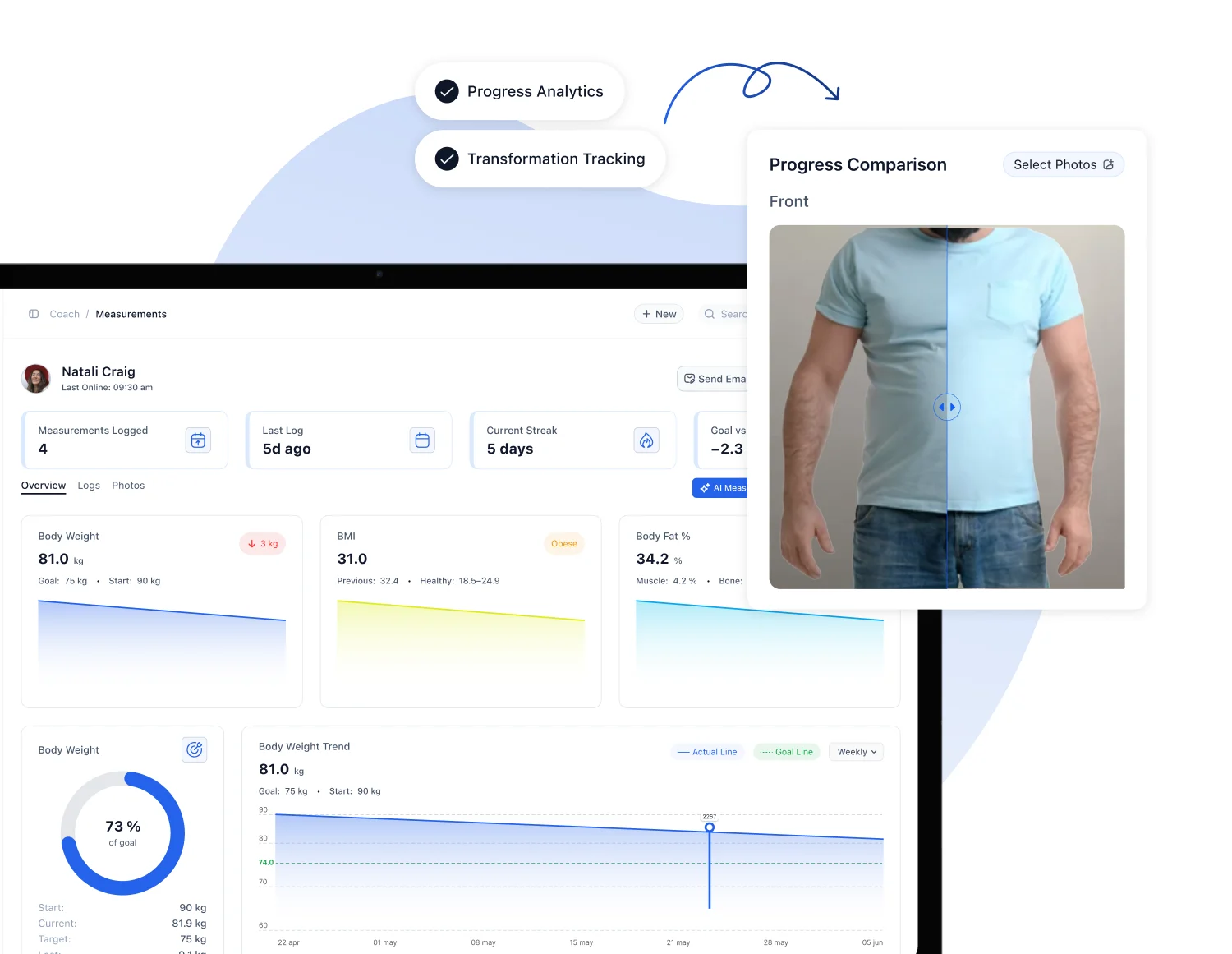
Most coaches should choose an all-in-one, fitness-focused coaching platform that combines bookings, program delivery, client apps, and payments in one dashboard. This cuts admin time, improves client experience, and scales as client count grows. This category includes platforms built for coaches who need integrated bookings, program delivery, client apps, and API/MCP support. Run the trial checklist below before committing.
TL;DR:
- Model costs at current and projected client counts over the next 12 months: per client pricing suits uncertain, small rosters, while flat or tiered fees favor growth.
- Run a pilot for 7–14 days with one or two real clients, testing onboarding, booking, logging, messaging, payments, calendar sync, and export.
- Reject a platform if client data export is incomplete, calendar sync duplicates or drops events, or a test client cannot complete onboarding without help.
- Confirm calendar synchronization works both ways, request a complete sample export, and check plan caps and AI access; MCP requires company, client, and module consent.
Decide Your Business Variables First
Platform fit starts with business shape, not features. Three variables narrow the field before you compare a single tool.
Client volume ceiling determines which pricing shape works. A per-client fee structure stays cost-effective at low volume but becomes expensive as client numbers grow. A flat monthly fee typically costs more at low volume but offers better value as you scale. Industry buyer guides recommend modeling cost of ownership at more than one client count, because the cheapest option at 10 clients may be the expensive one at 50.
Revenue mix shapes platform architecture. A coach running pure one-to-one sessions needs deep program customization and messaging. A coach running group programs or cohort-based courses needs enrollment management, group messaging, and scheduling that handles many clients on one calendar slot. A studio mixing memberships, one-to-one add-ons, and group classes needs all three working together, which usually rules out single-purpose scheduling tools.
Delivery model separates program-first platforms (built around training plans, check-ins, and async coaching) from live-first platforms (built around video sessions and real-time bookings). Buying a live-first tool for a program-first business means bolting on a separate app for plan delivery, and vice versa.
Work through this before touching a demo:
- Count your current active clients and estimate your 12-month target count.
- Break that target into delivery types: one-to-one sessions, group programs, memberships, or online PT.
- Identify which type generates the majority of revenue today and which you expect to grow fastest.
- Flag any platform category that doesn’t support your dominant delivery type as a red flag, regardless of price.
A coach who skips this step ends up comparing a live-video platform against a program-delivery platform as if they solved the same problem. They don’t, and the comparison wastes time that a clear business-variable exercise avoids entirely.
Core Features That Actually Matter for Coaches
Feature lists on vendor pages run long. Most of what’s on them doesn’t change outcomes for a working coach. These six categories do.
- Delivery depth: a program or activity builder with sequencing, automated pathways, and scheduled check-ins, not just a static PDF uploader.
- Scheduling and calendar: booking pages that handle group classes, small-group sessions, and one-to-one appointments, plus two-way sync with Google Calendar and Outlook or Microsoft 365. Test the sync behavior directly during a trial rather than trusting the feature list.
- Payments and billing: native payment processing or a clean integration, subscription support for recurring memberships, and clarity on transaction fees versus flat software cost.
- Client experience: a single-login mobile app covering workout logging, habit tracking, and resource access, since a confusing client app drives drop-off regardless of how strong your programming is.
- Admin automation: contract handling, automated reminders, reporting, and reusable templates that cut the repetitive work coaches do between sessions.
- Data and compliance: straightforward export of client records, and for coaches handling health-related intake data, a clear policy on how that data is stored and who can access it. Buyer guidance from Capterra lists communication tools, document storage, and mobile app presence among the practical checkpoints worth testing before signing.
Pro Tip: Test the calendar sync and the client app on day one of any trial. Both reveal more about day-to-day fit than a sales call ever will.
Delivery depth and client experience carry the most weight for most coaching businesses, because they touch every session you run. Scheduling and payments matter just as much operationally, but they tend to work similarly across serious platforms. Admin automation is where the time savings compound over months, not days, so a short trial won’t show its full value, though you can still check whether templates and reminders exist at all.
A platform that nails delivery and client experience but has a clunky calendar is a different problem than one with a great calendar and a weak program builder. Know which gap you can tolerate before you sign a contract.
How to Evaluate Pricing and Total Cost of Ownership
Coaching software pricing comes in three shapes, and picking the wrong one for your growth plan costs real money within a year.
Per-client pricing charges a fee for each active client on the platform. It’s cheap when you’re small and expensive once you scale past a few dozen clients.
Flat pricing charges one fee regardless of client count, up to a plan’s member cap. It costs more upfront at low volume but flattens your cost curve as you grow.
Tiered pricing sets fixed fees at defined client or coach caps, with a jump to the next tier once you exceed them. This is a middle path: predictable within a tier, with a clear upgrade trigger.
Buyer guides recommend this exact exercise, because pricing that looks competitive at your current size can become the priciest option once you hit your growth target.
| Pricing shape | Cheapest at | Gets expensive at | Best fit |
|---|---|---|---|
| Per-client | Low client count | High client count | Solo coaches starting out |
| Flat fee | High client count, under the cap | Right at the member cap | Coaches scaling toward a plan limit |
| Tiered | Anywhere within a tier | The moment you cross a tier boundary | Teams planning staged growth |
Beyond the base fee, watch for hidden costs: white-label app add-ons, payment processing fees on top of the subscription, charges for additional coach seats, and the time cost of migrating existing client data if you switch platforms later.
As a decision rule: favor flat or tiered pricing once you have a steady client base and a growth target in mind. Favor per-client pricing only if you’re testing a new coaching model with an uncertain client count, since it limits your downside while you validate demand.
Usability and Client-Experience Testing: A Hands-On Trial Checklist
A demo shows you what a platform can do. A trial shows you what it’s actually like to use. Run both sides of the workflow before deciding.
Setup tasks to run first:
- Build one real program, not a placeholder, with at least three sessions or check-ins.
- Enroll one or two test clients, ideally real clients willing to try a new app for a week.
- Configure a booking page covering one group slot and one one-to-one slot.
- Set up a test payment or subscription to see the billing flow end to end.
Client-side steps to test:
- Complete the onboarding flow as a brand-new client would see it.
- Log a workout or habit entry and check how many taps it takes.
- Complete a check-in form and confirm the coach receives it promptly.
- Find a shared resource, like a recipe or a training video, without help.
- Note app load time and whether navigation feels intuitive on a phone.
Coach-side steps to test:
- Build and schedule a multi-week program from scratch.
- Message a client directly inside the platform and confirm notification delivery.
- Export a client’s data and check the file for completeness.
- Sync your calendar and confirm a booked session appears correctly on both ends.
Psychology points to hands-on trials with one or two real clients as the fastest way to surface hidden admin costs and friction that a sales demo won’t reveal.
Score each step pass or fail rather than on a vague impression. A stop decision is warranted when onboarding takes a test client more than a few minutes to complete, when calendar sync shows the wrong time zone or duplicates events, or when exporting data fails or produces an incomplete file. A go decision follows when every core workflow, booking, logging, messaging, and export, works without a workaround.
Integration, Data Portability, and API/MCP Considerations
Integration quality decides whether a platform fits into your existing workflow or forces you to change how you run your business.
- Calendar sync: confirm whether Google Calendar and Outlook or Microsoft 365 sync is two-way or one-way, and whether event details like client name and session type carry over correctly. FITsociety’s calendar integration page is a starting point for checking current sync behavior, but confirm the specifics for your plan before relying on it.
- Full data export: request a sample export covering contacts, purchase history, and program assignments before signing, not after. Data portability is often ignored until a migration becomes urgent, and an incomplete export at that point costs far more time than checking it upfront.
- API and MCP access: a public API and Model Context Protocol (MCP) support let connected tools and AI agents interact with coaching data under defined permissions. FITsociety’s developer documentation describes modules for client data, calendars, and finance exposed through its API and MCP registry for these integrations.
- Consent model: client-level AI access typically requires explicit opt-in at multiple levels. FITsociety’s client AI access documentation describes a consent flow where a company must enable the MCP integration feature, connect the specific client, and get explicit module-level consent before any client-bound AI access is granted.
MCP access requires layered consent, not a single toggle: FITsociety’s own documentation specifies company-level feature enablement, a client-company connection, and explicit per-module approval as separate steps. That layered structure matters if you’re evaluating AI-connected workflows for client data, since it limits what any single integration can access without your approval at each step.
Before buying, ask the vendor’s support team for API documentation and a live export demo. A vendor that can produce both quickly signals a mature integration layer. One that can’t, or that hedges on providing a sample export, is a migration risk waiting to surface later.
Scalability, Team Features, and White-Label Considerations
A platform that works for one coach doesn’t automatically work for a team. Test for this explicitly if you plan to grow beyond solo practice.
- Roles and permissions: during a trial, create an admin account, a manager account, and a coach account, then confirm each sees only what it should. A platform without granular roles forces every team member into full admin access, which gets messy fast.
- White-label branding: a branded mobile app replaces the platform’s own branding with yours, typically as a paid add-on. It’s worth the cost once your business depends on client-facing brand consistency, less so if you’re still validating your coaching model.
- Plan caps: every tiered platform sets a member cap and a coach-seat cap per plan. Know your plan’s limits and the upgrade path before you hit them mid-season with active clients depending on the platform.
- Solo versus team tools: a solo-focused tool optimizes for one person managing everything. A team-grade platform adds role separation, shared client visibility, and centralized billing across coaches. Moving from the first to the second mid-growth usually means a data migration, so plan the switch before you’re forced into it.
FITsociety’s plan structure illustrates how these caps scale: the Coach plan covers up to 100 members and 2 coaches, the Team plan covers up to 600 members and 10 coaches with roles, permissions, and AI for members, and the Club plan removes the member and coach caps entirely and includes a white-label app. A white-label app is available as an add-on on the Coach and Team plans. Confirm current caps and add-on pricing on FITsociety’s pricing page before committing, since plan details are updated over time.
How to Treat AI and Automation When Choosing a Platform
AI features show up on nearly every coaching platform’s marketing page now. Separate what works today from what’s still a roadmap promise.
Immediate productivity AI includes drafting training plans, generating form templates, and summarizing check-in responses, tasks that save real time when the output needs only light editing. Roadmap promises, like fully autonomous client coaching or predictive adherence scoring, are harder to verify and shouldn’t factor into today’s decision.
During a trial, generate a sample AI output, a draft training plan or a form, and check two things: is it accurate for a real client scenario, and can you edit it quickly without starting over. Buyer guidance on evaluating coaching AI recommends asking whether AI drafts are editable and whether AI features are included in your plan or gated behind a higher tier before you commit.
Pro Tip: Ask the vendor directly which plan tier includes AI features before you trial a plan that lacks them, since testing a capability you can’t actually use at your price point wastes trial time.
Price AI access against the time it actually saves, not against how advanced it sounds in a demo. If a gated AI feature would meaningfully cut your weekly admin load, factor its plan tier cost into your pricing model from the earlier section. If it’s a nice-to-have you’d rarely use, treat AI readiness as a tiebreaker between two platforms that are otherwise equal, not as a deciding factor now.
A Compact Weighted Decision Checklist You Can Use Now
Turn everything above into a single scoring exercise. Score each criterion 0 to 5 based on your trial experience, multiply by its weight, and total the result.
- Delivery depth and program builder, weight 3
- Client app experience and logging ease, weight 3
- Scheduling and calendar sync accuracy, weight 2
- Payment and subscription handling, weight 2
- Admin automation (reminders, templates, reporting), weight 2
- Data export completeness, weight 2
- Calendar and third-party integrations, weight 2
- Pricing shape fit for your growth plan, weight 2
- Team roles and permissions (if applicable), weight 1
- AI feature usefulness and plan access, weight 1
- Platform responsiveness and uptime during trial, weight 1
| Score range | What it means |
|---|---|
| — | Strong fit, proceed to a pilot with real clients |
| — | Workable, but flag weak categories before committing |
| Below 30 | Reconsider, the platform likely doesn’t match your business shape |
Red-flag triggers that should override a high total score: a failed or incomplete data export, calendar sync that drops or duplicates events, or a client onboarding flow that confuses a real test client. Any one of these points to a problem that a strong score elsewhere won’t offset once you’re managing paying clients on the platform.
Run a 7 to 14 Day Evaluation With Clients
A pilot with real clients tells you more in two weeks than any amount of solo testing.
- Day 1 to 2: set up your account, build one real program, and configure your booking calendar with at least one group and one one-to-one slot.
- Day 3 to 4: onboard one or two real clients through the actual client-facing flow, not a staff account.
- Day 5 to 7: run one scheduled session through the platform, whether a booked call or an in-person session logged through the app.
- Day 7 to 10: collect at least one habit check-in and one progress update from each test client.
- Day 10 to 12: process a real or test payment to confirm billing and subscription handling work as expected.
- Day 12 to 14: review the full cycle with your test clients and ask directly what felt confusing or slow.
Track three metrics across the pilot: how many onboarding steps your test clients actually completed without help, how much less time you spent on admin tasks compared to your current process, and any specific moments where a client got stuck or frustrated.
At the end of the pilot, answer three questions: did the platform handle your real booking and delivery workflow without a workaround, did your test clients complete onboarding and logging without friction, and does the pricing shape still fit once you model your 12-month client target. A yes on all three supports migrating fully. A no on any one means either a different plan tier or a different platform deserves a second look before you commit further.

Why FITsociety Maps to the Checklist
Community-driven fitness software is built, with ongoing development shaped by feedback from fitness professionals using it day to day. That doesn’t mean every feature request gets built, but practical workflows tend to inform what gets prioritized.
Against the checklist above, FITsociety covers the core categories directly: client onboarding through intake forms, training and nutrition plan delivery, progress tracking, a booking calendar covering group classes, small-group sessions, one-to-one appointments, and online PT, plus membership and payment handling in one dashboard. Coaches work from a dashboard while clients use a portal and mobile app. Google Calendar and Microsoft Outlook or Microsoft 365 integrations are available for calendar sync, and a public API with MCP support exists for connected workflows and AI-agent integrations, as described in FITsociety’s developer documentation.
This fits coaches and teams running group bookings alongside one-to-one coaching, online PT businesses needing integrated scheduling and payments, and teams planning to use API or MCP access for automation as they grow. CoachAI supports drafting tasks like training plans, forms, and recipes within this same environment.
Plan limits and add-ons scale with business size, from the Coach plan up through Team and Club. Confirm exact sync behavior, current plan caps, and pricing directly on FITsociety’s official pages before committing, since these details are updated over time.
How to Try FITsociety
Everything in the checklist above, calendar sync, booking for groups and one-to-one sessions, a client-facing app, payments, and API or MCP access for connected workflows, is available to test directly inside FITsociety.
A short pilot is the fastest way to confirm fit for your own business:
- Create an account and build one real program inside the dashboard.
- Connect your Google Calendar or Outlook or Microsoft 365 account and confirm sync behavior with a test booking.
- Invite one or two test clients to experience onboarding, logging, and check-ins through the client app.
Running these three steps against the trial checklist from earlier gives you a direct read on fit before any commitment. Start a trial and check current plans and pricing on the FITsociety website.
FAQ
What is the best online coaching software?
There’s no single best platform for every coach, since fit depends on your client volume, revenue mix, and delivery model. All-in-one, fitness-focused platforms that combine bookings, program delivery, and client apps, such as FITsociety, tend to fit coaches who need integrated workflows rather than separate tools stitched together.
What is the 70/30 rule in coaching?
This question refers to a coaching principle outside the scope of software selection, and definitions of it vary depending on the coaching discipline. We can’t confirm a single canonical version of this rule, so check the specific context it’s being applied in before relying on a definition.
What is the best platform for online coaching?
The strongest fit for online coaching combines program delivery, booking for one-to-one and group sessions, a client-facing app, and payment handling in one system rather than requiring multiple disconnected tools. Buyer guidance recommends matching platform architecture to your client volume and revenue mix before comparing specific vendors.
Can ChatGPT be my life coach?
General-purpose AI tools like ChatGPT can help draft content or answer questions, but they aren’t built as coaching management platforms and don’t handle client scheduling, payments, progress tracking, or program delivery. Purpose-built coaching software exists specifically to manage those business operations, with AI features like CoachAI in FITsociety layered into that same workflow rather than replacing it.
How long should I trial coaching software before switching?
A 7 to 14 day pilot with one or two real clients is typically enough to surface onboarding friction, calendar sync issues, and admin time savings. Buyer guidance from Psychology.com points to hands-on trials with real clients as the fastest way to uncover hidden costs and usability problems that a demo won’t reveal.