A client handover passes a client from one coach to another without a gap in training, bookings or trust. The handoff process has six parts: scope and timing, consent, a written handover record, a client introduction, a transfer of bookings and payments, and a check after the first session. Done in one system, the coach hands over a live record, not a pile of messages and spreadsheets.
TL;DR
- Define the type first: temporary cover, shift change, or permanent transfer. Each needs a different end point.
- Get the client’s consent before sharing health, progress or personal information.
- Hand over the current plan, goals, preferences, barriers, open actions and the next session, not only the program.
- The outgoing coach introduces the new coach. The client should hear it from the coach they know.
- Confirm access, bookings and billing, then review after the first covered session.
When a handover is needed
Three situations cover most cases.
- Temporary cover. Vacation, illness, a conference. The client returns to the original coach.
- Role or schedule change. A coach moves shifts, locations or from in-person to online. The client stays with the business.
- Permanent transfer. A coach leaves, retires, closes a book of business, or the client needs a different specialty.
A practical handover guide describes the handover as passing the receiving trainer the current plan, relevant preferences, open decisions and next steps, and notes it suits holiday cover, shift changes and a lasting change of trainer (Workoutswizard). Professional bodies treat it the same way. The British Columbia Association of Kinesiologists names client handover reports as useful when moving between practitioners, including when a practitioner retires (BCAK charting guide, December 2024).
The type decides the paperwork. Temporary cover needs a hand-back note. A permanent transfer needs a full record, a client introduction and a billing change.
Step 1: Set scope, dates and ownership
Write down four things before anything moves.
- Which clients, one or a whole book.
- Start date and end date, or “permanent”.
- Outgoing coach, incoming coach, and who answers questions during the transition.
- A review point, such as the first session or two weeks in.
Where it goes wrong: no named owner. The client messages the old coach, the old coach is away, nobody replies. Name one contact for the transition period.
Studios and gyms: settle ownership in writing before a coach ever leaves. IDEA Health & Fitness Association advises that a contract should state whose clients they are, and that managers use language that treats clients as the facility’s (IDEA). Independent coaches who sell or transfer a book of clients should agree terms with the receiving coach in the same way.
Step 2: Get client consent
The client’s information belongs in the handover only with their agreement. Professional codes say this in consistent terms:
- The College of Physiotherapists of Ontario advises explaining why a transfer is happening, what to expect, and getting consent to share relevant health information (CPO guide, effective August 1, 2024).
- AUSactive’s Code of Ethical Conduct requires respect for client privacy and consent before health information is released to third parties when necessary (AUSactive, July 2025).
- Exercise & Sports Science Australia calls for accurate, up-to-date records, secure storage, and disclosure only with client consent, with limited legal and safety exceptions (ESSA code, December 2024).
- Coaching Ireland’s Code of Ethics says records are stored securely and shared only with written client consent or when required by law (Coaching Ireland).
These are Canadian, Australian and Irish documents. The rules that apply to you depend on your country, state and any credential you hold. In the US, check your state requirements and your own client agreement. When the record includes medical details, ask your attorney or your professional body.
A simple consent routine:
- Tell the client who the new coach is and why the change is happening.
- List what will be shared: plan, progress, goals, preferences, relevant health notes.
- Let the client decline any item.
- Record the answer and the date.
If the client declines to share health notes, the new coach starts with a fresh intake for that part. Intake forms and check-ups, which FITsociety supports, make that repeat step short.
Step 3: Build the handover record
A file is useful only if the incoming coach can act on it. The BCAK guide frames handover information as functional and client-centered: abilities, progress, symptoms, barriers, goals, preferences and expectations, not only a training plan (BCAK).
Use this template. Copy it into your own document or intake form.
Handover template
| Field | What to write |
|---|---|
| Client and coaches | Client name, outgoing coach, incoming coach |
| Handover type | Temporary cover, shift change, or permanent |
| Dates | Start, end (or permanent), review date |
| Consent | Date given, items shared, items declined |
| Current goal | Goal, target date, why it matters to the client |
| Current plan | Program phase, week number, nutrition plan, last changes |
| Progress | Key measurements, recent check-in results, personal records |
| Barriers | Injuries, schedule limits, equipment access, adherence issues |
| Preferences | Communication channel, session style, cueing, dislikes |
| Boundaries | What the client has agreed to, what is out of scope |
| Open actions | Action, owner, due date |
| Next session | Date, time, format (in person, group, online PT) |
| Contact during cover | Who answers questions and who decides on plan changes |
The field list follows the structure in the Workoutswizard handover guide: scope and dates, both trainers, review point, goal and plan, recent experience and preferences, boundaries, open actions with owners and due dates, and the next session.
What to leave out
Share what the new coach needs to coach. Skip personal notes unrelated to training, old billing disputes and opinions about the client’s character. Facts and observed patterns go in. Judgments stay out.
Write for a cold reader
The incoming coach may not know the client at all. Replace shorthand (“same as last block”) with the actual numbers. Explain why an exercise was swapped. State what has been tried and failed.
Step 4: Transfer the plan, not just a description of it
The fastest handover is one where the new coach opens the client’s live plan and sees what the client sees. That avoids retyping and the errors retyping brings.
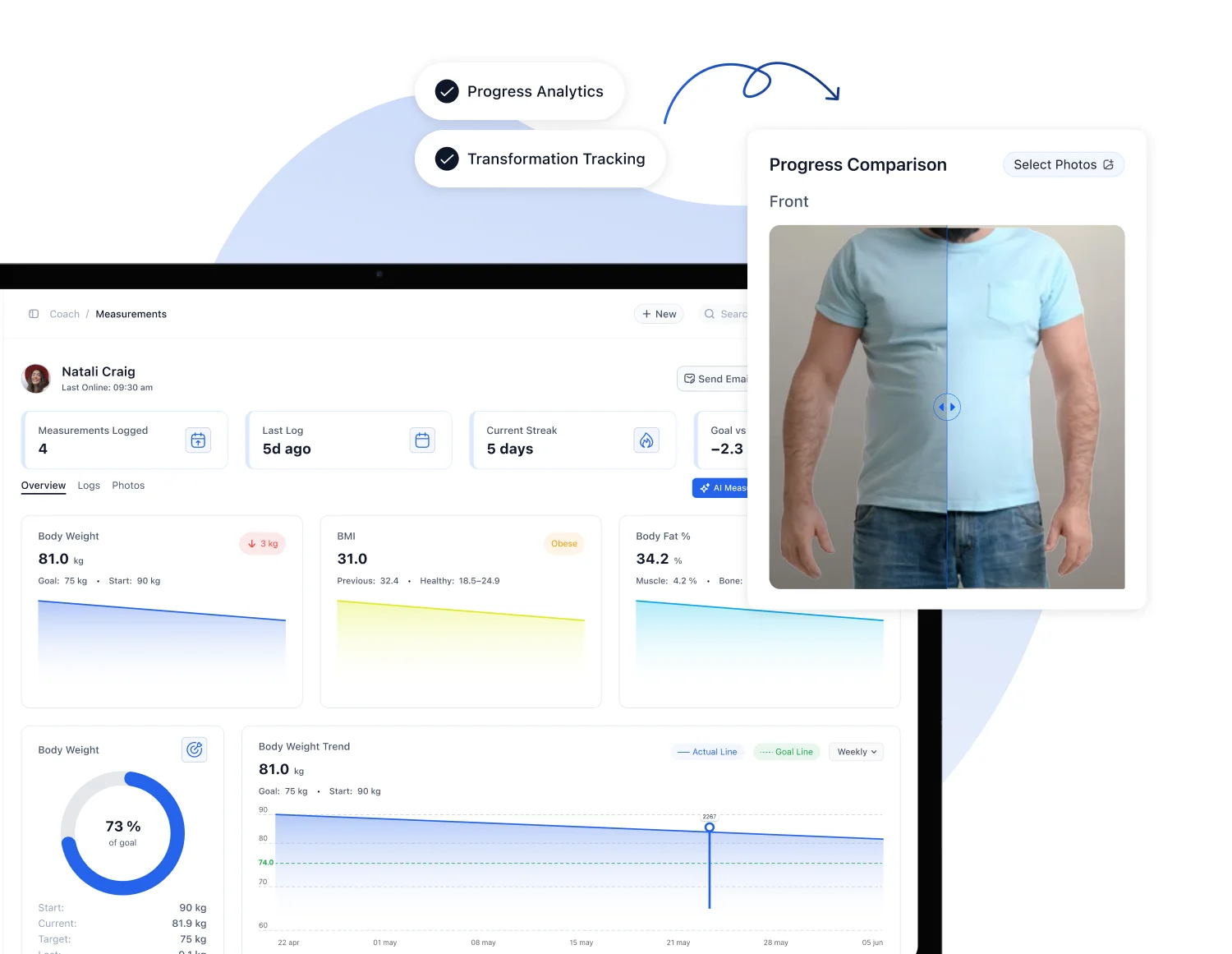
In FITsociety, training plans, nutrition plans, progress tracking, intake forms and check-ups sit in one environment. Coaches work in a dashboard and clients use a portal and mobile apps. That puts the plan, logged workouts and measurements in one place for the incoming coach.
Before the handover call, the incoming coach should be able to answer:
- What is the client doing this week?
- What did they log in the last two weeks?
- What changed in the last check-in?
- What is the next planned progression?
For the logging side, the help article on logging workouts and weights explains how coaches and members record sessions. If the new coach plans to adjust the program, the guide to customizing a training plan covers the options.
Rule for permanent transfers: keep the plan stable for the first one or two sessions. A new coach who rewrites everything on day one makes the change feel like a restart. Change one variable at a time and tell the client why.

Step 5: Introduce the new coach
The client hears the news from the coach they know, before the new coach makes contact. IDEA’s guidance for a trainer departure follows this order: tell the client directly and reassure them they will be well taken care of (IDEA).
The introduction has four parts:
- The reason. Short and honest. No drama, no criticism of the business.
- The new coach. Name, background, and why this coach suits this client’s goal.
- What stays the same. Program, schedule, check-in rhythm, tools.
- What happens next. The date and format of the first session.
Message template
Hi [Name], a quick update. From [date], [New Coach] will take over your coaching because [reason]. [New Coach] has your current plan, your goals and the notes we agreed to share. Your sessions stay on [days/times]. Your next session is [date] with [New Coach]. Reply here with any questions before then. I’ll stay reachable until [date].
Where it works best:
- A short call or video chat for permanent transfers, with the message as written follow-up.
- A three-way message thread or joint session for the first meeting, if the client is nervous.
- A written message alone for temporary cover.
The outgoing coach should not promise anything the new coach has not agreed to, such as pricing, session length or program style.
Step 6: Move bookings and recurring sessions
Plans transfer easily. Calendars are where handovers break. A client shows up for a session booked under a coach who is gone, or a group class loses its instructor with no notice.
Go through each booking type:
- One-to-one appointments. Reassign future sessions to the new coach. Confirm the new coach’s availability first.
- Small-group sessions. Decide whether the group stays together under the new coach, and tell every member.
- Group classes. Assign the instructor, then check room, capacity and waitlist.
- Online PT. Confirm the video link, time zone and the client’s device access.
FITsociety’s booking calendar covers group classes, small-group sessions, one-to-one appointments and online PT, so coaches and teams can coordinate bookings next to client coaching. Google Calendar and Microsoft Outlook/Microsoft 365 integrations are available. Both coaches can see the schedule, and the client gets one booking path. Verify sync behavior and your plan’s access on the FITsociety calendar page before you rely on it for a transfer.
Checklist for the booking move:
- [ ] Future sessions reassigned and confirmed with the new coach
- [ ] Client sees the correct coach and times
- [ ] External calendars (Google or Outlook) show the right entries
- [ ] Group rosters and waitlists updated
- [ ] Cancellation and rescheduling rules explained to the client
Run one test booking first. Look at it on the coach’s calendar and the client’s before moving the full schedule.
Step 7: Move memberships and payments
Money is the second place handovers fail. A client charged by a coach who left, or not charged at all, damages trust quickly.
Settle these items:
- Which membership or package the client holds and how many sessions remain.
- Whether the price, billing date or renewal terms change. If they do, tell the client in writing before the change.
- Who receives revenue for the remaining term, if coaches are paid per client.
- Whether unused sessions carry over.
FITsociety connects memberships and payments with client administration, so the subscription and the coaching record sit together. Studios and gyms with several coaches can keep one membership record while the assigned coach changes.
Step 8: Check the handover worked
The handover is not finished at the introduction. A short verification loop catches problems early.
Before the first session
- The incoming coach confirms they can open the record and deliver the agreed next step.
- Open questions go to the outgoing coach, who answers within an agreed window.
After the first session
- The incoming coach records what happened and any change needed.
- The client is asked one direct question: is anything unclear or different from what you expected?
At the review point
- Compare progress and adherence against the handover record.
- For temporary cover, hand back new decisions and unfinished actions to the original coach (Workoutswizard).
- For permanent transfers, close the outgoing coach’s access and note the date.
The College of Physiotherapists of Ontario also recommends clarifying next steps and following up as needed after a transition (CPO). Treat the review as a fixed calendar entry, not a good intention.
Handover timeline
A realistic schedule for a planned permanent transfer:
| When | Action | Owner |
|---|---|---|
| 2 to 4 weeks before | Agree scope, dates, contact person | Both coaches or manager |
| 2 weeks before | Client conversation and consent | Outgoing coach |
| 1 week before | Handover record completed, access confirmed | Outgoing coach, then incoming coach |
| 1 week before | Bookings and billing reassigned | Manager or coaches |
| Day of handover | Introduction message or call | Outgoing coach |
| First session | Incoming coach delivers agreed next step | Incoming coach |
| 1 to 2 weeks after | Review, resolve open actions | Incoming coach |
For an unplanned exit, compress the same steps. The record, the consent and the introduction still happen, only faster.
Common failure points
- No consent recorded. The coach shares more than the client agreed to.
- Plan without context. The new coach sees the program but not the injury history or the reason an exercise was removed.
- Silent calendar changes. The client finds out about a new coach when the session notification arrives.
- Two coaches, one client, no owner. Both think the other is handling it.
- Overcorrection. The new coach rewrites the program in week one.
- No follow-up. Nobody checks until the client stops showing up.
How FITsociety supports the handover
FITsociety is community-driven fitness software for personal trainers, online coaches, fitness studios and gyms, developed with feedback from fitness professionals. It brings client administration, intake forms and check-ups, training and nutrition plans, progress tracking, bookings, communication, memberships and payments into one environment. The incoming coach works from the client’s existing record, and the client keeps using the same portal and mobile apps.
The plans, as published on the FITsociety site:
| Plan | Price |
|---|---|
| Coach | €179 per month |
| Team | €289 per month |
| Club | €489 per month |
FITsociety provides the software. Coaches and teams deliver the coaching and remain responsible for their decisions, including what information to share and with whom. A public API and MCP support are also available for connected coaching workflows. Confirm details and plan access on the official site.
FAQ
Do I need client consent to hand over their information?
Professional codes in several countries say yes: share health and personal information with a new provider only with the client’s consent, with narrow legal and safety exceptions. Record what the client agreed to share and when. Check the rules where you and your client are based.
How much notice should a client get?
Give as much as the situation allows. For a planned permanent transfer, two to four weeks lets the client ask questions and meet the new coach before the old one leaves. For short cover, a message a few days ahead with the cover dates and contact is enough.
What is the minimum I should hand over?
The current goal, the current plan and phase, recent progress, barriers or limits, client preferences, open actions with owners and due dates, and the next session. Leave out anything the client did not agree to share.
Who should tell the client about the new coach?
The outgoing coach, ideally in person or by call, followed by a written message. The new coach then makes contact with a specific next step, such as the date of the first session.
How do I know the handover worked?
The incoming coach can open the record and deliver the agreed next step, the client attends the first session, and the review shows no loss in adherence or progress. If any of these fails, fix the cause before the next session.
Sources
- When Personal Trainers Leave, IDEA Health & Fitness Association
- Clinical Record Keeping and Charting, British Columbia Association of Kinesiologists (December 2024)
- Assessment, Diagnosis, Treatment Standard guide, College of Physiotherapists of Ontario (effective August 1, 2024)
- Code of Ethical Conduct, AUSactive (July 2025)
- Code of Professional Conduct and Ethical Practice, Exercise & Sports Science Australia (December 2024)
- Code of Ethics, Coaching Ireland
- Trainer client handover: fields and completed example, Workoutswizard
- FITsociety booking calendar