The best habit tracking ideas for coaching are few, specific and tied to a client’s goal. Track one or two daily behaviors, such as a protein serving at breakfast, a step target or a bedtime window. Record them in one place the client already opens, and review them weekly. Long lists of 45 or 100 habits make good printables. They make poor coaching plans.
This guide is for personal trainers, online coaches, studio owners and gym teams. It covers how to choose habits, 40+ habit ideas by category, a daily checklist template, how to handle missed days, and how to run the review.
TL;DR
- Start with one or two habits per client. Specify what, when and how often.
- Track leading indicators (behaviors) next to lagging ones (weight, strength, body composition).
- Keep nutrition tracking light: a few yes/no actions beat full food logs for most clients.
- Treat a missed day as data. Define a “minimal viable” version of each habit for bad days.
- Review weekly: acknowledge wins, clarify obstacles, adjust, set one or two next steps.
What makes a habit worth tracking
A habit belongs in a tracker when it passes four checks.
- It connects to the client’s goal. Walking after meals supports a fat-loss goal. A hydration habit does little for a client whose real obstacle is sleep.
- It is specific. The Aspetar Sports Medicine Journal advises that behaviors be specified in as much detail as possible: who, what, where, when, how often and in what context. Precisely specified behaviors are easier to target and measure. “Eat better” cannot be checked off. “One palm of protein at breakfast” can.
- It is small enough to start. The same source recommends starting with one or two key behaviors. A slow, graded approach builds self-efficacy, the client’s belief that they can do it.
- The client chose it. IDEA’s Derrick Price describes a six-step habit process: set goals and milestones, offer two or three goal-oriented options, let the client pick one, add a cue and a reward, remove disruptors, and follow up with check-ins. In his view, clients must select the habit themselves for it to hold. The coach supplies options and the rationale. The client makes the choice.
Leading and lagging indicators
Body weight, strength numbers and body composition are lagging indicators. They move slowly and sometimes in the wrong direction for reasons unrelated to effort. IDEA advises coaches to track leading indicators: attending scheduled workouts, completing strength sessions, preparing meals at home, hitting step goals, drinking enough water, keeping regular sleep and practicing stress management. It adds that a brief weekly checklist or habit tracker is more sustainable than detailed daily records.
That also gives the coach something to praise in weeks when the scale does not move. IDEA notes that reinforcing leading indicators helps clients stay engaged while visible progress is slow.
Why one habit at a time
Price cites research that habit formation can take up to 66 days and that focusing on one simple habit at a time leads to greater behavior change. Precision Nutrition’s John Berardi quotes Leo Babauta, who reported failure with multiple habits at once and 50 to 80 percent success with one. That is one person’s experience, not a trial. It matches the graded-approach guidance above.
Habit tracking ideas by category
Use these as a menu. Offer a client two or three that fit their goal. Do not hand over the whole list.
Training habits
- Attend every scheduled session or class
- Complete the planned strength workouts for the week
- Hit a daily step target
- Do one mobility exercise every day
- Take a 3-minute movement break every hour at a desk
- Complete a planned workout or a purposeful walk on rest days
- Log each workout, with weights, in the same place as the plan
The step and session targets work well because they are binary. The client either did it or did not. A coach can also use a different unit for each client: sessions per week for a beginner, steps for a desk worker, a mobility minute for someone who is sore.
Nutrition habits
Precision Nutrition’s Level 1 daily actions cheat sheet lists concrete examples. These can be tracked as one-tap items:
- Add one palm of protein at breakfast
- Eat a set number of fists of vegetables each day
- Check urine color as a hydration cue
- Spend five minutes on Sunday night naming the week’s obstacles and a plan for each
More ideas from the same family of hand-based portion habits:
- Add one nutrient-dense ingredient to a meal the client already eats
- Drink a glass of water at a fixed time
- Make water the default drink at meals
- Prepare lunch at home on workdays
- Eat slowly at one meal per day
Hydration shows how to scale a habit. NASM’s positive habits guide notes that if the goal is to drink half of body weight in ounces, starting with one 8 oz glass can be enough. It also notes the reward can be as simple as checking the day off on a calendar or a nutrition tracker.
Sleep, recovery and stress habits
- Put screens away 30 minutes before bed
- Keep a consistent bedtime or wake window
- Do a two-minute stretch or breathing routine before bed
- Take a one-minute reset during a busy moment
- Get outside for light and a short walk in the morning
NASM’s habit stacking guidance uses small anchors of this kind: a five-minute walk after a meal, water at a set time, a short pre-bed routine. Attaching a new habit to an existing one gives the client a cue they already have.
Business habits for coaches
Coaches can track their own routines the same way:
- Send each client a weekly check-in prompt
- Review every client’s logged habits before the weekly check-in
- Answer client messages within a set window
- Review upcoming bookings and open class spots at the start of the week
How to track eating habits without a burden
Full food logging asks for a lot: weighing, searching, entering, every meal. Some clients do it well. Many quit within weeks. A habit-based approach changes the unit of tracking from food to behavior.
Three formats keep it light:
| Format | Example | Client effort |
|---|---|---|
| Yes/no action | Protein at breakfast: done or not | Seconds per day |
| Count | Servings of vegetables: 0 to 5 | Seconds per meal |
| Weekly rating | “How well did meals match the plan?” 1 to 5 | One minute per week |
Pick one format per habit. Add a short note field for context, such as “travel week” or “late shift”.
Why some clients avoid tracking
Researchers Webb, Chang and Benn describe the “ostrich problem”: people often avoid information that would help them monitor progress, such as checking what they are eating, because the wish to assess progress accurately conflicts with the wish to protect self-image.
For a coach, this means a skipped log entry often signals discomfort, not laziness. Practical responses:
- Ask about the barrier in the next check-in with a systems question (“What got in the way on Tuesday?”) instead of an outcome question (“Why did you miss?”).
- Reduce the entry to the smallest version that still counts.
- Praise the logging itself, separately from what was logged.
IDEA recommends exactly this shift from outcome-focused to systems-based questions that encourage reflection rather than judgment.
Individualizing nutrition habits
Habit-based nutrition coaching works from the client’s current day. Start from what the client already eats, pick the one change with the most leverage, and write it as a specific action. A client who skips breakfast gets a protein-at-first-meal habit. A client who eats late gets a prep habit. Medical conditions, eating disorder history and medication-related diet questions belong with the client’s physician or a registered dietitian, and coaches should refer those clients rather than set habits for them.

Daily habit checklist template
Copy this into a plan or intake form. The coach and client pick two or three rows, fill the target column together and delete the rest.
| Habit | Specific target | Minimal version for a bad day | Check |
|---|---|---|---|
| Protein at breakfast | One palm of protein | Any protein source | Yes/No |
| Water | 8 oz glass at 10 a.m. and with lunch | One glass | Yes/No |
| Vegetables | Fists per day, set by coach | One serving at dinner | Count |
| Steps | Daily target set from the client’s baseline | 10-minute walk | Yes/No |
| Strength session | Planned sessions this week | One short session of main lifts | Yes/No |
| Mobility | One exercise | Two minutes | Yes/No |
| Screens off | 30 minutes before bed | 10 minutes before bed | Yes/No |
| Sunday reset | Five minutes: obstacles and plan | Name one obstacle | Yes/No |
How to use it:
- Fill the target column in the first session, using the client’s real baseline.
- Cap active rows at three.
- Add a new row only after the client has hit the current ones for several weeks. Price’s source suggests formation can take up to 66 days, so “several weeks” is a floor, not a promise.
- Remove a row when it becomes automatic or irrelevant.
Streaks, missed days and consistency
Streaks motivate some clients and punish others. A broken streak after 20 days can feel like starting over. Build the rule into the plan instead.
Define a minimal version. ACE advises coaches to help clients identify the “minimal viable output”: the least action that keeps the plan on track even on a bad day. ACE’s Chris Gagliardi explains that it keeps behavior change going and breaks the cycle of waiting for perfection. A two-minute walk counts. The table above has a column for it.
Count the day, not the perfection. A day with the minimal version is a completed day.
Use progress monitoring itself. A meta-analysis of 138 studies (N = 19,951) in Psychological Bulletin found that monitoring goal progress promoted goal attainment (d+ = 0.40). Effects were larger when the information was physically recorded and when outcomes were reported or made public. That supports a written record and a regular report to the coach.
Use accountability. Berardi’s summary of Babauta’s advice includes reporting progress daily to a group or another person. In a coaching business, the coach is that person, and a studio can add a class group.
Pair digital tools with the right technique. A review of 62 randomized trials in adults with overweight or obesity found that in digital interventions, goal setting, graded tasks, social incentive and self-monitoring were significant moderators of physical activity. Habit tracking inside a client app covers several of these at once: a goal, a small task, a self-recorded entry and a coach who sees it.

Reviewing habits: the weekly routine
Daily tracking is for the client. Reviewing is for the coach and client together. NASM’s weekly check-in script has four moves:
- Acknowledge wins
- Clarify challenges
- Explore adjustments
- Set one or two small, realistic steps for the coming week
A 10-minute version:
- Minute 1 to 2: Read the week’s entries before the call or message.
- Minute 3 to 5: Name what went well, with the specific habit.
- Minute 6 to 8: Ask one systems question about the weakest habit.
- Minute 9 to 10: Agree on next week’s one or two steps and update the target.
For monthly reviews, check whether the habit still fits the goal, whether to retire it, and whether to add the next one. For online coaches, the same format works as a written reply or a short voice note.
Running habit tracking in FITsociety
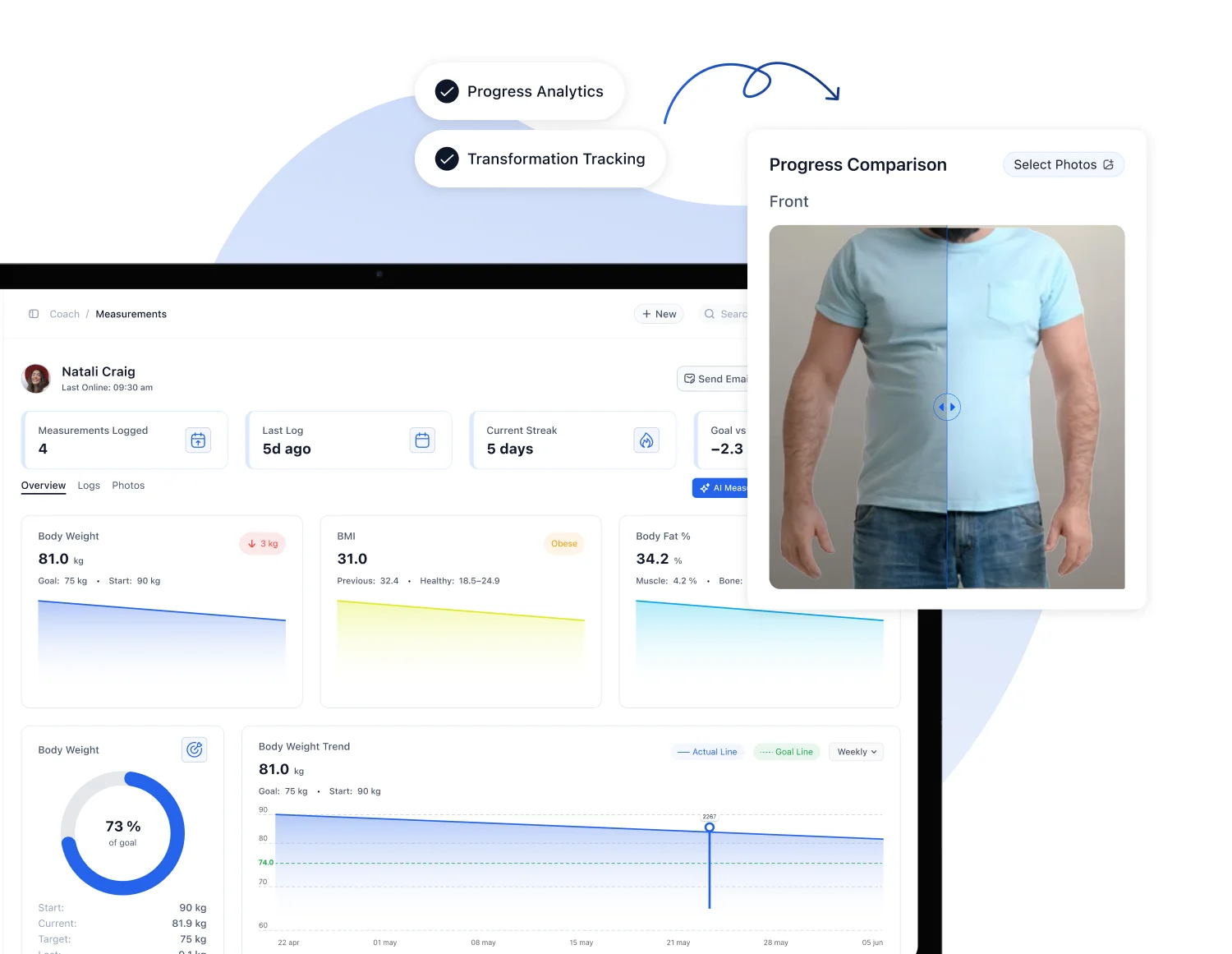
FITsociety is community-driven fitness software for personal trainers, online coaches, studios and gyms, and it is developed with feedback from fitness professionals. It covers the parts of this routine in one environment: intake forms, training and nutrition plans, daily habit logging, progress and measurement tracking, automated check-ins and reminders, and chat. Coaches work in a dashboard. Clients use a portal and mobile apps.
How the checklist above maps to it:
- Intake: use forms to capture the client’s baseline before choosing targets. CoachAI can draft forms, training plans and recipes for the coach to edit.
- Daily: clients log habits. Reminders prompt them.
- Training: workouts and weights are logged in the same place as the plan. The help article on logging workouts and weights explains the flow for coaches and members.
- Weekly: review habit entries and progress data, then message the client in chat.
FITsociety publishes three plans: Coach at €179 per month, Team at €289 per month and Club at €489 per month. Details are on fitsociety.io. Coaches remain responsible for the habits they assign and the advice they give.
For studios and teams
Studios and gyms add a coordination layer. Several coaches may see the same client, and bookings, memberships and habits sit side by side. Useful team rules:
- One owner per client for habit targets, so the client gets one message.
- A shared habit vocabulary: the same names and units across coaches.
- A weekly look at attendance and booking patterns next to habit data. A client who stops booking sessions often stops logging first.
- Group habits for classes or challenges, such as attendance or steps, with the same minimal-version rule.
FITsociety’s booking calendar handles group classes, small-group sessions, one-to-one appointments and online PT. Google Calendar and Outlook/Microsoft 365 integrations are available. Coaches and teams can then see sessions and client coaching in one view.
Common mistakes
- Too many habits. Five rows on day one means five misses by day four.
- Vague wording. “Eat clean” cannot be checked.
- Coach-picked habits only. Without client choice, ownership is low.
- Tracking without review. Entries nobody reads teach the client that tracking does not matter.
- Only outcome questions. “Did you lose weight?” ends reflection. “What made Thursday easy?” starts it.
- No exit. A habit that has become automatic should be retired so the tracker stays short.
FAQ
How many habits should a client track at once?
One or two to start, three at most. The Aspetar guidance recommends starting with one or two key or bundled behaviors, and IDEA’s process centers on one chosen habit. Add the next only after the first holds.
What is a good daily habit checklist for fitness clients?
A short one: a protein portion at breakfast, water at a set time, a daily step target, a strength session on planned days and screens off before bed. Write each with a specific target and a minimal version for bad days. The template above covers this.
How long does it take to build a habit?
It varies. IDEA’s habit article cites research that formation can take up to 66 days. Plan for weeks to months, and keep reviewing weekly instead of waiting for a fixed date.
Should clients log everything they eat?
Not by default. Habit-based nutrition coaching tracks actions such as protein at breakfast or vegetables at dinner, which take seconds. Detailed logs fit clients who want them and handle them well. Clients with a history of disordered eating should work with their physician or a registered dietitian.
How should a coach handle a missed day?
Count the minimal version as done, ask a systems question about what got in the way, and resume the next day. A missed day is information for the next adjustment, not a reset.
Sources
- Effective behavior change techniques to promote physical activity (Obesity Reviews, 2021)
- Behaviour change science and mobile technology in sports nutrition (Aspetar Sports Medicine Journal, 2021)
- Building Systems That Create Lasting Change (IDEA Health & Fitness Association)
- 6 Steps to New Habits (IDEA Health & Fitness Association, 2017)
- Fitness success secrets: On practicing one strategic habit (Precision Nutrition)
- Level 1 Skills, Practices & Daily Actions Cheat Sheet (Precision Nutrition, 2020)
- Nutrition and Behavior Change: The Power of Positive Habits (NASM)
- Building Client Habits That Outlast Training Programs (NASM, 2025)
- The Ostrich Problem: motivated avoidance or rejection of information about goals (Webb, Chang and Benn, 2013)
- Does Monitoring Goal Progress Promote Goal Attainment? (Psychological Bulletin, 2016)
- Simplifying Healthy Habits for Lasting Behavior Change (ACE, 2026)