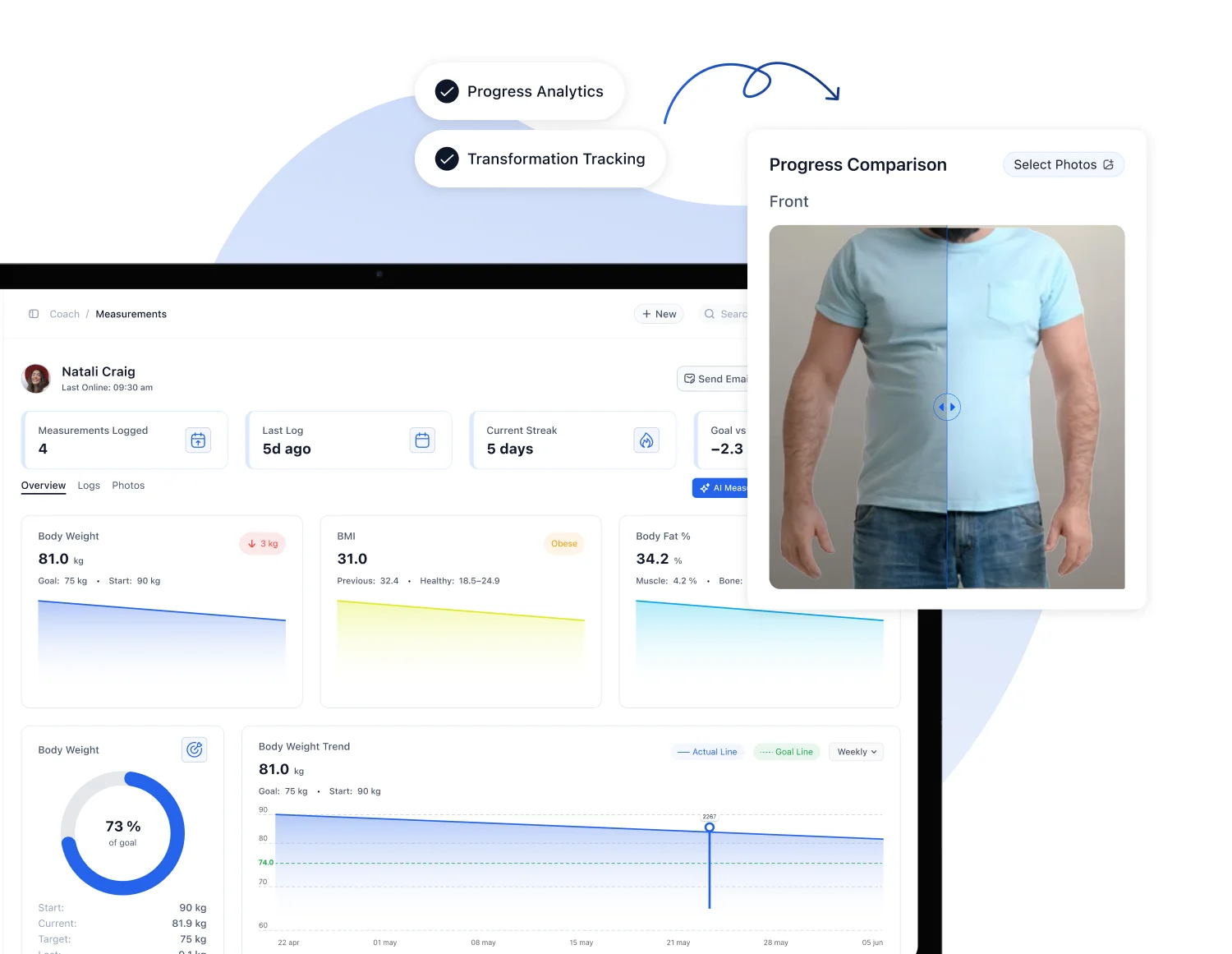
A fitness webshop lets a coach sell memberships, session packs and coaching programs online, with payment and booking connected to client records. The shop works best when it is tied to the same system that holds intake forms, plans, calendars and recurring billing. This guide covers what to sell, how to structure offers, how bookings fit in, and how FITsociety handles the webshop side.
TL;DR
- A coaching webshop sells a small set of clear offers: recurring memberships, session packs, group class access and online coaching programs.
- The shop is only useful when purchases flow into client administration, bookings and payments without manual copying.
- Each offer states who it serves, what support is included, how sessions are booked and how renewal works.
- FITsociety includes webshop tools for memberships and sessions, a booking calendar, subscription management and payment processing. Plans: Coach $179? No: Coach 179 EUR, Team 289 EUR, Club 489 EUR per month.
- Coaches stay responsible for programming and client decisions. Software handles administration.
What a fitness webshop is for a coach
A product store for supplements or apparel is a different thing. A coaching webshop sells access to a service:
- Time: one-to-one sessions, small-group sessions, group classes
- Access: memberships, class passes, an app and portal
- Programs: training plans, nutrition plans, progress reviews
- Recurring coaching: monthly online coaching with check-ins and chat
The buyer pays, then expects something to happen: a confirmation, a way to book, an intake form, a first plan. The webshop is the start of onboarding, not just a checkout page.
What to sell: five offer types
| Offer | Best for | What the buyer gets | Billing |
|---|---|---|---|
| Monthly membership | Studios, gyms, clubs | Ongoing access to classes or facilities | Recurring |
| Online coaching subscription | Online coaches | Plan, check-ins, chat, progress reviews | Recurring |
| Session pack | Independent trainers | A set number of one-to-one or small-group sessions | One-time |
| Class pass | Studios | Entry to group classes | One-time or recurring |
| Single program | Online coaches | A fixed-length training or nutrition plan | One-time |
Start with two or three offers. A long menu slows the buyer and creates more questions for the coach to answer by message.
Define the offer before building the shop
A clear offer answers four questions. Write the answers down before creating any product page.
- Who is it for? Beginners, postpartum clients, runners, older adults, athletes. Narrow is easier to explain.
- What support is included? Programming, nutrition guidance, check-ins, chat access, video review, live sessions.
- How is it delivered? In person, online, or a mix.
- What are the terms? Duration, renewal, cancellation, session expiry.
Offer description template
Copy and fill in for each product:
Offer name:
For: (client type and goal)
Includes: (plan, sessions, check-in frequency, chat access)
Delivery: (in person / online / hybrid)
Booking: (how sessions are scheduled, cancellation window)
Price and billing: (amount, one-time or recurring)
Renewal / expiry: (when it renews, when unused sessions lapse)
First step after purchase: (intake form, welcome message, first booking)
The last line matters most. It decides how the first week feels for the client.
Choose the delivery model the offer supports
Online and in-person coaching suit different clients, and the shop should say which one an offer uses. Research from Rutgers University describes online training as time-saving, typically lower in cost and suited to people who exercise at home. In-person training offers wider equipment access and stronger form assessment.

The American Council on Exercise notes that face-to-face coaching is limited by geography and overhead, while online coaching is a flexible, scalable alternative that fits client schedules.
A 2025 randomized controlled trial in the Journal of Strength & Conditioning Research reported higher adherence (88.2%) and better performance gains with supervised in-person training than with app-guided or self-guided training. App-based approaches still remain a viable option when full supervision is impractical.
Practical reading for a shop:
- Sell supervised sessions where form and assessment matter.
- Sell online coaching where schedule and distance matter.
- Hybrid offers combine a few in-person or live video sessions with app-based programming and check-ins.
Connect the shop to bookings
A purchase that does not connect to a calendar creates admin work. Typical failure points:
- A client buys a 10-session pack, then asks by text which times are open
- A class sells out, but the shop still shows it as available
- A coach on a team is double-booked
- A paused membership still allows class reservations
Booking types to plan for
- One-to-one appointments: the coach sets availability; the client picks a slot.
- Small-group sessions: fixed capacity, a set time, a named coach.
- Group classes: recurring schedule, larger capacity, drop-in or pass-based.
- Online PT: video sessions with the same booking rules as in-person ones.
FITsociety’s booking calendar covers group classes, small-group sessions, one-to-one appointments and online PT in one place. Google Calendar and Microsoft Outlook/Microsoft 365 integrations are available, so coaches can see work bookings next to the rest of the schedule. Exact synchronization behavior and plan availability are listed on the calendar features page.
Coordinating a team
When several coaches share a business, the calendar needs more than availability:
- Each coach has an individual schedule
- The team sees the combined view
- Sessions are tied to the client record, so the coach sees history before the session
- Membership status is visible when a client books
That connection between calendar and coaching record is the main practical difference between a general scheduling tool and coaching software.
Pricing the offers
Pricing depends on market, experience, format and how much support is included. Use the following checks:
- Time cost: count programming, check-in reviews and chat as work, not only live sessions.
- Support level: a plan with weekly check-ins and chat priced the same as a plan delivered once is a mismatch.
- Capacity: small-group and class pricing should reflect fixed capacity.
- Recurring versus one-time: recurring billing suits ongoing coaching and memberships. Packs suit trainers whose clients prefer a fixed commitment.
Published figures on typical online coaching prices vary widely by niche and region. Check local competitors’ public pages and set prices from your own costs and positioning instead of relying on a single average.
Terms to state in the shop
| Term | What to write |
|---|---|
| Session expiry | How long a pack stays valid |
| Cancellation | Notice required and what happens to the session |
| Renewal | Date, amount and how to cancel |
| Pause | Whether memberships can be paused |
| Scope | What coaching includes and excludes |
Clear terms prevent most billing disputes before they start.
What happens after the purchase
A purchase should trigger onboarding. A sequence that works for most coaches:
- Confirmation with the next step
- Intake form: goals, history, schedule, equipment, health questionnaire
- First booking or plan delivery
- Check-in reminder at an agreed interval
- Progress review at a set point, such as monthly
The ESSA Digital Practice Standards advise practitioners to explain the risks and limitations of digital services, work within professional scopes and develop emergency contact procedures. These are Australian professional standards, but the principles apply to any coach delivering online: put scope, consent and an emergency contact step into onboarding, not into fine print.
Rules differ by country. Brazil, for example, has a 2024 resolution from CONFEF requiring online physical activity services to involve a registered professional and follow data protection law. Coaches should check the rules for their own country, state and certification body.
Using AI to draft content
Coaches use AI to draft plans, forms, recipes and news posts. FITsociety’s CoachAI supports these tasks. The American Council on Exercise says AI may help with individualized plans and feedback, but exercise professionals must review generated content for accuracy and scope. Diagnosing conditions or injuries stays outside the scope of exercise professionals.
In practice:
- Treat AI output as a draft
- Review every plan against the client’s intake information
- Refer clients with medical questions to a qualified health professional
Checklist: launching a coaching webshop
- [ ] Two or three offers, each with the template above filled in
- [ ] Clear price, billing period and renewal terms
- [ ] Booking rules matched to each offer (one-to-one, small group, class, online)
- [ ] Calendar connected to Google Calendar or Outlook/Microsoft 365 if used
- [ ] Intake form sent automatically after purchase
- [ ] Payment method and subscription handling tested with a real purchase
- [ ] Cancellation and session expiry policy published
- [ ] Scope and consent wording reviewed against local professional guidance
- [ ] Welcome message written
- [ ] Check-in schedule set
How FITsociety handles the webshop
FITsociety is community-driven fitness software for personal trainers, online coaches, studios and gyms. It is developed with feedback from fitness professionals. Feedback informs ongoing improvements, though not every request is built.
Relevant parts for selling:
- Webshop tools for selling memberships and sessions
- Payment processing and subscription management for recurring memberships
- Booking calendar for group classes, small groups, one-to-one and online PT
- Client intake forms and check-ups
- Training and nutrition plans, progress tracking, daily habits
- Chat and reminders
- Client portal and mobile apps
- Public API and MCP support for connected coaching workflows
- Google Calendar and Outlook/Microsoft 365 integrations
Published plans, per month:
| Plan | Price |
|---|---|
| Coach | 179 EUR |
| Team | 289 EUR |
| Club | 489 EUR |
See FITsociety for current plan contents and a trial. Coaches deliver the coaching and remain responsible for their decisions. FITsociety provides the software.
Which setup fits which business
| Business | Typical shop setup |
|---|---|
| Independent trainer | Session packs, small-group access, a monthly coaching option |
| Online coach | Recurring coaching subscription, single programs |
| Studio | Memberships, class passes, small-group sessions |
| Gym or club | Tiered memberships, multi-coach bookings, multiple locations |
Common mistakes
- Too many products at launch
- No stated expiry on session packs
- Selling a service the calendar cannot deliver
- Manual onboarding after every sale
- Vague scope, which invites out-of-scope questions
- Using AI output without review
FAQ
What can a coach sell in a fitness webshop?
Coaches sell memberships, session packs, class passes, online coaching subscriptions and fixed-length programs. FITsociety includes webshop tools for selling memberships and sessions. Start with two or three offers and add more once the first ones run smoothly.
Does the webshop need to connect to a booking calendar?
Yes, for any offer that includes live sessions or classes. Without a connection, the coach handles availability, capacity and expiry by hand. FITsociety’s calendar covers group classes, small-group sessions, one-to-one appointments and online PT, with Google Calendar and Outlook/Microsoft 365 integrations.
Is online coaching as effective as in-person training?
It depends on the client and goal. A 2025 trial found stronger adherence with supervised in-person training, while app-based training remained a viable alternative when supervision is impractical. Many coaches offer hybrid options.
How much does FITsociety cost?
The published plans are Coach at 179 EUR per month, Team at 289 EUR per month and Club at 489 EUR per month. Check the FITsociety site for current plan contents.
Sources
- Online or In-Person Personal Training? How to Make a Decision (Rutgers University)
- The Benefits of Face-to-Face and Online Health Coaching (ACE)
- Optimizing resistance training outcomes (Journal of Strength & Conditioning Research abstract)
- Digital Practice Standards, Version 1 (ESSA)
- Resolution 542 of 2024 (CONFEF)
- AI in Health & Fitness: How to Leverage New Technology (ACE)